
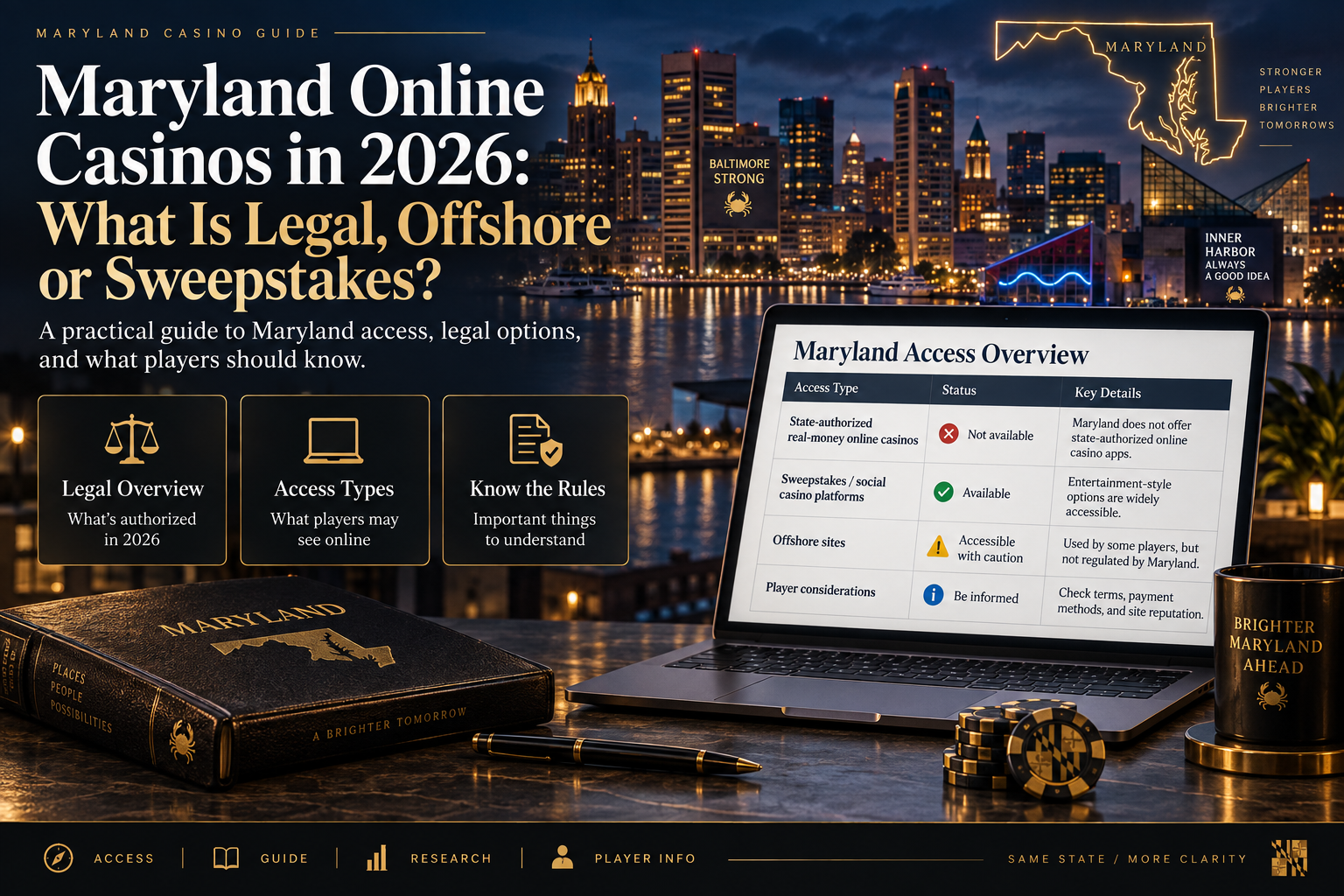

Maryland has legal land-based casinos, mobile sports betting and registered online fantasy competitions, but it does not currently have legal real-money online casino gaming.
Maryland Lottery and Gaming is unusually clear on this point: licensed sports wagering and registered online fantasy competitions are the only legal online gaming options in the state, and it says no other form of real-money online or mobile gaming is operating legally in Maryland.
That distinction matters because searches for “Maryland online casinos” still return offshore casinos, crypto gambling sites, sweepstakes platforms and social casinos. A website being accessible from Maryland does not make it authorized by Maryland.
The regulator's current Legal vs. Illegal Online Gaming guidance is therefore the best starting point before comparing games, bonuses or crypto payment methods.
Maryland Online Gambling Status at a Glance
| Product | Maryland-authorized? | Real-money/prize element | What readers should understand |
| State-regulated online casino | No | N/A | Maryland has not authorized statewide iGaming |
| Offshore online casino | No | Usually real money | Foreign licensing does not create Maryland authorization |
| Prize-based sweepstakes casino | Not an authorized Maryland online casino | Redeemable promotional prizes may be offered | Maryland has sent cease-and-desist letters to many such operators |
| Pure social casino | Different from real-money gaming | Normally non-redeemable entertainment currency | Must be distinguished from prize-redemption models |
| Online sportsbook | Yes, if licensed | Real-money sports wagers | Separate state-regulated market |
| Online fantasy competition | Yes, if registered | Contest prizes | Separate registered category |
| Land-based casino | Yes | Real-money casino gambling | Six casinos operate under state regulation |
Are Real-Money Online Casinos Legal in Maryland?
Not through a state-licensed commercial iGaming market.
Maryland Lottery and Gaming says that sports wagering through licensed operators and online fantasy competitions from registered operators are currently the state's only legal online gaming options. Its guidance expressly says no other forms of real-money online or mobile gaming or wagering are operating legally in Maryland.
That means conventional online casino products such as:
- Real-money internet slots.
- Online blackjack.
- Online roulette.
- Online baccarat.
- Real-money live dealer casino games.
are not part of Maryland's authorized online gaming market.
A foreign operator should therefore not be described as:
“Maryland licensed,” “Maryland regulated,” or “a legal Maryland online casino”
simply because it accepts an address in Baltimore, Bethesda, Annapolis or elsewhere in the state.
Sports Betting Is Legal Online—Casino Gaming Is Not
Maryland's legal mobile sportsbook market often causes confusion because it proves that some online wagering is authorized.
But Maryland regulates products by category.
The state regulator currently identifies licensed online sports wagering operators and registered online fantasy competition operators as the legal online options.
That authorization does not extend automatically to online slots or table games.
A sportsbook being legal in Maryland does not mean:
“Online gambling is generally legal in Maryland.”
The more accurate statement is:
Certain online gambling products are expressly authorized; conventional real-money online casino gaming currently is not.
Maryland Mobile Sports Betting Actually Began in 2022
Some ranking content contains outdated history here.
One page in the supplied reference says Maryland online sports betting did not launch until late 2023. Maryland Lottery and Gaming's own timeline says the first mobile sports wagering operators launched in November 2022, following the 2020 referendum and 2021 enabling legislation.
That difference matters because state pages should use the regulator's timeline rather than recycling another affiliate article's date.
Why Do Search Results Still Show “Best Maryland Online Casinos”?
Because affiliate publishers frequently rank websites according to availability, not Maryland authorization.
An offshore casino may:
- Let Maryland residents create an account.
- Accept Bitcoin or USDT.
- Offer real-money slots.
- Offer poker or live-dealer games.
- Hold a foreign gambling license.
- Process withdrawals to cryptocurrency wallets.
Those characteristics describe a foreign gambling service.
They do not make it a Maryland-regulated online casino.
The lead competitor in the supplied document explicitly says Maryland online casinos are not regulated at state level but then describes offshore operators as filling the gap. Another section concedes that offshore casinos operate outside Maryland's regulated gambling system.
For readers, the clearer wording is:
“offshore casino accessible from Maryland”
rather than:
“Maryland online casino.”
Maryland Is Actively Challenging Unauthorized Online Gaming
This is one of the most important updates missing from generic Maryland casino rankings.
Maryland Lottery and Gaming says it periodically contacts online platforms that appear to be operating illegally in Maryland and asks them either to confirm they are not operating illegally or to cease gaming activity they are not licensed or registered to conduct.
Its current enforcement list includes both conventional offshore gambling businesses and many well-known sweepstakes-style brands. The regulator stresses that its list is not exhaustive and that only the sports wagering and fantasy operators identified as licensed or registered on the page should be considered to be conducting legal online gaming activity.
That substantially changes how a 2026 Maryland casino article should be written.
Sweepstakes Casinos Need Particular Caution in Maryland
Older affiliate content commonly presents sweepstakes casinos as a straightforward legal alternative to online casinos.
That position is difficult to reconcile with Maryland's current regulatory guidance.
Maryland Lottery and Gaming's cease-and-desist list includes operators associated with brands such as:
- High 5 Casino.
- McLuck.
- Real Prize.
- Stake.us.
- Crown Coins Casino.
- Chumba Casino.
- LuckyLand Slots.
- Pulsz.
The inclusion of an operator on the regulator's cease-and-desist list is far stronger evidence about Maryland's position than an affiliate site's statement that the platform “accepts Maryland players.”
This creates a major SERP freshness problem
The supplied reference recommends or discusses several of these sweepstakes brands as Maryland-facing casino options.
It even contains an especially clear internal contradiction: one section labels MegaBonanza as accepting Maryland players, while the terms immediately beneath the offer state that it is not available in Maryland.
That is why a state casino guide should never rely on a static affiliate table when the operator's current terms or regulator's enforcement position says otherwise.
Social Casino and Sweepstakes Casino Are Not the Same Thing
This distinction is useful because not every casino-style game involves real money or redeemable prizes.
Pure social casino
A traditional social casino may let a user play with virtual entertainment credits that:
- Have no cash value.
- Cannot be withdrawn.
- Cannot be redeemed for gift cards or cash equivalents.
That is materially different from real-money gambling.
Sweepstakes-style casino
A sweepstakes platform commonly uses a promotional currency that can potentially be redeemed for prizes after satisfying its rules.
That redemption feature changes the product.
A publisher should therefore determine:
Can the virtual currency or resulting winnings ultimately be redeemed for something of value?
rather than relying on labels such as “social casino,” “sweeps casino” or “free casino.”
“No Purchase Necessary” Does Not Override Maryland's Regulatory Position
A no-purchase method can be important to the legal structure of a promotional sweepstakes.
But it should not be treated as a universal answer to gambling regulation.
Maryland's regulator does not say:
“Any dual-currency casino with a free entry option is legal.”
Instead, it says licensed sports wagering and registered online fantasy competitions are currently the legal online gaming options and has sent cease-and-desist notices to numerous prize-based gaming platforms.
For a Maryland-specific article, current state enforcement should take precedence over generic nationwide descriptions of sweepstakes law.
Maryland Has Six State-Regulated Land-Based Casinos
Maryland's legal casino industry exists—but it is currently land based.
Maryland Lottery and Gaming identifies six casinos operating within the state's regulated gaming program. The regulator also oversees sports wagering and requires those operators to comply with state gaming and responsible-gambling requirements.
That creates a useful comparison.
A Maryland-regulated casino participates in:
- State licensing.
- Compliance monitoring.
- Financial auditing.
- Security requirements.
- Responsible-gambling requirements.
- Regulatory complaint procedures.
An offshore casino does not become part of that framework because its website can be opened from Maryland.
What Happened to Maryland Online Casino Legalization in 2026?
Maryland lawmakers again considered iGaming legislation in 2026.
House Bill 1343, titled Internet Gaming – Authorization and Implementation, would authorize the State Lottery and Gaming Control Commission to license and regulate internet gaming if the required conditions were satisfied.
As of the latest official record, HB 1343 remains listed as “In the House – Hearing 3/05 at 1:00 p.m.” The bill did not become an enacted Maryland online-casino law. Its official page also states that the measure is contingent on a referendum.
The current proposal can be followed through the Maryland General Assembly HB 1343 record.
Why a Statewide Vote Matters
Maryland cannot simply launch commercial internet casino gaming through regulator action alone.
Maryland Lottery and Gaming explains that Article XIX of the Maryland Constitution requires any expansion of commercial gambling to receive approval from a majority of voters in a statewide referendum. The General Assembly must first approve placing the expansion question on the ballot.
The regulator explains that process in its Maryland gaming FAQ.
So the path to regulated Maryland iGaming is not:
bill introduced → casinos immediately launch
but more broadly:
legislative approval → required referendum → voter approval → implementation and licensing
when applicable legislation is structured to satisfy the constitutional requirement.
What the 2026 Bill Does Not Mean
HB 1343 appearing in the legislature does not mean Maryland online casinos are already legal.
Until the necessary legislation and referendum requirements are completed:
- There is no Maryland-licensed statewide online casino market.
- Offshore casinos do not become Maryland-licensed operators.
- Sweepstakes sites do not become licensed iGaming platforms.
- Existing sportsbook licenses do not automatically authorize online slots.
- Proposed internet-gaming rules should not be described as current law.
That distinction is especially important for evergreen SEO content that may stay indexed long after a legislative session ends.
Why This Guide Does Not Rank Offshore Casinos as “Maryland's Best”
The supplied competitors make aggressive commercial evaluations.
One article ranks operators according to safety, bonuses, games and payout speed, including claimed 15-minute withdrawals and offshore licensing. Another says every ranked operator holds an international gaming license and describes those licenses as requiring specific auditing, segregation of player funds and account controls.
Those claims need to be verified jurisdiction by jurisdiction rather than generalized across all foreign licenses.
More importantly, the Maryland regulator says unlicensed online gaming beyond authorized sports wagering and registered fantasy competitions is not operating legally in the state.
Ranking one offshore platform as the “best Maryland casino” would therefore blur the exact distinction Maryland readers need to understand.
How to Research an Offshore Casino From Maryland
If a user independently encounters an offshore platform, the useful checks are regulatory and operational—not merely promotional.
| Check | What to verify |
| Operator identity | Legal company controlling the casino |
| Licensing authority | Which foreign jurisdiction actually issued the license |
| License status | Whether the regulator confirms the domain/operator |
| Maryland status | Whether the platform has received Maryland enforcement attention |
| Restricted locations | Whether Maryland is excluded in current terms |
| KYC | When identification may be requested |
| Withdrawal rules | Minimums, maximums, review times and fees |
| Bonus rules | Wagering, max bet, contribution and cashout caps |
| Complaint process | Whether an independent regulator accepts player disputes |
| Responsible-gambling tools | Limits, time-outs and self-exclusion |
A foreign license may tell you something about the operator's home regulatory system.
It does not resolve Maryland legality.
Does Bitcoin Make an Offshore Casino Legal in Maryland?
No.
Cryptocurrency changes the payment method, not the gambling authorization.
The same distinction applies to:
- Bitcoin.
- Ethereum.
- Litecoin.
- USDT.
- USDC.
- Dogecoin.
- Solana.
A casino accepting crypto can still be an unauthorized online gambling operator in Maryland.
Crypto may affect:
- Settlement speed.
- Network fees.
- Wallet custody.
- Transaction reversibility.
- Currency volatility.
None of those features creates a Maryland gaming license.
Crypto Does Not Automatically Mean No KYC
Some casino marketing combines “crypto,” “anonymous” and “no verification” as though they mean the same thing.
They do not.
An operator can accept cryptocurrency and still request:
- Government-issued ID.
- Proof of address.
- Payment verification.
- Source-of-funds information.
- Security checks before withdrawal.
Public blockchain transactions can also expose wallet addresses, amounts and transaction history.
Crypto payment support and account-identification policy should therefore be evaluated separately.
Why a 10-Minute Crypto Cashout Can Still Take Much Longer
The reference contains exceptionally short published payout claims for certain offshore crypto casinos, including under 10-minute cashout targets.
That number should not be interpreted as a universal withdrawal guarantee.
A casino payout typically involves:
request → account review → KYC/bonus review → approval → blockchain broadcast → confirmations → wallet receipt
Only the final stages depend on blockchain speed.
A withdrawal may therefore take longer because of:
- Verification.
- Bonus review.
- Pending periods.
- Account security review.
- Withdrawal limits.
- Operator processing.
The fastest published payment rail does not necessarily equal the fastest complete withdrawal.
Compare Bonus Conditions Before Bonus Size
The supplied SERP repeatedly promotes offers of 300%, 375%, 500% and even 600%.
That makes bonus mathematics particularly important.
Before opting into an offer, check:
- Wagering multiple.
- What the multiple applies to.
- Eligible games.
- Game contribution.
- Maximum permitted bet.
- Promotional cashout cap.
- Expiration.
- Minimum deposit.
- KYC and withdrawal conditions.
OnlineCryptoCasino.us's crypto casino bonus terms guide explains how these conditions interact.
Example: 10x does not always mean the same thing
Assume:
Deposit: $100
Bonus: $100
Wagering: 10x
If 10x applies only to the $100 bonus:
$100 × 10 = $1,000 in qualifying wagering
If it applies to deposit plus bonus:
$200 × 10 = $2,000
The advertised multiplier is identical.
The required turnover is not.
“No Wagering” Does Not Mean No Conditions
A wager-free bonus can still include:
- Minimum deposit.
- Maximum winnings.
- Withdrawal minimum.
- Expiration.
- Eligible game restrictions.
- KYC.
- Payment restrictions.
- State restrictions.
Treat 0x wagering as one term, not as proof that winnings are automatically unrestricted.
RTP Is Not a Short-Term Payout Promise
Competitor rankings also use high RTP figures as an indicator of stronger casino value.
RTP can be useful for understanding game mathematics, but it represents a theoretical long-run return under the stated game configuration.
A 96% RTP does not mean:
- A $100 session should return $96.
- The player has a 96% chance of winning.
- Losses will eventually be recovered.
- A game is profitable for the player.
Short-term results can vary substantially.
RTP should not be used as language implying predictable winnings.
Maryland's Legal Online Alternatives Are Narrower Than Many SERPs Suggest
For real-money online gaming, Maryland's regulator currently identifies only:
licensed sports wagering and registered online fantasy competitions.
That means readers should be skeptical of pages that label a large list of offshore or sweepstakes brands “legal Maryland online casinos.”
The regulator's position is considerably narrower.
Responsible Gambling Matters Even Outside the Regulated Market
One important difference with offshore gambling is that state protections may not follow the user.
Maryland Lottery and Gaming requires regulated casinos and sportsbooks to maintain responsible-gambling programs.
An offshore operator's controls depend on that individual platform.
Useful personal safeguards include:
- Set the entertainment budget before depositing.
- Keep gambling money separate from essential expenses.
- Never borrow to gamble.
- Avoid increasing bets to recover losses.
- Record crypto deposits in U.S.-dollar equivalents.
- Keep long-term cryptocurrency holdings separate from gambling funds.
- Use time-outs and deposit limits where available.
- Stop when gambling is no longer recreational.
For more detailed risk-management guidance, see the site's responsible gambling guide.
Maryland Online Casino Research Checklist
| Question | Why it matters |
| Is the platform actually authorized by Maryland? | Website availability is not regulatory approval |
| Is it sports betting, fantasy, casino gaming, social play or sweepstakes? | Maryland treats product categories differently |
| Has Maryland Lottery and Gaming identified the operator? | Enforcement information can override old affiliate claims |
| Who is the legal operator? | Establishes accountability |
| Is a foreign license independently verifiable? | Footer logos are not enough |
| Does the site currently accept Maryland? | State restrictions change |
| When can KYC occur? | Verification can delay withdrawals |
| What are the full withdrawal rules? | Headline payout speeds omit review stages |
| What does the bonus really require? | Large percentages can hide high rollover |
| What complaint process exists? | Particularly important outside state regulation |
| What responsible-gambling tools exist? | Helps users set limits and stop |
Final Takeaway
Maryland's current regulatory position is clearer than many casino search results suggest.
As of September 19, 2026:
- Maryland does not have legal statewide real-money online casino gaming.
- Licensed sports wagering and registered online fantasy competitions are currently the state's legal online gaming options.
- Offshore websites accepting Maryland users are not Maryland-regulated casinos.
- Maryland Lottery and Gaming has issued cease-and-desist letters to numerous offshore and sweepstakes-style gaming operators.
- Pure entertainment-only social casino play should be distinguished from prize-redemption sweepstakes models.
- HB 1343 proposed a regulated internet-gaming framework in 2026 but did not create an active iGaming market.
- Expansion of Maryland commercial gambling requires statewide voter approval after legislative action.
- Cryptocurrency changes payment mechanics; it does not change a site's Maryland authorization.
For Maryland readers, the strongest first question is therefore not:
“Which casino gives the largest bonus?”
It is:
“Is this product actually authorized in Maryland, and what regulatory protection applies if something goes wrong?”
FAQs
No conventional real-money online casino market is currently authorized. Maryland Lottery and Gaming says licensed sports wagering and registered online fantasy competitions are the only legal online gaming options in the state.
No. An offshore casino holding a foreign license is not a Maryland-licensed casino. Maryland's regulator says no other form of real-money online/mobile gaming beyond licensed sports wagering and registered fantasy competitions is operating legally.
A blanket “yes” is not supported by Maryland's current regulator guidance. Maryland Lottery and Gaming has issued cease-and-desist letters to numerous prize-based and sweepstakes-style operators and says only its listed licensed or registered online operators should be considered to be conducting legal gaming activity.
Yes, when offered through a licensed Maryland sports wagering operator. Mobile sports betting first launched in November 2022.
HB 1343 proposed an internet-gaming framework, but it has not created a legal online casino market. The official record still lists the measure at the House hearing stage and makes the proposal contingent on a referendum.
Maryland Lottery and Gaming says Article XIX of the state Constitution requires expansions of commercial gambling to be approved by a majority of voters in a statewide referendum, after the General Assembly authorizes placing the question on the ballot.
No. Cryptocurrency changes how a deposit or withdrawal moves. It does not convert an unauthorized online gambling operator into a Maryland-licensed casino.