
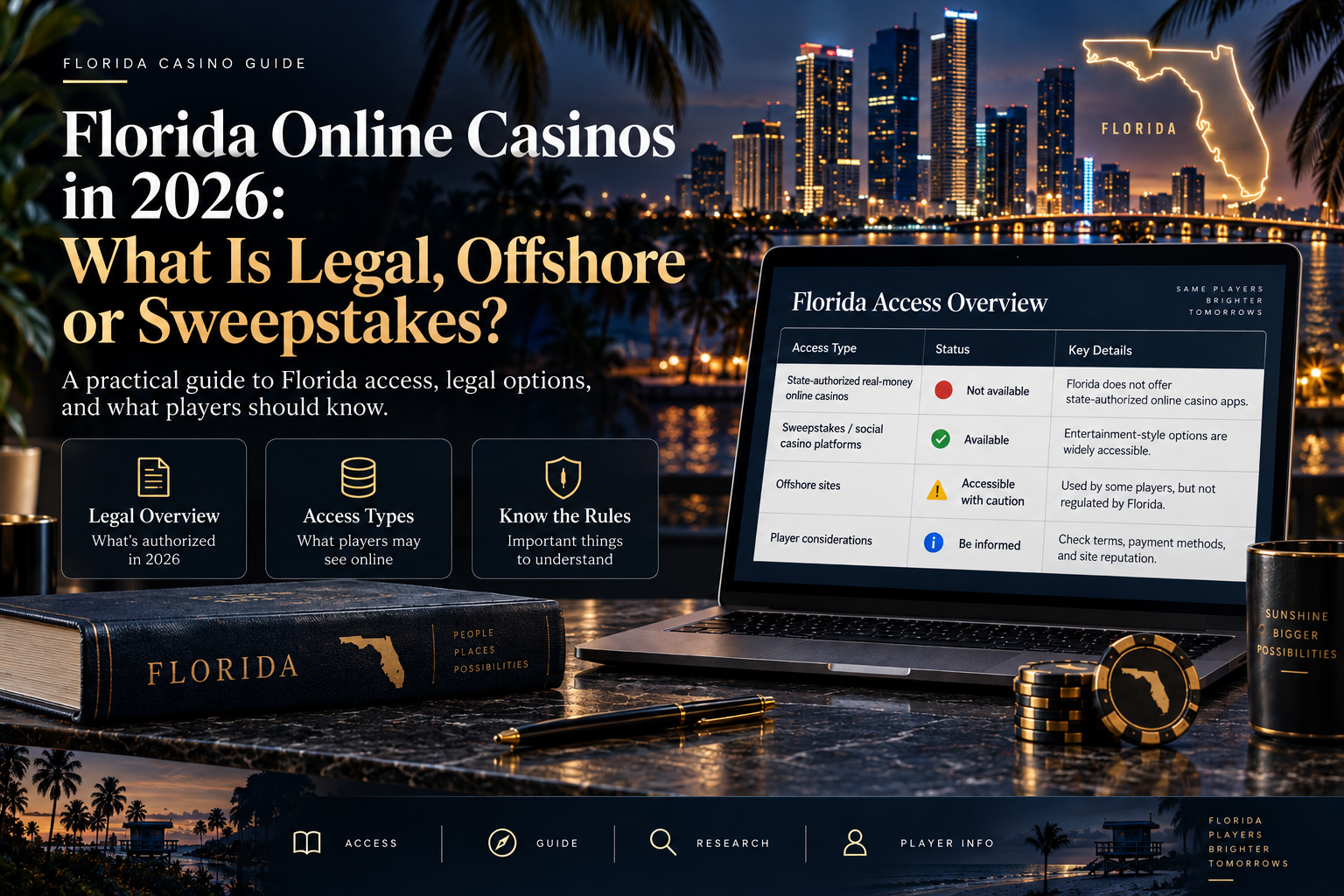
Florida does not operate a state-licensed commercial online casino market in 2026.
That distinction should come before any discussion of 400% bonuses, instant crypto payouts or thousands of online slots. An offshore gambling website can accept a Florida registration without becoming a Florida-regulated casino.
Florida does have several authorized forms of gambling, including tribal casino gaming, licensed cardrooms, pari-mutuel wagering and certain slot-machine facilities. Online sports wagering also exists through the state's Seminole gaming framework. Conventional online casino gaming is a different category. The Florida Gaming Control Commission warns that gambling is strictly regulated and that participation in unlicensed gambling activity may violate state law.
Florida Gaming Control Commission gambling FAQ
Florida Online Gambling at a Glance
| Product | Florida-regulated? | Real-money/prize element | What readers should understand |
| State-licensed online casino | No | N/A | Florida has no state commercial iGaming licensing system |
| Offshore online casino | No Florida license | Usually | Accessibility does not equal Florida authorization |
| Sweepstakes-style casino | Not a Florida casino license | Prize model varies | Must be assessed under applicable sweepstakes and gambling law |
| Social casino | No casino license | Usually no cash redemption | Entertainment model rather than conventional real-money gambling |
| Seminole online sports betting | Separate authorized framework | Yes | Sports wagering, not an online casino license |
| Tribal casino | Yes, under tribal/federal framework | Yes | Land-based casino gaming under separate law |
| Pari-mutuel/cardroom gaming | Yes, where licensed | Yes | Regulated separately by Florida |
| Florida Lottery | State authorized | Yes | Separate from casino gaming |
The biggest mistake is treating everything in this table as one type of “Florida casino.”
Are Real-Money Online Casinos Legal in Florida?
Florida law does not create a licensing route for a normal commercial website offering internet slots, roulette, blackjack and similar casino games to the public.
Florida Statutes §849.08 broadly addresses playing games of chance for money or another thing of value, while Chapter 849 contains numerous separate exceptions and specifically authorized forms of gaming. The Florida Gaming Control Commission likewise tells consumers that authorized gambling is tightly regulated.
That means a foreign website should not be described as:
- Florida licensed.
- Florida regulated.
- Approved by Florida.
- A state-authorized Florida online casino.
solely because it accepts Florida users.
A person's particular legal circumstances can depend on the activity and facts involved, so readers needing legal advice should consult a qualified Florida attorney rather than treating an affiliate review as a legal opinion.
Why Do Google Results Show So Many “Florida Online Casinos”?
Because publishers often use location-based search terminology for international casinos that allow registrations from a state.
An offshore operator may:
- Accept Florida addresses.
- Accept U.S. dollars.
- Take Bitcoin or USDT.
- Offer slots and live-dealer games.
- Hold a foreign license.
Those facts describe the operator and its accessibility.
They do not establish state authorization.
The reference material itself makes this distinction in one section, stating that Florida has no state-licensed online casino market and that the listed operators instead rely on international licensing.
That is the terminology this article retains.
Offshore Casino vs. Florida-Regulated Gambling
A foreign license and a Florida gambling authorization serve different legal systems.
A Florida-regulated gambling business
Where Florida authorizes gambling, regulators can potentially oversee matters such as:
- Licensing.
- Compliance.
- Game or facility rules.
- Investigations.
- Enforcement.
- Operator conduct.
An offshore casino
An offshore casino primarily operates under its own foreign corporate and licensing arrangements.
A Florida user may therefore have different practical options if a dispute arises involving:
- Withheld withdrawals.
- Account closure.
- Bonus enforcement.
- KYC.
- Player funds.
A valid foreign license can still be meaningful evidence about who supervises the business. It should simply not be presented as Florida regulation.
Are Offshore Online Casinos Legal for Florida Players?
This is where many commercial pages become too categorical.
One competitor says that offshore casinos are legal in Florida because they are based in international jurisdictions. Another says Floridians can “safely gamble” at them. Those statements go beyond what the existence of a foreign license proves.
Florida's regulator takes a more cautious position. Its FAQ says legal gaming is strictly regulated, warns that participation in unlicensed gambling activity may be against the law, and states that online sports wagers are generally not lawful unless offered by or in conjunction with the Seminole Tribe under the authorized framework.
So the responsible distinction is:
An offshore site may be accessible from Florida, but accessibility is not Florida authorization.
Do not treat an operator's “Florida accepted” status as a legal ruling.
What About Sweepstakes Casinos in Florida?
Sweepstakes-style sites deserve separate treatment because they do not necessarily operate like conventional cash-deposit casinos.
Florida Statutes §849.094 recognizes a category called a game promotion conducted in connection with and incidental to the sale of consumer products or services. Among other requirements, the law prohibits requiring an entry fee, payment or proof of purchase as a condition of entering such a promotion.
Florida Statutes §849.094 on game promotions
That statute is often cited in discussions of promotional sweepstakes.
But there is an important limitation:
Section 849.094 should not automatically be treated as a blanket legalization of every casino-style sweepstakes website.
Whether a particular platform fits within Florida's game-promotion framework can depend on its actual structure, consideration, prizes, promotional model and other provisions of state law.
Gold Coins and Sweeps Coins Are Not the Same as a Cash Casino Balance
Many sweepstakes platforms use two currencies.
Gold Coins
Gold Coins are generally used for entertainment-style play and normally are not the redeemable prize currency.
Sweeps Coins
Sweeps Coins or an equivalent promotional currency may be used in prize-eligible play subject to the operator's official sweepstakes rules.
Typical rules can cover:
- Free methods of entry.
- Playthrough.
- Prize redemption.
- Account verification.
- Location restrictions.
- Redemption minimums.
That is substantially different from depositing $100 directly into a conventional casino account and wagering the $100.
Florida's $5,000 Sweepstakes Rule Is Commonly Misrepresented
The reference material states that sweepstakes redemptions are capped at $5,000.
That is not what §849.094 says.
The statute uses $5,000 in total announced prize value as a threshold triggering requirements such as filing the promotion's rules and prize list with the Florida Department of Agriculture and Consumer Services and establishing a qualifying trust account or surety bond.
It is not a universal rule saying:
“A Florida player can never redeem more than $5,000.”
That is an important factual correction because some individual casino-style platforms may separately impose Florida-specific prize limits in their own terms. An operator rule and the statutory $5,000 filing threshold should not be confused.
Did Florida Ban Sweepstakes Casinos in 2026?
Florida lawmakers considered substantial gambling legislation during the 2026 session.
One of the major measures, CS/CS/SB 1580, would have added an express statutory definition of “Internet gambling” covering online casino-style games such as slots, video poker and table games. The proposal passed votes in both chambers in different legislative forms but ultimately died in returning messages on March 13, 2026. It therefore did not become law.
Florida Senate record for SB 1580 (2026)
This matters for two reasons.
First, articles saying Florida enacted SB 1580 in 2026 would be wrong.
Second, the bill failing does not automatically mean every casino-style sweepstakes or offshore product is lawful. Existing Chapter 849 and other Florida rules still apply.
What Online Betting Is Authorized in Florida?
Florida's regulator lists several lawful gambling categories, including pari-mutuel wagering, certain tribal casino gaming, licensed cardrooms, the Florida Lottery, limited licensed slot gaming and lawful sweepstakes or drawings that comply with applicable law.
Online sports betting is a separate category
Florida's FAQ states that online sports wagering generally is not lawful unless conducted through sportsbooks operated by or in conjunction with the Seminole Tribe.
That authorization should not be stretched into:
“Florida legalized online gambling.”
It authorizes a particular sports-wagering framework.
It does not establish a statewide commercial online casino market.
Florida Tribal Casinos Are Not Online Casinos
Florida's tribal gaming market is substantial, but it operates through a distinct state, tribal and federal framework.
A tribal casino can lawfully offer gambling products that an ordinary commercial website cannot simply replicate statewide online.
Likewise, the existence of legal casino floors in Florida does not establish authority for an offshore website to offer internet slots to Florida users.
The legal category matters more than whether both products use the word “casino.”
Licensed Cardrooms and Pari-Mutuel Gaming Are Separate Again
The Florida Gaming Control Commission regulates cardrooms, pari-mutuel wagering and qualifying slot-machine facilities.
Those businesses operate under specific licenses and statutes.
That structure provides a useful test when reviewing online claims:
If a site calls itself a “regulated Florida casino,” which Florida license does it actually hold?
If there is no answer, the marketing description should not be taken literally.
What Does This Mean for Crypto Casinos in Florida?
Cryptocurrency does not alter the underlying regulatory classification.
An offshore operator that accepts:
- Bitcoin.
- Ethereum.
- USDT.
- Litecoin.
- Dogecoin.
- Solana.
does not become a Florida-regulated casino because cryptocurrency is used.
Crypto changes the payment rail.
It can affect:
- Deposit processing.
- Blockchain fees.
- Wallet custody.
- Network selection.
- Withdrawal mechanics.
- Transaction reversibility.
It does not itself create gambling authorization.
Why “Fast Crypto Payouts” Need Qualification
Florida casino ranking pages frequently advertise withdrawal times such as:
- Under one hour.
- Same day.
- 24 hours.
Those can describe one publisher's test or an operator's stated target.
They are not universal guarantees.
A crypto casino withdrawal can contain several stages:
withdrawal request → account review → KYC/bonus review → casino approval → blockchain transaction → confirmation
The blockchain is only part of that process.
A fast network cannot remove:
- Account verification.
- Withdrawal limits.
- Security review.
- Bonus disputes.
- Casino processing time.
Any payout claim should therefore identify whether it is:
- An operator's published estimate.
- An independently measured result.
- A blockchain confirmation estimate.
- An actual contractual guarantee.
Crypto Does Not Mean No KYC
This is another recurring misconception.
A casino can accept cryptocurrency and still request:
- Government-issued identification.
- Address verification.
- Payment information.
- Source-of-funds documentation.
- Additional security checks.
Likewise, “no KYC at registration” does not necessarily mean “verification can never occur.”
Check the live withdrawal and account-verification terms before depositing.
How to Evaluate an Offshore Casino That Accepts Florida Users
If a reader independently researches an offshore casino, start with regulatory and withdrawal questions—not its welcome offer.
1. Identify the legal operator
Look beyond the brand name.
Find:
- Company name.
- Corporate jurisdiction.
- License number.
- Licensing authority.
2. Verify the foreign license
Use the issuing regulator's own database where available.
Do not rely solely on:
- Footer logos.
- Affiliate badges.
- Claims such as “internationally licensed.”
3. Check current Florida eligibility
Restricted locations change.
The review you found through Google may be months old.
Read the operator's current terms rather than assuming an old ranking remains accurate.
4. Read KYC rules
Determine when verification may occur.
Look especially at:
- Registration.
- First withdrawal.
- Large withdrawals.
- Security triggers.
5. Review withdrawal rules
Check:
- Minimum withdrawal.
- Maximum withdrawal.
- Daily/weekly limits.
- Processing periods.
- Crypto networks.
- Fees.
- Pending periods.
6. Read the bonus terms mathematically
A 600% bonus is not automatically better than a 100% bonus.
Check:
- Wagering multiple.
- Whether wagering applies to bonus only or deposit plus bonus.
- Game contribution.
- Maximum bet.
- Cashout cap.
- Expiration.
Our crypto casino bonus terms guide explains how those conditions interact.
7. Examine responsible-gambling tools
Useful controls can include:
- Deposit limits.
- Time-outs.
- Self-exclusion.
- Session limits.
- Account closure.
Do not assume a foreign operator offers the same protections available through a regulated U.S. state market.
Sweepstakes Sites Need a Different Checklist
For a sweepstakes-style platform, also check:
- Whether Florida is currently eligible.
- What the entertainment currency does.
- What the prize-eligible currency does.
- How the free entry route works.
- Whether a purchase is ever required.
- Playthrough requirements.
- Prize-redemption minimum.
- Identity verification.
- Per-play or account prize limits.
- Current official sweepstakes rules.
A large Gold Coin balance should not be presented as though it were equivalent to a cash casino bankroll.
Offshore Casino Bonuses: Ignore the Headline First
The supplied reference contains offers ranging from 101% to 600% and other large promotional packages.
The percentage alone tells readers almost nothing about practical value.
For example:
Offer A
- 500% match.
- 60x wagering.
- Restricted games.
- Maximum cashout.
Offer B
- 100% match.
- 10x wagering.
- Broader qualifying games.
- No promotional cashout cap.
Offer A has the larger banner.
Offer B may impose far less wagering.
The full terms determine the difference.
Do Not Treat “No Wagering” as “No Restrictions”
A 0x-wagering promotion can still have:
- Minimum deposit.
- Maximum winnings.
- Withdrawal minimum.
- Free-spin expiry.
- KYC.
- Location restrictions.
- Game restrictions.
- Payment-method restrictions.
“No wagering” describes one condition.
It is not equivalent to unrestricted cash.
Age Requirements: Avoid One Blanket Florida Number
The reference material contains inconsistent age statements—some sites are presented as 18+, others 19+ and others 21+.
That is partly because the document mixes:
- Offshore casinos.
- Sweepstakes platforms.
- Tribal casinos.
- Lottery and racing.
- Other regulated gambling.
Do not publish a blanket sentence such as:
“You must be 18 to gamble online in Florida.”
or:
“Every Florida casino requires 21+.”
The relevant minimum can depend on the product, venue and operator.
Users should verify both applicable Florida law and the current platform terms.
Payment Methods Should Come After Regulatory Checks
Commercial pages often emphasize cards, crypto and e-wallets before discussing the operator itself.
Reverse that order.
First determine:
- What type of gambling product this is.
- Who operates it.
- Which regulator, if any, oversees it.
- Whether Florida access is permitted.
- What happens in a dispute.
Then compare payment methods.
A five-minute Bitcoin withdrawal has little value if the account never clears the casino's approval process.
Responsible Gambling Still Applies to Crypto and Sweepstakes Products
Casino-style gaming is entertainment with a financial risk of loss.
Crypto can make repeated funding particularly easy because a wallet transfer may require only a few steps.
Useful safeguards include:
- Decide the budget in U.S. dollars before starting.
- Do not use rent, bill or emergency money.
- Do not borrow to gamble.
- Do not increase wagers to recover losses.
- Keep longer-term cryptocurrency separate from gambling funds.
- Use limit and cooling-off tools where available.
- Stop if gambling begins interfering with finances, work or relationships.
The site's responsible gambling guide covers crypto-specific budgeting and account-control measures in more detail.
Florida Online Casino Comparison Checklist
| Question | Why it matters |
| Is this a Florida-regulated product? | Separates state-authorized gaming from international access |
| Who operates the site? | Establishes who is responsible |
| Is the claimed license independently verifiable? | Prevents reliance on copied logos |
| Is Florida currently eligible? | State availability can change |
| What KYC can be required? | Affects withdrawal access |
| What are the withdrawal limits? | Determines how quickly balances can actually leave |
| What do the bonus terms require? | Headline percentage alone is insufficient |
| Which crypto network is supported? | Reduces wrong-network payment risk |
| What complaint process exists? | Particularly important offshore |
| What gambling-control tools exist? | Helps users set limits and stop |
Final Takeaway
Florida online casino search results combine several products that should not be treated as equivalent.
As of September 19, 2026:
- Florida does not operate a state-licensed commercial online casino market.
- Florida law broadly regulates gambling and specifically authorizes particular forms of gaming.
- Offshore casinos may be technically accessible but are not Florida-licensed merely because they accept Florida registrations.
- Sweepstakes/game promotions have a distinct Florida statutory framework, but §849.094 should not be interpreted as an automatic legal shield for every casino-style sweepstakes product.
- A proposed 2026 measure expressly addressing “Internet gambling,” SB 1580, ultimately died and did not become law.
- Online sports wagering under the Seminole framework is a separate legal category from online casino gaming.
- Bitcoin or another cryptocurrency changes how money moves; it does not change whether the gambling product is authorized.
For readers, the useful question is therefore not simply:
“Which Florida casino has the biggest bonus?”
It is:
“What exactly is this platform, who regulates it, and what protections apply before I send money or crypto?”
FAQs
Florida does not operate a state-licensed commercial online casino market. Chapter 849 regulates gambling, while specific authorized gambling categories operate under separate provisions. Florida's Gaming Control Commission cautions that participating in unlicensed gambling may violate state law.
No. A Curaçao, Anjouan or other foreign authorization does not constitute a Florida gaming license.
Some platforms may currently accept Florida residents, but availability does not itself establish legal status. Florida's game-promotion statute contains specific requirements, and the legal treatment of a casino-style product depends on its structure and applicable law.
No. Section 849.094 uses $5,000 in total announced prize value as a threshold for additional filing and financial-security requirements. It is not a universal $5,000-per-player redemption cap.
The Florida Gaming Control Commission says online sports wagers generally must be offered by or in conjunction with the Seminole Tribe under the authorized framework. That does not mean ordinary online casino gaming has been legalized.
No. Bitcoin, USDT or another digital asset changes the payment method, not the gambling platform's regulatory status.
SB 1580 proposed express new statutory language covering Internet gambling, but the bill died in returning messages on March 13, 2026 and did not become law. Existing Florida gambling statutes remain relevant.