
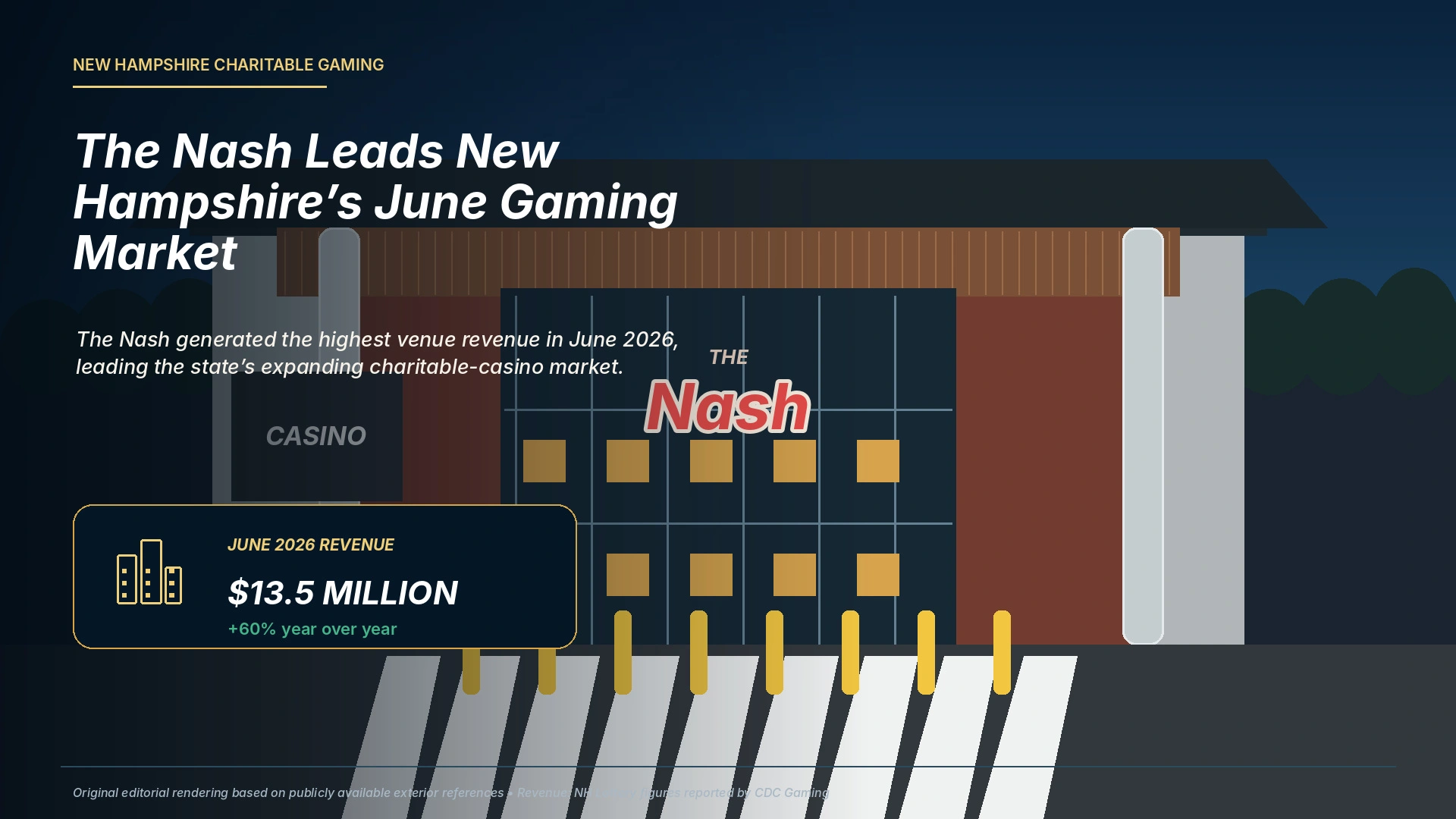
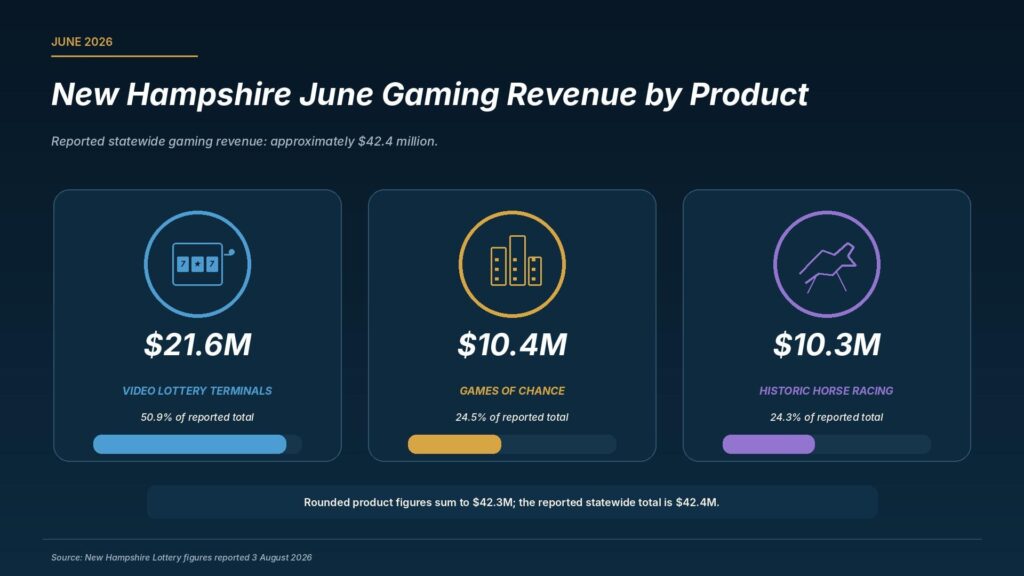
New Hampshire’s charitable gaming venues generated a reported $42.4 million in June 2026, approximately 31% more than a year earlier. Video lottery terminals contributed $21.6 million—just over half of the monthly total—while The Nash in Nashua led all reported venues with $13.5 million.
The year-over-year increase reflects the rapid expansion of VLTs following their authorization in 2025. It does not represent uniform growth across every gaming category: June revenue was lower than May, and the state’s older historic-horse-racing segment appears to have declined substantially.
Key facts
| Detail | June 2026 Result |
| Total charitable gaming revenue | $42.4 million |
| Year-over-year change | Up approximately 31% |
| Video lottery terminals | $21.6 million |
| VLT share of total | Approximately 50.9% |
| Games of chance | $10.4 million |
| Third reported segment | $10.3 million, down approximately 56% |
| Leading venue | The Nash, $13.5 million |
| Second-largest venue | The Brook, $8.6 million |
| Comparison with May | Down approximately 9.6% |
| Market covered | Regulated charitable gaming, not online casino or sports-betting revenue |
Sources: New Hampshire Lottery figures reported by CDC Gaming and the Commission’s official reporting structure.
VLTs generated more than half of June revenue
Video lottery terminals produced $21.6 million during June, accounting for approximately 50.9% of the total.
The result demonstrates how quickly VLTs have become the largest reported component of New Hampshire’s charitable gaming market. The state authorized the machines through its 2025 budget legislation, and emergency regulations allowed their rollout at licensed charitable gaming facilities later that year.
Before VLTs were introduced, New Hampshire charitable casinos could offer electronic machines whose results were based on historic horse races. VLTs use randomly determined outcomes and operate under a different statutory framework.
Their contribution was also substantially larger than either of June’s other individual categories.
Games of chance generated $10.4 million, up 17.3% year over year. These games include authorized casino-style formats conducted under RSA 287-D. VLTs and historic-horse-racing machines are reported separately.
One source category requires clarification
CDC Gaming reported that “table games” produced $10.3 million and declined 56%. That description conflicts with the Commission’s official reporting structure, which separates monthly revenue into:
- Games of chance.
- Video lottery terminals.
- Historic horse racing.
Because table games are already included within games of chance under New Hampshire law, the $10.3 million line appears to represent historic horse racing rather than a separate table-game category. The earlier May report also identified the comparable third segment as HHR.
The safest publication treatment is therefore to identify the figure as an apparent HHR result and retain the qualification unless the underlying June PDF provides a different category label.
June revenue was below May despite the annual increase
June’s $42.4 million total was approximately $4.5 million below May’s $46.9 million, a month-over-month reduction of about 9.6%.
VLT revenue declined from $24.3 million in May to $21.6 million in June. Games-of-chance revenue remained broadly unchanged at $10.4 million, while the third segment declined from May’s reported $12.3 million to approximately $10.3 million.
The figures therefore support two different conclusions:
- New Hampshire’s market was substantially larger than it was in June 2025.
- Revenue eased from the immediately preceding month.
The annual growth rate should not be described as evidence that revenue increased every month or that June set a new record.
The Nash generated almost one-third of the total
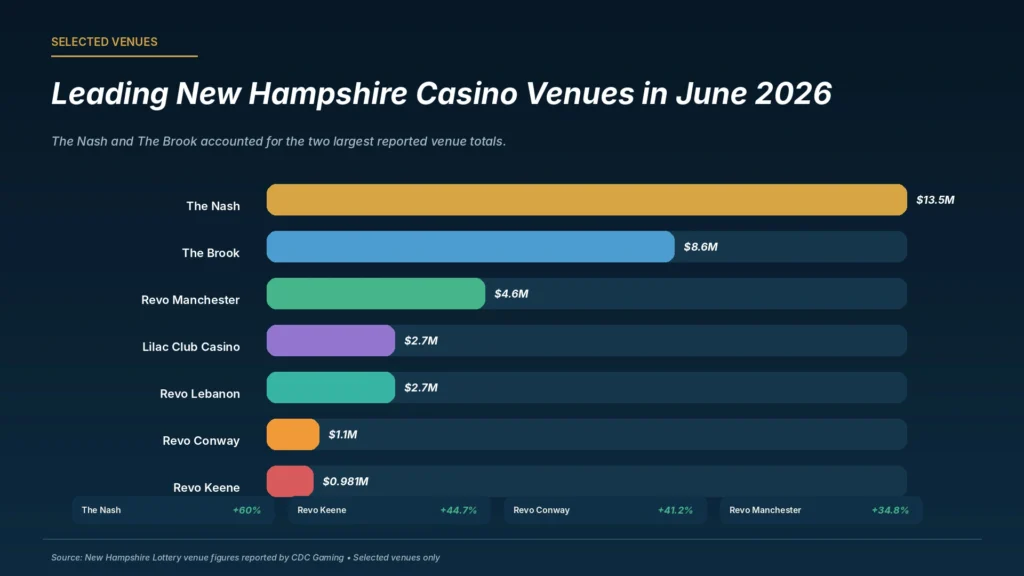
The Nash led the June market with $13.5 million, up 60% from $8.4 million one year earlier. Its revenue represented approximately 31.8% of the statewide total reported for the month.
The Brook ranked second with $8.6 million, an increase of 19.3%.
Together, The Nash and The Brook generated $22.1 million, equivalent to slightly more than 52% of the statewide result.
Selected venue results
| Venue | June Revenue | Year-over-Year Change |
| The Nash | $13.5 million | +60.0% |
| The Brook | $8.6 million | +19.3% |
| Revo Casino Manchester | $4.6 million | +34.8% |
| Lilac Club Casino | $2.7 million | +32.9% |
| Revo Casino Lebanon | $2.7 million | +31.7% |
| Revo Casino Conway | $1.1 million | +41.2% |
| Revo Casino Keene | $981,037 | +44.7% |
| Aces + Eights | $139,450 | -20.0% |
Aces + Eights was the only venue in the 12-property June report to record a year-over-year decline.
The number of venues in a monthly report should not necessarily be treated as the permanent number of casinos operating statewide. The American Gaming Association’s broader market overview lists 14 charitable casino locations, indicating that venue activity or reporting status can differ by period.
How New Hampshire’s charitable casino system works
New Hampshire’s market differs from the conventional commercial-casino systems used in states such as Nevada and New Jersey.
The American Gaming Association records zero traditional commercial casinos in New Hampshire. Instead, licensed gaming operators conduct games in partnership with qualifying charitable organizations.
Qualifying organizations can include religious, charitable, civic, veterans’, fraternal and certain other nonprofit groups that meet the registration and tax-exemption requirements in RSA 287-D.
The revenue generated at these venues is divided among:
- The licensed operator.
- Contracted charitable organizations.
- State funds.
- Regulatory and responsible-gambling purposes.
The precise distribution depends on whether the revenue comes from games of chance, historic horse racing or VLTs.
How VLT revenue is distributed
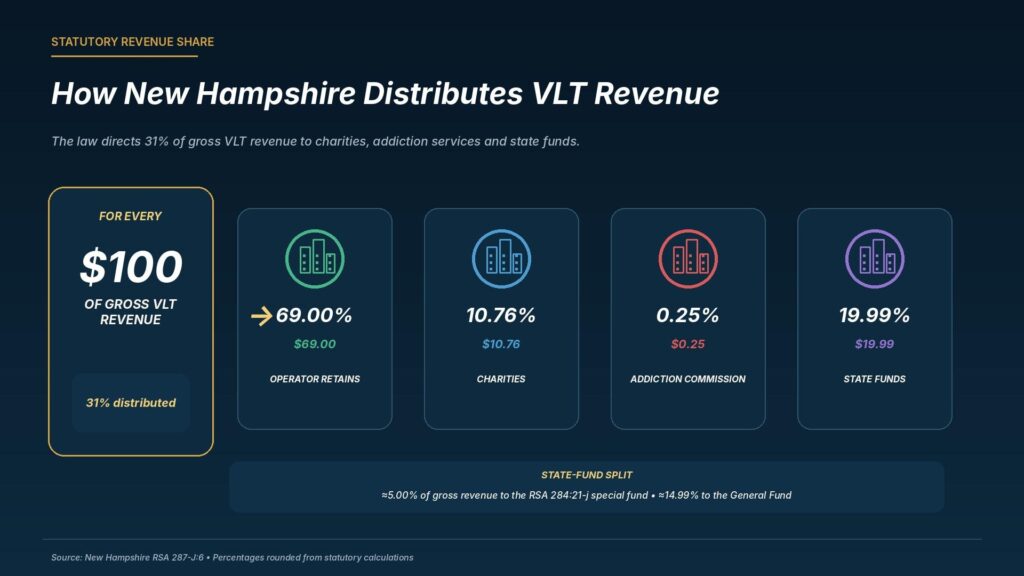
Under RSA 287-J:6, a VLT licensee collects 31% of gross video lottery revenue.
The statute requires:
- 0.25% of gross VLT revenue to go to the Governor’s Commission on Addiction, Treatment and Prevention.
- The remaining 30.75% statutory amount to be divided between contracted charities and the New Hampshire Lottery and Gaming Commission.
- Charities to receive 35% of that 30.75% amount.
- The Commission’s remaining portion to be divided between a special fund and the state general fund.
It would therefore be inaccurate to state that charities automatically receive 35% of all gross VLT revenue.
The 2025 expansion changed the revenue mix
New Hampshire’s 2025 budget legislation produced two major changes for charitable gaming venues.
First, it authorized VLTs, giving casinos access to casino-style electronic games beyond historic-horse-racing machines.
Second, it removed the previous $50 maximum wager for table games. The current statute states that no maximum wager applies to games of chance, HHR or VLT wagers.
The effects were already visible before the June report.
New Hampshire Public Radio reported that the state received $60.2 million from charitable gaming during 2025, compared with $35.2 million in 2024. Charitable organizations received approximately $64 million, up from $39.3 million.
Those figures cover a different measurement from the June operator-revenue total, but they show how the wider expansion increased the amount flowing through the system.
VLT growth may be replacing some HHR activity
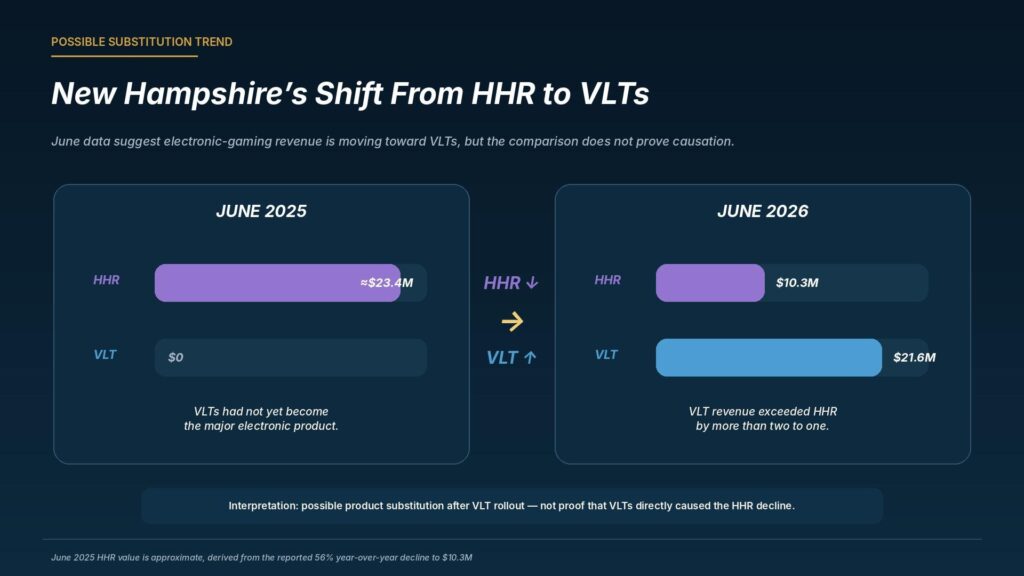
The June results suggest that part of the VLT expansion may be occurring at the expense of historic horse racing.
In May, VLTs generated $24.3 million while HHR produced $12.3 million. June VLT revenue was $21.6 million, while the apparent HHR figure was $10.3 million and down around 56% year over year.
New Hampshire Public Radio previously reported that VLTs were expected to generate more revenue per machine and cost less to operate than HHR devices, giving operators a financial reason to prioritize them.
That pattern does not prove that the same customers moved directly from HHR to VLTs. Establishing substitution would require machine counts, unique-player data and revenue per device—information that was not included in the June summary.
Charity gaming-date proposal did not become law
The uploaded source refers to Senate Bill 542 as “dead.” The more exact official description is that the House listed the measure for interim study.
SB 542 would have reduced the maximum number of annual game dates available to an individual charity from ten to seven while adjusting how many organizations larger venues would support on each date.
Because it was not enacted, the June results were not subject to the proposed seven-date limit.
The interim-study status means lawmakers may continue examining charity access, revenue concentration and the relationships between larger operators and nonprofit beneficiaries.
What the figures mean for players
The June report does not create new games, change age restrictions or authorize online casino gambling.
It records revenue from products already operating within New Hampshire’s regulated charitable gaming system.
State law generally prohibits anyone under 18 from entering premises where games of chance are being conducted, subject to a limited carnival exception. Venues may impose additional entry or product-specific restrictions.
Players should also distinguish the reported market from:
- Mobile sports betting.
- Online casino gaming.
- Sweepstakes casinos.
- Offshore gambling sites.
- Cryptocurrency casino activity.
The $42.4 million result does not include those categories. The availability of an offshore or cryptocurrency website does not make it part of New Hampshire’s regulated charitable gaming market.
Responsible-gambling implications
VLTs allow rapid, repeated machine-based wagering. Their contribution to more than half of June revenue makes responsible-gambling controls increasingly relevant as the market expands.
New Hampshire law directs 0.25% of gross VLT revenue to the Governor’s Commission on Addiction, Treatment and Prevention.
Revenue growth should not be interpreted as evidence that gambling is financially beneficial to individual players. Casino revenue represents money retained by the gaming system after prizes and other relevant adjustments, not money earned by customers.
Players should decide spending and time limits before entering a venue, avoid attempting to recover losses by increasing wagers and treat gambling solely as entertainment.
OnlineCryptoCasino.us provides additional responsible-gambling guidance covering spending limits, warning signs, session controls and support resources.
What happens next?
The next important data point will be the Commission’s July 2026 gaming revenue report.
That report will help establish whether:
- VLT revenue returns to May’s level.
- Total revenue remains above the prior-year comparison.
- Historic horse racing continues to decline.
- The Nash maintains its statewide lead.
- More venues begin reporting VLT revenue.
- The gap between the largest casinos and smaller locations continues widening.
The confirmed position for June is that New Hampshire charitable gaming revenue was 31% higher year over year, but the increase was driven primarily by VLTs rather than broad-based growth across every product.
FAQs
New Hampshire’s charitable gaming venues generated a reported $42.4 million. That was approximately 31% more than in June 2025 but about 9.6% below May 2026.
Video lottery terminals were the largest contributor. VLTs generated $21.6 million, representing approximately 50.9% of the monthly total.
The Nash led the June report with $13.5 million. Its revenue increased 60% from $8.4 million a year earlier.
No. The state operates a charitable gaming system in which licensed operators work with nonprofit organizations. The American Gaming Association records zero traditional commercial casinos in New Hampshire.
The source label is questionable. CDC Gaming calls the $10.3 million segment “table games,” but the Commission’s official reporting structure identifies the third category as historic horse racing. The figure should be treated as apparent HHR revenue unless the underlying report confirms otherwise.
No. Charitable gaming and sports betting are reported separately. The June figure covers games of chance, VLTs and historic horse racing.