

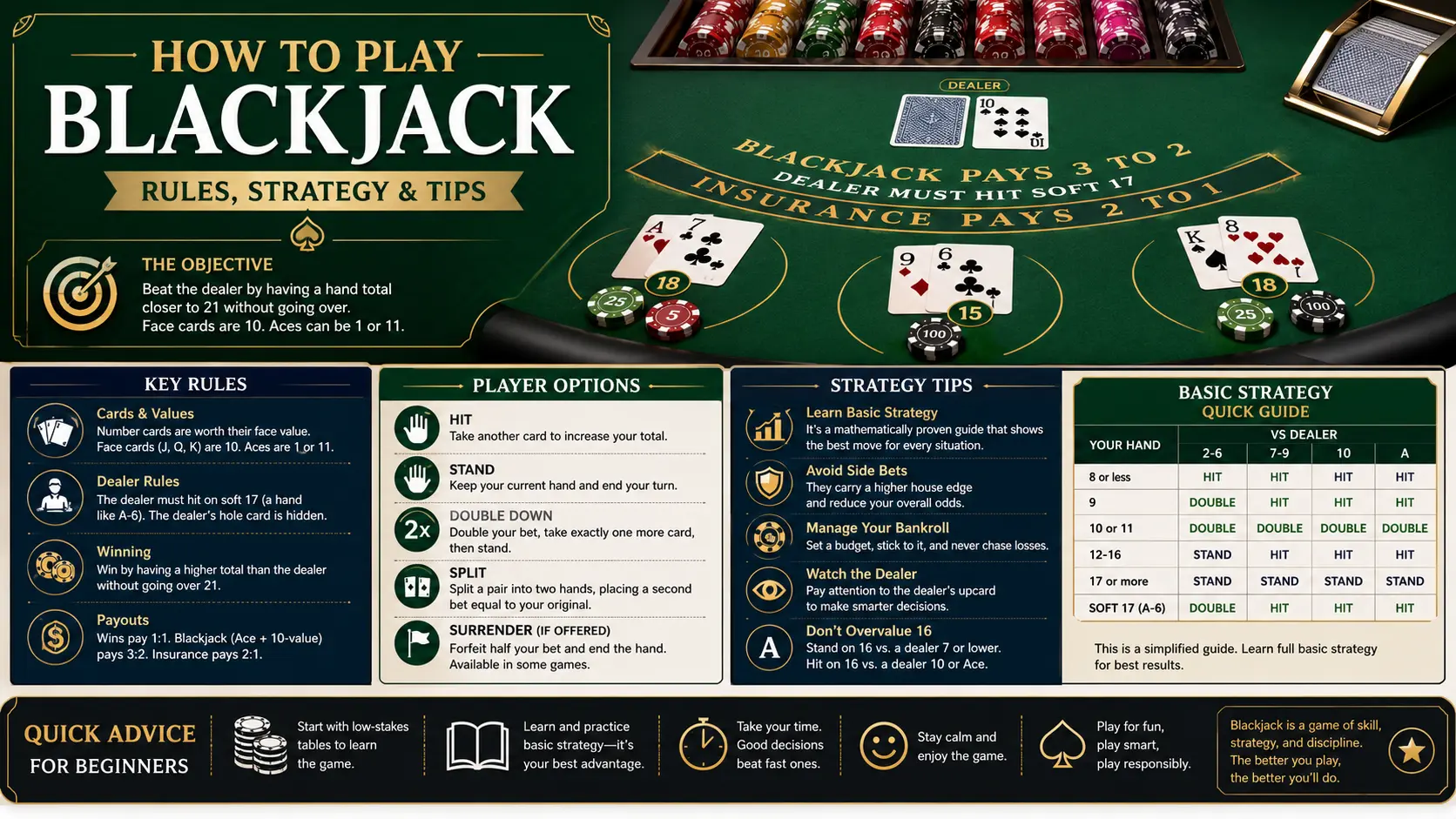
How to Play Blackjack: Blackjack is one of the world's most popular casino card games, where your goal is to beat the dealer by getting a hand value as close to 21 as possible without going over. With simple rules and a low house edge when played correctly, it's a favorite among both beginners and experienced players.
Blackjack is a casino card game in which you try to finish with a hand closer to 21 than the dealer without going over 21. You are playing against the dealer, not against the other people at the table, and you do not need to reach exactly 21 to win.
A standard blackjack round begins with two cards. After comparing your total with the dealer’s visible card, you can hit, stand, double down, split, or surrender when the table rules allow it.
Blackjack is easy to understand, but the mathematically correct decision can change according to your cards, the dealer’s upcard, and the rules being used. This guide explains the complete process for beginners without suggesting that any strategy can guarantee a profit.
Blackjack Rules at a Glance
Here are the main blackjack rules beginners should understand:
- Your goal is to beat the dealer without exceeding 21.
- Cards from 2 through 10 are worth their printed value.
- Jacks, Queens, and Kings are worth 10.
- An Ace can count as either 1 or 11.
- An Ace combined with a 10-value card as the first two cards is a natural blackjack.
- A hand that exceeds 21 busts and loses immediately.
- A regular winning hand normally pays 1:1.
- A natural blackjack should ideally pay 3:2.
- A tie between the player and dealer is usually a push, so the original bet is returned.
Individual casinos can apply different rules for soft 17, splitting, doubling, surrender, and blackjack payouts. Always check the information displayed at the table before placing a bet.
What Is the Objective of Blackjack?
The objective is to beat the dealer in one of three ways:
- Finish with a higher total than the dealer without going over 21.
- Remain in the game when the dealer busts.
- Receive a natural blackjack when the dealer does not also have blackjack.
You do not need a total of exactly 21.
For example:
- A player total of 18 beats a dealer total of 17.
- A player total of 13 wins if the dealer busts.
- A player total of 20 loses if the dealer finishes with 21.
- A player and dealer with the same total usually push.
Beginners sometimes take unnecessary cards because they believe they must get as close to 21 as possible. In many situations, the better decision is to stand and allow the dealer to take the risk of drawing.
Blackjack Card Values
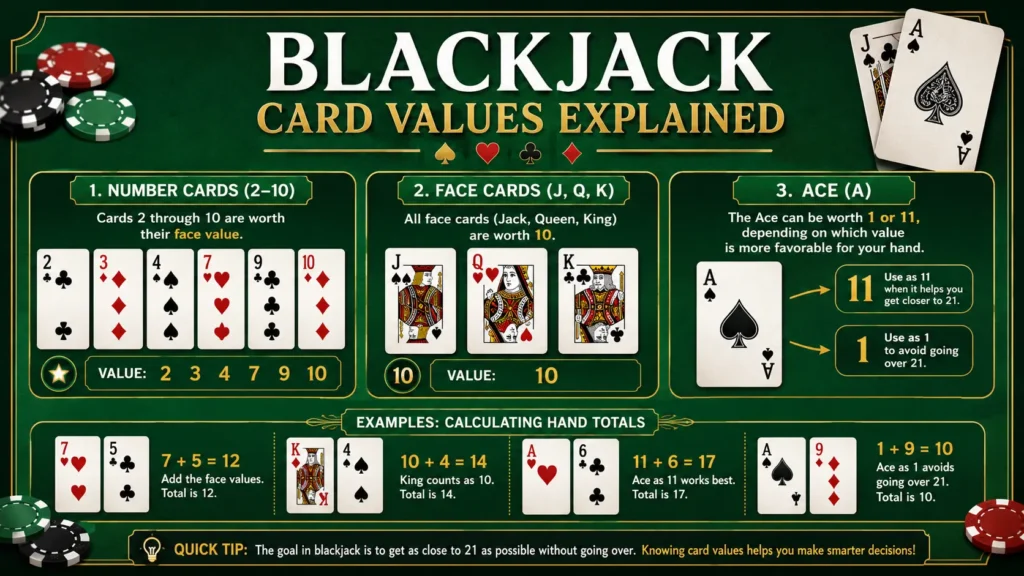
Blackjack uses a standard 52-card deck without jokers.
| Card | Blackjack value |
| 2 through 9 | Printed value |
| 10 | 10 |
| Jack | 10 |
| Queen | 10 |
| King | 10 |
| Ace | 1 or 11 |
The value of an Ace changes automatically to create the strongest legal hand.
For example:
- Ace + 6 is a soft 17.
- Ace + 6 + 10 becomes a hard 17 because the Ace must count as 1.
- Ace + King is a natural blackjack.
- Ace + Ace begins as 12, with one Ace counted as 11 and the other as 1.
What Is a Soft Hand in Blackjack?
A soft hand contains an Ace that is currently being counted as 11.
For example, Ace-6 is called soft 17. Taking another card cannot immediately make the hand bust because the Ace can change from 11 to 1.
If you draw a 10, the hand becomes:
- Ace = 1
- 6 = 6
- 10 = 10
- Total = 17
A hard hand either contains no Ace or contains an Ace that must count as 1.
Examples include:
- 10 + 6 = hard 16
- Ace + 6 = soft 17
- Ace + 6 + 10 = hard 17
- 8 + 8 = hard 16
Soft and hard totals require different strategy decisions, so they should not be treated as the same type of hand.
How to Play Blackjack Step by Step
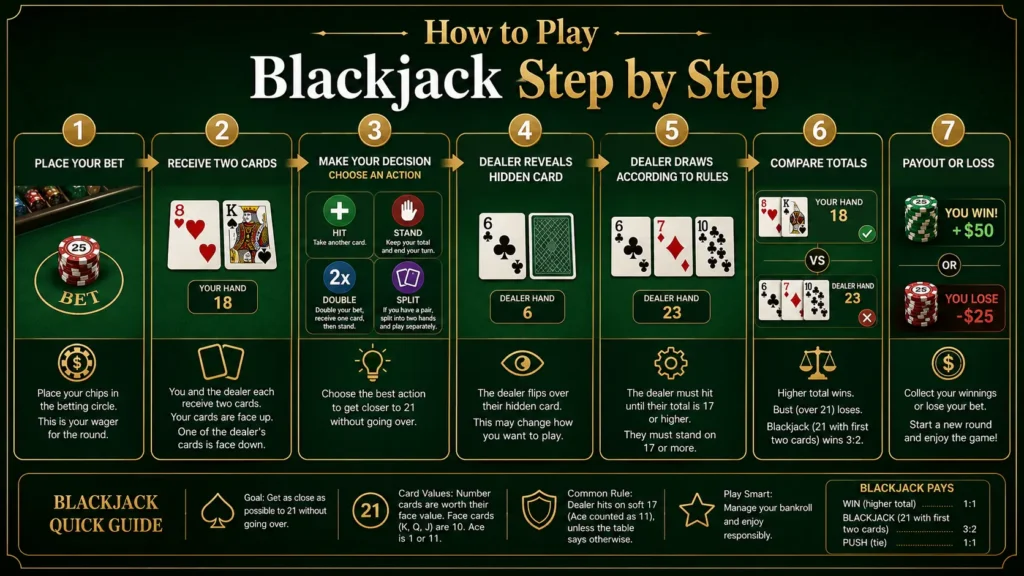
1. Place your bet
Place your wager in the designated betting area before the round begins.
In online blackjack, you normally select a chip value and click the betting area. At a physical table, you place casino chips inside the marked betting circle.
2. Receive the first two cards
The player normally receives two cards face-up.
In American-style blackjack, the dealer generally receives:
- One face-up card called the upcard
- One face-down card called the hole card
European-style blackjack may deal the dealer’s second card later. This can affect what happens to additional bets placed through splitting or doubling if the dealer eventually reveals blackjack.
3. Check your hand total
Add the values of your first two cards and compare your total with the dealer’s visible card.
The dealer’s upcard helps determine whether you should hit, stand, double, or split.
4. Choose your action
Depending on your hand and the table rules, you may be able to:
- Hit
- Stand
- Double down
- Split
- Surrender
5. The dealer completes the hand
Once every player has finished, the dealer reveals the hidden card and follows the table’s fixed drawing rules.
The dealer usually:
- Hits totals of 16 or lower
- Stands on hard 17 or higher
- Either hits or stands on soft 17, depending on the table
6. The bets are settled
The casino compares each remaining player hand with the dealer’s completed hand.
Winning bets are paid according to the table rules, while losing bets are collected.
Blackjack Actions Explained
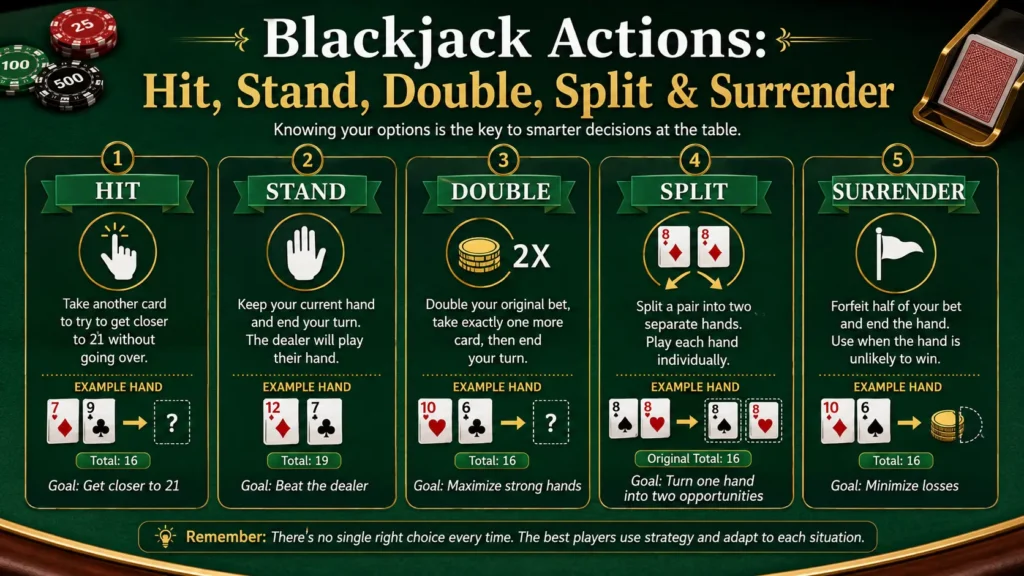
Hit
To hit means taking another card.
You can usually continue hitting until you either stand or exceed 21. Hitting is often correct when your current total is too weak to compete with the dealer’s likely completed hand.
Stand
To stand means keeping your current total and ending your turn.
Standing does not guarantee that your hand will win. It means that taking another card presents more risk than allowing the dealer to complete the hand.
Double down
Doubling down normally allows you to double your original wager in exchange for receiving exactly one more card.
Doubling can be valuable when:
- Your starting total has a strong chance of improving.
- The dealer has a vulnerable upcard.
- The table rules permit the correct strategy decision.
For example, a player holding 11 against a dealer 6 will normally double under common American blackjack rules.
Some casinos restrict the totals that can be doubled. Always check the table rules.
Split
When your first two cards have the same value, the casino may allow you to divide them into two separate hands.
You must place a second wager equal to the original bet. Each card then becomes the first card of a new hand.
Split rules can vary. Check whether the table permits:
- Doubling after splitting
- Resplitting pairs
- Resplitting Aces
- Hitting split Aces
- More than one card on each split Ace
Surrender
Late surrender allows you to give up your hand after the dealer checks for blackjack.
You normally lose half the original wager and recover the other half.
Not every table offers surrender. When available, it can reduce losses on selected weak hands, such as hard 16 against a strong dealer upcard.
Insurance
Insurance is a separate side bet offered when the dealer shows an Ace.
The insurance wager is normally limited to half your original stake and pays 2:1 when the dealer has blackjack.
Insurance does not protect the original hand in the way its name suggests. It is an independent wager on whether the dealer’s hidden card is worth 10.
Basic strategy advises most players to decline insurance because the wager carries its own house advantage.
How Does the Blackjack Dealer Play?
The dealer cannot freely choose whether to hit or stand. The dealer must follow the table’s fixed rules.
The most important variation is soft 17.
Dealer stands on soft 17
A dealer holding Ace-6 must stand.
This rule may be displayed as:
- Dealer stands on all 17s
- Dealer stands on soft 17
- S17
Dealer hits soft 17
A dealer holding Ace-6 must take another card.
This rule may be displayed as:
- Dealer hits soft 17
- H17
A dealer-hit-soft-17 rule is less favorable to the player than an otherwise identical stand-on-soft-17 game.
The soft-17 rule is important because it can change some basic strategy decisions.
Blackjack Payouts
| Result | Typical payout |
| Regular winning hand | 1:1 |
| Natural blackjack | 3:2 |
| Insurance win | 2:1 |
| Push | Original wager returned |
| Losing hand | Original wager lost |
| Surrender | Half the wager normally returned |
Regular winning-hand example
You bet $10 and beat the dealer without blackjack.
- Original stake returned: $10
- Profit: $10
- Total returned: $20
3:2 blackjack example
You bet $10 and receive a natural blackjack.
- Original stake returned: $10
- Profit: $15
- Total returned: $25
6:5 blackjack example
You bet $10 and receive a natural blackjack.
- Original stake returned: $10
- Profit: $12
- Total returned: $22
Why 3:2 Blackjack Is Better Than 6:5
The payout for a natural blackjack is one of the first table rules you should inspect.
A 3:2 table pays $15 profit on a $10 blackjack. A 6:5 table pays only $12 on the same hand.
Although the difference appears small on one wager, it can have a significant effect over many rounds. A 6:5 payout increases the casino advantage compared with an otherwise identical 3:2 game.
Whenever possible, choose a table clearly stating:
Blackjack pays 3 to 2
Do not assume that a lower minimum bet automatically makes a 6:5 table better value.
What Is Blackjack Basic Strategy?
Basic strategy is a mathematically calculated set of decisions for every possible player total against each dealer upcard.
It does not predict the next card, and it cannot guarantee that a hand or session will win. Instead, it identifies the decision with the strongest expected result under a defined set of rules.
The correct strategy can change according to:
- The number of decks
- Whether the dealer hits soft 17
- Whether doubling after splitting is allowed
- Whether surrender is available
- Whether the dealer checks for blackjack
- Restrictions on doubling
- Rules for split Aces
For this reason, a strategy chart should always identify the blackjack rules it assumes.
Rules Used for the Strategy Charts Below
The charts in this guide assume:
- Four to eight decks
- American-style blackjack
- Dealer stands on soft 17
- Dealer checks for blackjack
- Double on any first two cards
- Double after split allowed
- No surrender
- Blackjack pays 3:2
These charts provide a general multi-deck strategy reference. They should not be treated as universal instructions for every blackjack variation.
Strategy chart abbreviations
- H: Hit
- S: Stand
- D: Double if allowed; otherwise hit
- P: Split
Basic Strategy for Hard Hands
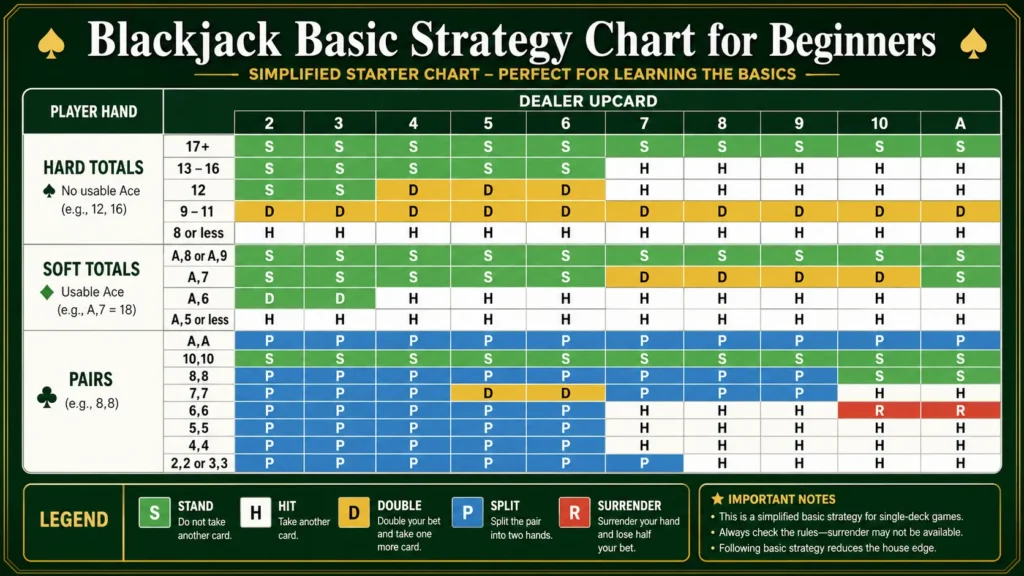
| Your total | Dealer 2 | 3 | 4 | 5 | 6 | 7 | 8 | 9 | 10 | Ace |
| 5–8 | H | H | H | H | H | H | H | H | H | H |
| 9 | H | D | D | D | D | H | H | H | H | H |
| 10 | D | D | D | D | D | D | D | D | H | H |
| 11 | D | D | D | D | D | D | D | D | D | H |
| 12 | H | H | S | S | S | H | H | H | H | H |
| 13–16 | S | S | S | S | S | H | H | H | H | H |
| 17–21 | S | S | S | S | S | S | S | S | S | S |
How to read the hard-hand chart
Suppose you hold 10-6 for a hard 16.
- Dealer shows 5: stand
- Dealer shows 8: hit
- Dealer shows 10: hit when surrender is unavailable
The decision changes because a dealer 5 is considered vulnerable, while a dealer 8 or 10 is more likely to finish with a competitive total.
Basic Strategy for Soft Hands
| Your hand | Dealer 2 | 3 | 4 | 5 | 6 | 7 | 8 | 9 | 10 | Ace |
| A-2 or A-3 | H | H | H | D | D | H | H | H | H | H |
| A-4 or A-5 | H | H | D | D | D | H | H | H | H | H |
| A-6 | H | D | D | D | D | H | H | H | H | H |
| A-7 | S | D | D | D | D | S | S | H | H | H |
| A-8 | S | S | S | S | S | S | S | S | S | S |
| A-9 | S | S | S | S | S | S | S | S | S | S |
A soft hand can often be played more aggressively because the Ace can change from 11 to 1 after another card is drawn.
For example, doubling Ace-6 against a dealer 5 is different from doubling a hard 17. The soft hand cannot bust after receiving one additional card.
Basic Strategy for Pairs
| Pair | Dealer 2 | 3 | 4 | 5 | 6 | 7 | 8 | 9 | 10 | Ace |
| 2-2 | P | P | P | P | P | P | H | H | H | H |
| 3-3 | P | P | P | P | P | P | H | H | H | H |
| 4-4 | H | H | H | P | P | H | H | H | H | H |
| 5-5 | D | D | D | D | D | D | D | D | H | H |
| 6-6 | P | P | P | P | P | H | H | H | H | H |
| 7-7 | P | P | P | P | P | P | H | H | H | H |
| 8-8 | P | P | P | P | P | P | P | P | P | P |
| 9-9 | P | P | P | P | P | S | P | P | S | S |
| 10-10 | S | S | S | S | S | S | S | S | S | S |
| A-A | P | P | P | P | P | P | P | P | P | P |
Important pair rules
- Always split Aces under these assumptions.
- Always split 8s when surrender is unavailable.
- Never split 10s.
- Treat a pair of 5s as a hard 10.
- Split 9s against 2 through 6 and against 8 or 9.
- Stand with a pair of 9s against 7, 10, or Ace.
Simple Blackjack Strategy for Beginners
A full strategy chart is more reliable than a short list, but beginners can start with these general principles.
Stand on hard 17 or higher
Drawing to a hard 17 or higher creates too much risk of busting.
Hit hard totals of 8 or lower
These hands cannot bust after receiving one additional card.
Stand on hard 13 through 16 against dealer 2 through 6
These dealer upcards are relatively vulnerable. Allow the dealer to complete the hand rather than taking an unnecessary bust risk.
Hit hard 13 through 16 against dealer 7 through Ace
Your current total is usually too weak against a stronger dealer upcard.
Always split Aces and 8s
Splitting Aces creates two opportunities to begin with an 11.
Splitting 8s replaces one hard 16 with two separate starting hands.
Never split 10s
A total of 20 is already one of the strongest possible blackjack hands.
Do not split 5s
A pair of 5s is a hard 10, which is often a strong doubling hand.
Avoid insurance
Insurance is a separate wager rather than protection for the main hand.
Blackjack Strategy Examples
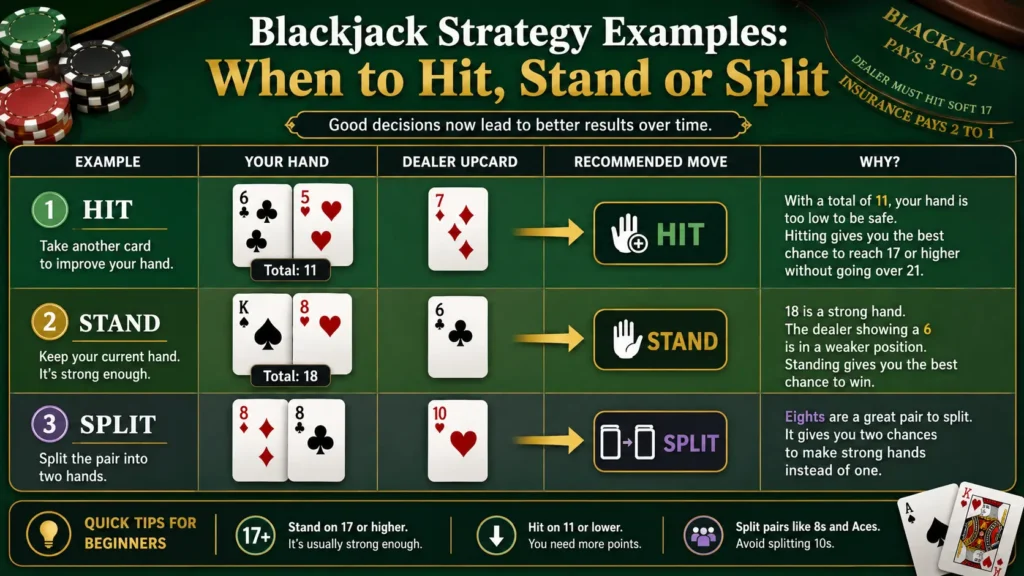
Example 1: Hard 16 against dealer 6
Your cards: 10-6
Dealer upcard: 6
Recommended action: Stand
The hand looks weak, but taking another card creates a high risk of busting. The dealer still needs to complete a vulnerable hand.
Example 2: Hard 16 against dealer 10
Your cards: 9-7
Dealer upcard: 10
Recommended action without surrender: Hit
Standing normally leaves you with a total that is unlikely to beat the dealer’s completed hand.
Example 3: Hard 11 against dealer 6
Your cards: 8-3
Dealer upcard: 6
Recommended action: Double
Eleven is a strong starting total, while the dealer’s 6 is vulnerable.
Example 4: Soft 18 against dealer 9
Your cards: Ace-7
Dealer upcard: 9
Recommended action: Hit
Although 18 appears respectable, soft 18 can draw another card without immediately busting and is not strong enough to stand against a dealer 9 under these rules.
Example 5: Pair of 8s against dealer 10
Your cards: 8-8
Dealer upcard: 10
Recommended action without surrender: Split
Keeping the cards together produces a hard 16, one of the weakest starting hands. Splitting creates two separate opportunities to improve.
How Blackjack Rules Affect the House Edge
There is no single house-edge percentage that applies to every blackjack table.
The casino advantage changes according to the table rules and the accuracy of the player’s decisions.
Important factors include:
Blackjack pays 3:2
This is substantially more favorable than a 6:5 payout.
Dealer stands on soft 17
S17 is more favorable to the player than an otherwise identical H17 game.
Double after split is allowed
This provides more flexibility after creating separate hands.
Fewer decks
Fewer decks can slightly improve the player’s expected return when all other rules remain equal. However, a single-deck table paying 6:5 can still be worse than a multi-deck table paying 3:2.
Late surrender is available
Surrender can reduce losses on selected weak hands.
Resplitting Aces is allowed
This provides additional flexibility after receiving another Ace on a split hand.
Under favorable rules and accurate basic strategy, blackjack can have a relatively low house edge compared with many other casino games. Poor rules or repeated strategy errors can increase it considerably.
Can You Guarantee a Win at Blackjack?
No blackjack system can guarantee a profit.
Basic strategy improves the quality of your decisions, but it does not control the order of the cards. A correct decision can lose, while an incorrect decision may occasionally win.
The value of basic strategy appears across many hands rather than in the guaranteed result of one round.
Avoid systems claiming that you can guarantee wins by:
- Increasing the bet after every loss
- Following recent table patterns
- Waiting for a hand to become due
- Copying the dealer’s strategy
- Using unverified prediction software
- Betting according to lucky sequences
Betting systems can change how quickly your bankroll rises or falls, but they do not remove the underlying casino advantage.
Does Card Counting Work in Online Blackjack?
Whether card counting is possible depends on the blackjack format.
RNG blackjack
Software-based blackjack commonly reshuffles after every hand or uses a virtual shoe that prevents meaningful deck penetration.
Traditional card counting is therefore generally ineffective in RNG blackjack.
Live dealer blackjack
Live dealer games use physical cards, but the shoe is normally shuffled before every card has been dealt. The number of decks and shuffle point can make counting impractical.
Land-based blackjack
Card counting can sometimes identify situations where the remaining shoe has become more favorable to the player.
However, successful counting requires:
- Accurate card tracking
- Correct basic strategy
- Sufficient bankroll
- Favorable table conditions
- Consistent bet management
Casinos may also refuse service or remove players according to their policies. This beginner guide focuses on basic strategy rather than advantage play.
Online Blackjack vs Live Dealer Blackjack
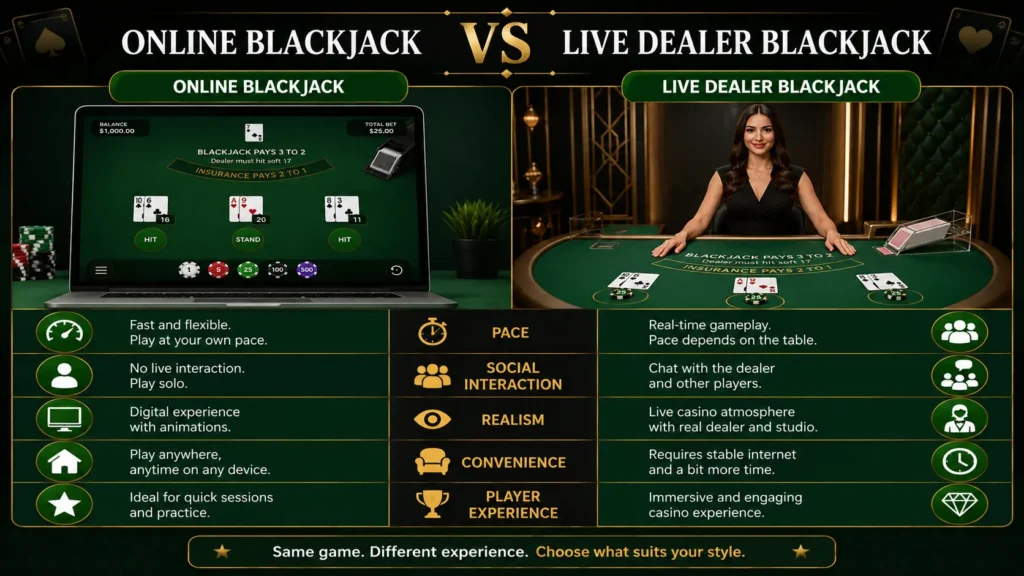
RNG online blackjack
RNG blackjack is controlled by software and normally offers faster rounds, lower minimum bets, and private gameplay.
It can be useful for beginners because players often have more time to check a strategy chart before making a decision.
Live dealer blackjack
Live dealer blackjack streams a real dealer and physical cards to the player’s device.
The experience is closer to playing at a physical casino table, although decisions may be timed and minimum bets can be higher. Players who prefer streamed tables can compare available games, payment methods, and casino features in our guide to the best Bitcoin live casinos.
Land-based blackjack
A physical casino provides real chips, traditional table etiquette, and direct interaction with the dealer.
Minimum bets and game rules can vary between casinos and even between tables on the same casino floor.
Where Can You Play Blackjack With Cryptocurrency?
Crypto casinos may offer several blackjack formats, including:
- RNG blackjack
- Live dealer blackjack
- European blackjack
- American blackjack
- Infinite blackjack
- Speed blackjack
- Multihand blackjack
- Provably fair blackjack-style games
This article focuses on blackjack rules and basic strategy. Players who are ready to compare operators can review our guide to Bitcoin blackjack casino sites, which covers casino features, supported cryptocurrencies, payment options, and available blackjack variants.
Before depositing, check whether online gambling is permitted in your location. You should also review the casino’s licence, withdrawal policy, verification requirements, and bonus terms.
Players who want to compare a wider selection of platforms can also explore our independently researched guide to the best crypto casinos.
Common Blackjack Mistakes
Playing at a 6:5 table
A smaller minimum bet does not necessarily make a 6:5 blackjack table better value. The reduced natural-blackjack payout can have a significant effect on the game’s expected return.
Taking insurance
Insurance sounds like protection for your main bet, but it is actually a separate wager on whether the dealer has a 10-value hole card.
Standing on every total from 12 through 16
The correct action depends on the dealer’s upcard.
Standing on hard 16 against a dealer 5 is different from playing the same hand against a dealer 10.
Copying the dealer’s rules
The player acts before the dealer and loses immediately after busting. For this reason, players should not simply hit every total below 17.
Splitting 10s
A total of 20 is already one of the strongest blackjack hands. Splitting it normally gives up a strong position in exchange for two less certain hands.
Standing on soft 17
A soft 17 can improve without immediately busting. Depending on the dealer’s upcard, the correct action is normally to hit or double.
Chasing losses
Increasing your wager after a losing hand does not make the next hand more likely to win.
Ignoring the table rules
A strategy chart designed for an S17 game may contain different decisions from one created for H17, single-deck, or European no-hole-card blackjack.
Blackjack Myths and Facts
| Myth | Fact |
| You must reach exactly 21 | You only need to beat the dealer without busting |
| Another player permanently changes your odds | Other players affect individual card sequences but not the game’s long-term house advantage |
| A losing streak means a win is due | Previous hands do not guarantee the next result |
| Insurance protects your original hand | Insurance is a separate side bet |
| The dealer decides whether to hit | The dealer follows fixed table rules |
| Basic strategy guarantees a profit | It improves decisions but cannot remove normal variance |
| Every blackjack table has the same odds | Payouts, decks, and table rules can change the house edge |
How to Manage a Blackjack Bankroll
Bankroll management does not change the mathematical house advantage, but it can help control how much money you risk.
Set a session budget
Choose an amount you can afford to lose before beginning.
Once the budget is gone, end the session instead of depositing additional money to recover losses.
Use modest and consistent bets
Large increases in stake size can increase volatility and end a session quickly.
Set a time limit
Online blackjack can produce many wagers in a short period. A time limit can be just as important as a financial limit.
Do not treat a win target as guaranteed
A win target can help you decide when to stop, but the game cannot be expected to produce a specific return.
Never borrow money to gamble
Do not gamble with money needed for housing, food, debt payments, savings, or other essential expenses.
Other Casino Table Games to Learn
Blackjack is not the only casino game where understanding the rules and house edge can improve the quality of your decisions.
Players looking for another card game with relatively simple decisions can learn how Bitcoin baccarat works. Baccarat generally involves fewer player choices than blackjack, but its available bets carry different house edges.
Those who prefer wheel-based games can compare the rules and available formats offered by leading Bitcoin roulette sites.
Players interested in slots, table games, and other categories can also explore our guide to popular Bitcoin casino games.
Each game uses a different probability structure. Blackjack remains distinctive because player decisions can directly influence the expected return of a hand.
Responsible Blackjack Play
Blackjack should be treated as paid entertainment rather than a way to earn income.
Set a fixed budget before beginning, and avoid using money needed for housing, food, debt payments, savings, or other essential expenses.
Use deposit, loss, wagering, and time limits whenever the casino provides them. Take a break when gambling stops feeling enjoyable or when you feel pressure to recover previous losses.
Our guide to responsible gambling support explains common warning signs, account-control tools, and resources that may help players manage their gambling activity.
In the United States, the National Problem Gambling Helpline can be reached by calling or texting 1-800-MY-RESET.
Final Takeaway
Blackjack becomes easier to understand once you remember four principles:
- The objective is to beat the dealer without exceeding 21.
- Your decision should consider both your hand and the dealer’s upcard.
- Basic strategy must match the rules used at the table.
- No strategy can guarantee a winning session.
Begin by learning the card values and the differences between hitting, standing, doubling, and splitting. After that, practise using a strategy chart designed for the specific blackjack variation you are playing.
Whenever possible, choose a table that pays 3:2 for blackjack. Check whether the dealer hits soft 17, avoid insurance unless you fully understand the mathematics behind it, and always play within a fixed entertainment budget.
FAQs
Place a bet, receive two cards, and compare your total with the dealer’s visible card. Choose whether to hit, stand, double, or split. The dealer then completes their hand. You win by finishing closer to 21 than the dealer without going over 21.
The objective is to beat the dealer. You can win with any legal total higher than the dealer’s total or by remaining in the hand when the dealer busts.
Cards from 2 through 10 are worth their printed values. Jacks, Queens, and Kings are worth 10. An Ace can count as either 1 or 11.
A natural blackjack is an Ace and a 10-value card received as the first two cards. At a favorable table, it pays 3:2 unless the dealer also has blackjack.
The correct decision depends on your total, the dealer’s upcard, and the table rules. Under common multi-deck S17 rules, hard totals of 8 or lower are hit, while hard 13 through 16 are hit against dealer 7 through Ace.
Under the strategy assumptions used in this guide, stand on hard 17 or higher. Also stand on hard 13 through 16 when the dealer shows 2 through 6.
Under most standard basic-strategy charts, Aces and 8s are split. Exact decisions can differ in unusual blackjack variants or where surrender and no-hole-card rules apply.
Basic strategy normally recommends standing on a pair of 10-value cards because the total is already 20.
Both influence the result. The order of the cards is based on chance, while the player’s decisions influence the game’s expected return.
No. Basic strategy identifies the mathematically strongest decision under specified rules, but any individual hand or session can still lose.
A 3:2 blackjack payout is better. A $10 natural blackjack produces $15 profit at 3:2 but only $12 at 6:5.
Basic strategy generally recommends declining insurance because it is a separate side bet with an unfavorable expected return for players who are not counting cards.
Casino blackjack commonly uses one, two, six, or eight decks. Online and live dealer games vary, so check the table information before playing.
The basic objective and actions are similar. However, RNG blackjack, live dealer tables, and physical casinos may use different deck, shuffle, payout, and dealer rules.