
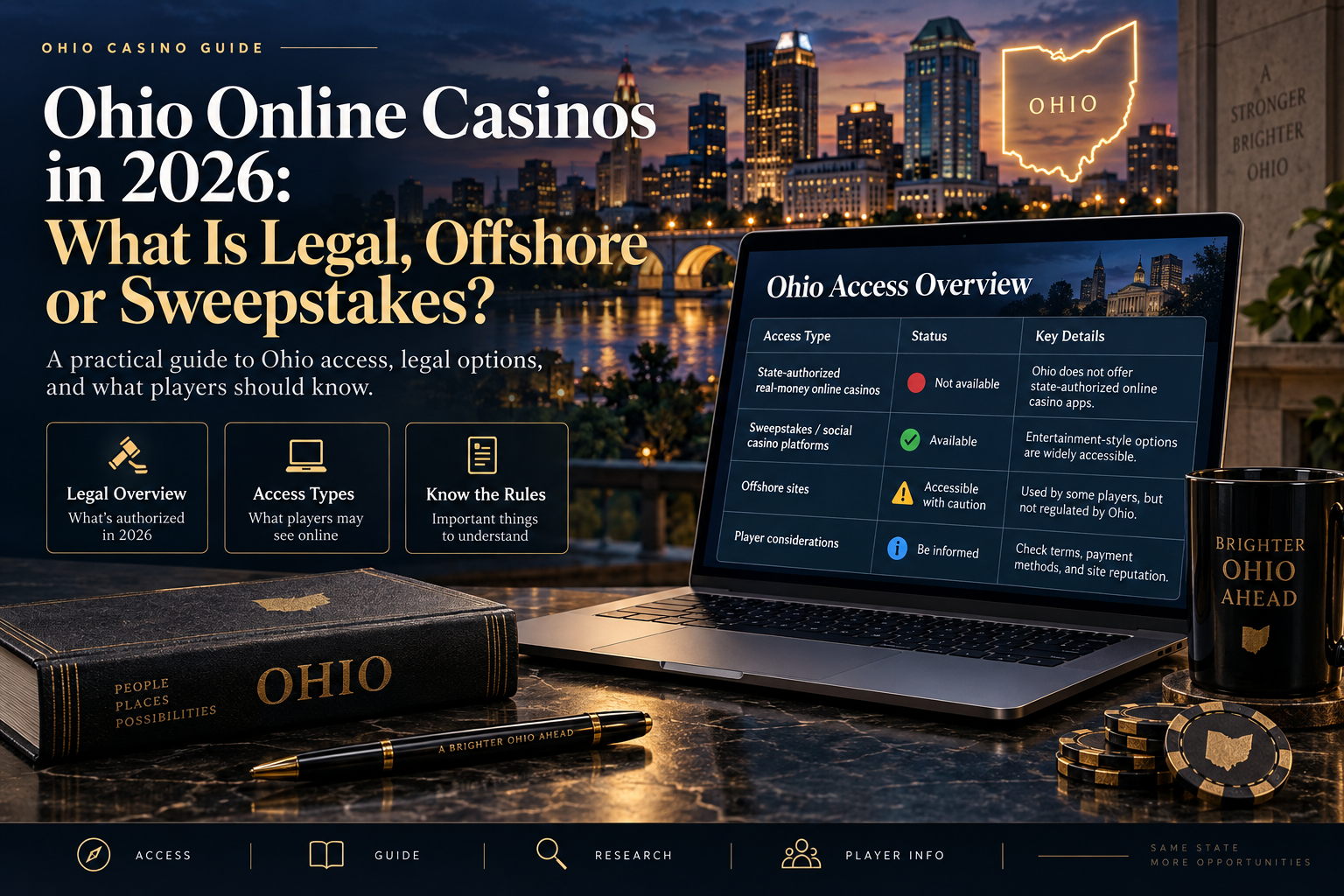
Ohio has regulated online sports betting, physical casinos and other authorized forms of gaming—but it has not yet created a state-licensed real-money online casino market.
That distinction is easy to miss when Google results advertise “Ohio online casinos” alongside 300% deposit bonuses, Bitcoin withdrawals and thousands of slots.
Those sites generally fall into two different categories: offshore real-money casinos operating outside Ohio's regulatory system, and sweepstakes-style platforms using promotional virtual currencies. Neither should be presented as an Ohio-licensed internet casino.
As of September 19, 2026, legislation that would establish regulated internet casino gaming has been introduced but has not been enacted.
Ohio Online Gambling Status at a Glance
| Product | Ohio-regulated? | Real-money/prize component | Key point |
| State-licensed online casino | No | N/A | Ohio has not enacted an iGaming licensing framework |
| Offshore online casino | No Ohio license | Usually real-money | Accessibility does not mean Ohio authorization |
| Sweepstakes-style casino | Not an Ohio casino license | Promotional prize model | Must be assessed under Ohio sweepstakes/gambling law |
| Free-play social casino | Not casino-regulated | Usually no redeemable cash prizes | Entertainment model |
| Online sportsbook | Yes, when licensed | Real-money sports wagers | Regulated separately under Ohio sports-gaming law |
| Physical casino gaming | Yes | Real-money | Separate state-authorized framework |
| Lottery/charitable gaming | Yes where authorized | Varies | Governed under separate statutory systems |
The regulatory category should be established before comparing games, bonuses or crypto payment speeds.
Are Real-Money Online Casinos Legal in Ohio?
Ohio has not enacted legislation authorizing state-licensed internet casino games such as online slots, roulette or blackjack.
Ohio Revised Code Chapter 2915 defines a game of chance to include games such as poker, craps and roulette when a player gives something of value in the hope of gain and the outcome depends largely on chance. The chapter also restricts operating or facilitating games of chance conducted for profit and schemes of chance except where other law provides authorization.
Ohio Revised Code Chapter 2915 — Gambling
This makes one point especially important for an SEO page:
Ohio accepting registrations is not the same thing as Ohio licensing the casino.
A foreign operator should not be described as:
- Ohio licensed.
- Ohio regulated.
- Approved by the Ohio Casino Control Commission.
- A state-authorized Ohio online casino.
unless it genuinely holds the relevant Ohio authorization—which conventional online casino sites currently cannot obtain because that licensing framework has not been enacted.
Sports Betting Is Different From Online Casino Gaming
One weakness in the supplied reference is that some sections use “online gambling” as though Ohio treats every internet wagering product identically.
It does not.
Ohio has an express statutory framework for sports gaming under Chapter 3775. The Ohio Casino Control Commission licenses and regulates authorized sports-gaming operators under that framework.
Ohio Revised Code Chapter 3775 — Sports Gaming
That authorization should not be stretched into:
Ohio legalized online casinos.
A licensed Ohio sportsbook can offer authorized sports wagers because sports gaming has its own legal framework.
That does not authorize the same company—or an unrelated offshore company—to offer statewide real-money online slots and table games.
Why Do Search Results Still Show “Best Ohio Online Casinos”?
Because publishers often optimize around what users can access, rather than what Ohio regulates.
An offshore site may:
- Load from an Ohio internet connection.
- Permit an Ohio address at registration.
- Accept U.S. dollars.
- Accept Bitcoin, Litecoin or USDT.
- Offer blackjack, roulette and online slots.
- Hold a foreign gambling license.
Those facts may describe the service.
They do not create an Ohio casino license.
The supplied reference actually acknowledges this distinction, stating that there are currently no online casino apps licensed or regulated by the Ohio Casino Control Commission.
Yet the same competitor continues to rank offshore platforms as “Ohio casinos.”
A more accurate description is:
offshore casino accepting Ohio users
rather than:
Ohio-regulated online casino.
What Is an Offshore Casino?
An offshore casino is an operator based or licensed outside the U.S. state where the user resides.
It can still have:
- A corporate entity.
- A foreign license.
- Published casino rules.
- KYC procedures.
- Game suppliers.
- Customer support.
- Withdrawal limits.
But the key consumer-protection question is:
Which regulator can an Ohio user turn to if something goes wrong?
That is where offshore gaming differs materially from Ohio-regulated products.
An Ohio sportsbook licensed under state law participates in an Ohio regulatory system.
A casino licensed only by a foreign jurisdiction does not become subject to Ohio's casino-regulatory framework because someone accesses it from Columbus, Cleveland or Cincinnati.
Does a Foreign Gaming License Make an Offshore Casino Safe?
Not automatically.
A foreign license can provide useful information about:
- Legal operator.
- Corporate identity.
- Regulator.
- Licensing conditions.
- Potential complaint procedures.
But it should not be converted into an unsupported statement such as:
“This casino is safe for Ohio players.”
Safety also depends on practical issues such as:
- Whether the license is genuine and current.
- Whether the exact domain is covered.
- Withdrawal history.
- Player-fund procedures.
- Verification terms.
- Bonus enforcement.
- Security.
- Complaint resolution.
A logo in the footer is evidence to investigate, not proof by itself.
What About Sweepstakes Casinos in Ohio?
Sweepstakes sites require a different legal analysis.
Ohio law expressly defines a sweepstakes as a promotion in which consideration is not required to enter or become eligible for a prize and where the result is based on chance.
That explains why sweepstakes-style operators emphasize concepts such as:
- No purchase necessary.
- Free daily entries.
- Promotional Sweeps Coins.
- Alternative methods of entry.
- Separate entertainment currencies.
But the existence of that statutory definition does not establish that every dual-currency casino-style website is automatically lawful in Ohio.
Ohio law also contains detailed restrictions concerning schemes of chance and sweepstakes terminal operations.
The platform's actual structure matters.
Gold Coins and Sweeps Coins: Why the Difference Matters
Many casino-style sweepstakes sites use two currencies.
Gold Coins
Gold Coins typically function as entertainment credits.
They normally:
- Have no ordinary cash-redemption value.
- Can be purchased in packages.
- Are used for casino-style social play.
Sweeps Coins
A second promotional currency may be used for prize-eligible play.
Typical operator rules may require:
- A free method of obtaining entries.
- Eligible-state residency.
- Minimum age.
- Playthrough before redemption.
- Identity verification.
- Minimum redemption.
This is structurally different from a conventional casino account where a user deposits $100 and wagers that $100 directly.
“No Purchase Necessary” Does Not Automatically Resolve the Legal Question
This is an important information gap in competitor articles.
The reference calls sweepstakes platforms a completely legal “loophole” or alternative.
Ohio's law is more nuanced.
The state's sweepstakes definition makes absence of required consideration important, but other gambling provisions and the specific operation of the product can also matter.
Therefore:
A platform offering a free entry method should not be described as conclusively Ohio-legal solely because it says “no purchase necessary.”
Publishers should verify current terms and legal developments instead of relying on the operator's marketing classification.
Ohio HB 298 Could Change Both Online Casinos and Sweepstakes Gaming
Ohio House Bill 298 is particularly relevant to this topic because it addresses both sides of the current SERP.
The bill's stated purpose is to:
- Legalize and regulate internet gambling.
- Tax businesses providing internet gambling.
- Prohibit online sweepstakes games.
As of September 19, 2026, the Ohio Legislature still lists HB 298 as As Introduced. It was referred to the House Finance Committee and has not passed the House.
Ohio House Bill 298 — 136th General Assembly
That means neither part should be described as current law:
- Ohio has not yet legalized regulated internet casino gaming under HB 298.
- Ohio has not yet enacted HB 298's proposed prohibition on online sweepstakes games.
This legislation should be monitored because either outcome could materially change an Ohio casino article.
Why This Article Does Not Rank Offshore Casinos as “Ohio's Best”
The supplied competitor says its team deposited, played and withdrew real money at numerous offshore sites and then assigns numerical rankings.
It also reports individual experiences such as:
- $200 Litecoin deposits.
- $1,200 Bitcoin withdrawals.
- 10-hour Bitcoin cashouts.
- 20-hour Litecoin withdrawals.
Those are that publisher's claimed tests.
They cannot ethically be converted into:
“We tested these sites.”
unless OnlineCryptoCasino.us actually conducted and documented the same testing.
More importantly, ranking offshore brands under the heading “best Ohio online casinos” risks obscuring the fact that the platforms are not Ohio-regulated.
A more useful Ohio-specific page explains how to evaluate them without implying state authorization.
How to Evaluate an Offshore Casino That Accepts Ohio Users
Before comparing welcome bonuses, determine:
| Check | What to verify |
| Legal operator | Company actually running the casino |
| Licensing authority | Which jurisdiction issued the license |
| License validity | Whether the regulator verifies the operator/domain |
| Ohio eligibility | Current geographic restrictions |
| KYC | When identity verification can occur |
| Withdrawal terms | Minimums, limits, fees and processing rules |
| Bonus terms | Wagering, game contribution, max bet, cashout cap |
| Crypto networks | Exact blockchain supported for each asset |
| Complaint route | What happens if support cannot resolve a dispute |
| Responsible-gambling tools | Limits, breaks, exclusion and account closure |
This framework provides more information than an affiliate score out of 10.
Crypto Casinos in Ohio: Does Bitcoin Change the Legal Status?
No.
Bitcoin changes the payment method.
It does not create an Ohio casino license.
The same applies to:
- Ethereum.
- Litecoin.
- USDT.
- USDC.
- Dogecoin.
- Solana.
Crypto can influence:
- Deposit settlement.
- Network fees.
- Wallet custody.
- Transaction reversibility.
- Withdrawal processing after a casino approves payment.
It does not determine whether the gambling product itself is authorized by Ohio.
Crypto Is Not Automatically Anonymous
Another claim worth qualifying is that cryptocurrency creates “privacy and anonymity.”
Blockchain payments can be pseudonymous, but public networks record transaction data.
A casino can also associate a wallet with:
- An account.
- Email.
- IP and device information.
- KYC documents.
- Deposit history.
- Withdrawal history.
So an Ohio user should not interpret “Bitcoin casino” as:
no identity checks and guaranteed anonymity.
Those are separate questions.
Is Crypto Always the Fastest Casino Withdrawal Method?
No universal answer exists.
Competitor pages frequently advertise crypto withdrawals in:
- 15 minutes.
- One hour.
- 24 hours.
Those timings may reflect the operator's target or one publisher's test.
A full casino withdrawal normally includes more than the blockchain:
request → casino review → verification → approval → broadcast → confirmation → wallet receipt
A fast blockchain cannot eliminate:
- KYC review.
- Bonus review.
- Daily withdrawal limits.
- Casino payment queues.
- Security checks.
Treat advertised payout times as estimates unless the terms explicitly provide something stronger.
Bonuses: Headline Percentage Is Not Enough
The supplied reference features promotions as large as 450%, 600% and other multi-thousand-dollar offers.
A larger percentage does not automatically make a promotion more favorable.
Compare:
Offer A
- 400% bonus.
- 50x wagering.
- $5 maximum bet.
- Promotional cashout cap.
Offer B
- 100% bonus.
- 10x wagering.
- No promotional cashout cap.
The smaller headline could impose substantially less turnover.
Our internal guide to crypto casino bonus terms explains wagering bases, game contribution, maximum bets and cashout limits in more detail.
Before opting in, check:
- What the wagering multiple applies to.
- Which games contribute.
- Maximum stake.
- Cashout cap.
- Expiry.
- Verification.
- Cancellation treatment.
“No Wagering” Does Not Mean “No Rules”
Some Ohio-facing casino rankings highlight no-wagering promotions.
A 0x requirement can still include:
- Minimum deposit.
- Maximum winnings.
- Selected games.
- Promotion expiry.
- Withdrawal minimum.
- KYC.
- Restricted payment methods.
- Geographic restrictions.
“No wagering” describes only the playthrough requirement.
It does not mean unrestricted cash.
Ohio Casino Age: Do Not Use One Number for Every Product
Ohio's regulated sports-gaming framework requires operators to verify patrons are at least 21.
But offshore and sweepstakes sites can publish their own contractual age restrictions, and the supplied reference itself shows some sweepstakes sites at 18+ and others at 21+.
That is why a page should not simply say:
“Ohio online casinos are 18+.”
There is no state-licensed online casino category to which one Ohio iGaming age requirement currently applies.
For every platform, check both applicable law and current operator terms.
Ohio Online Sportsbooks Are Not Online Casinos
Ohio's regulated online sportsbook market sometimes creates another source of confusion.
A licensed sportsbook can accept sports wagers online under Chapter 3775.
That does not mean the same app is automatically permitted to add:
- Online slots.
- Live blackjack.
- Roulette.
- Baccarat.
- Video poker.
Those would fall under a different regulatory category and would require authority that Ohio has not yet enacted for statewide internet casinos.
Sweepstakes Sites Need Their Own Evaluation Checklist
For a sweepstakes-style platform, check:
- Current Ohio eligibility.
- Minimum age in the official terms.
- Entertainment-currency rules.
- Prize-eligible currency rules.
- No-purchase entry method.
- Playthrough or redemption requirements.
- Minimum redemption.
- KYC.
- Restricted states.
- Current sweepstakes rules.
Also verify whether the rules changed recently.
Pending Ohio legislation specifically targeting online sweepstakes games means this category deserves closer monitoring than a generic nationwide social-casino article suggests.
Retail Casinos, Racinos and Online Casinos Are Not the Same Market
Ohio already has legal in-person casino gaming and other licensed gaming products.
That does not imply that casino games can simply be moved online.
Each authorized gambling category exists within its own constitutional and statutory structure.
The difference is useful for readers because a state-regulated casino or sportsbook has:
- State licensing.
- Regulatory oversight.
- Specific compliance rules.
- State enforcement mechanisms.
An offshore website operates under a different system.
What Would Regulated Ohio iGaming Change?
If legislation such as HB 298 were enacted in the future, Ohio could create a formal online casino market with specific rules concerning:
- Operator licensing.
- Player location.
- Minimum age.
- Approved games.
- Technical standards.
- Responsible-gambling requirements.
- Taxes.
- Enforcement.
- Consumer complaints.
HB 298 has not reached that stage.
As of September 19, 2026, describing Ohio as though it already has licensed internet casinos would be premature.
Responsible Gambling Applies Across Every Model
The regulatory category changes.
The financial risk of gambling does not.
Before using any casino-style platform:
- Set a dollar budget before depositing.
- Do not use money required for bills or emergencies.
- Do not borrow to gamble.
- Do not increase bets to recover previous losses.
- Keep long-term crypto holdings separate from gambling funds.
- Use breaks and account limits where available.
- Stop when gambling no longer feels recreational.
OnlineCryptoCasino.us maintains a dedicated responsible gambling guide covering budgeting, crypto-wallet separation, cooling-off and warning signs.
Ohio Online Casino Research Checklist
Before trusting a search result labeled “Ohio casino,” ask:
| Question | Why it matters |
| Is this product actually licensed by Ohio? | Accessibility and state authorization are different |
| Is it casino gaming, sports betting or sweepstakes play? | Each category has different rules |
| Who is the legal operator? | Identifies who controls the account and funds |
| Which regulator issued the license? | Determines available oversight |
| Is Ohio currently permitted? | Eligibility can change |
| When can KYC occur? | Affects withdrawals |
| What are the withdrawal limits? | Headline payout speed may be incomplete |
| What does the bonus really require? | Large percentage alone means little |
| Which blockchain network is required? | Prevents crypto payment errors |
| What dispute route exists? | Especially important offshore |
Final Takeaway
Ohio online casino search results currently combine products with very different legal and regulatory characteristics.
As of September 19, 2026:
- Ohio has not enacted a state-licensed internet casino framework.
- Ohio separately regulates online sports gaming under Chapter 3775.
- Offshore casinos may accept Ohio users, but that does not make them Ohio-regulated casinos.
- Ohio law defines sweepstakes around the absence of required consideration, but that definition should not be treated as blanket approval of every dual-currency casino-style website.
- HB 298 proposes both regulated internet gambling and a prohibition on online sweepstakes games, but it has not passed.
- Cryptocurrency changes payment mechanics, not a casino's regulatory status.
For Ohio readers, the useful first question is therefore not:
“Which site gives the biggest bonus?”
It is:
“What type of gaming product is this, who regulates it, and what protections actually apply?”
FAQs
Ohio has not enacted a licensing framework for statewide real-money internet casino gaming. Current gambling law regulates games and schemes of chance, while online sports betting exists under a separate statutory framework.
No. A foreign gaming license does not constitute an Ohio casino license. An offshore operator accepting Ohio registrations should be described as an offshore site rather than an Ohio-regulated casino.
Ohio law recognizes sweepstakes where consideration is not required, but that definition alone does not prove that every dual-currency casino-style website complies with all Ohio gambling laws. HB 298 would expressly prohibit online sweepstakes games if enacted, but the bill remains pending.
Yes. Ohio regulates sports gaming under Chapter 3775, including licensed online sports wagering. That authorization is separate from internet casino gaming.
No. HB 298 proposes regulated internet gambling, but as of September 19, 2026 the bill remains listed as introduced and has not passed the House.
No. Bitcoin changes the payment method. It does not create state authorization or turn a foreign casino license into an Ohio license.
Ohio-regulated sports gaming requires patrons to be at least 21. Sweepstakes and offshore operators can publish different contractual requirements, so users should verify the applicable product rules rather than assuming one age applies to every online casino-style site.