
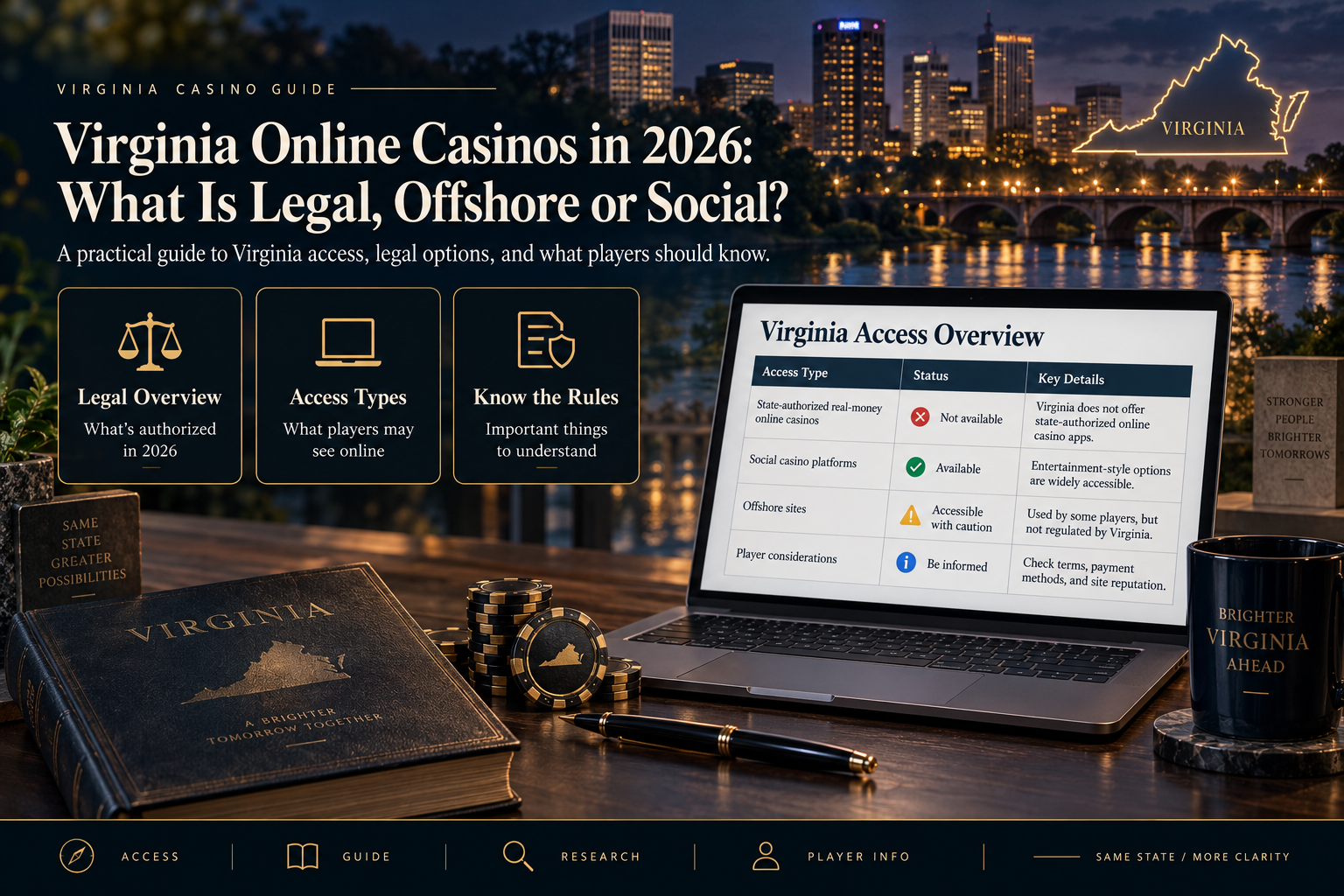
Virginia has licensed land-based casinos and regulated online sports betting, but it does not have a statewide state-licensed real-money online casino market as of September 19, 2026.
That distinction matters because searches for “Virginia online casinos” return products that operate under very different rules: offshore casinos offering real-money slots and table games, social casinos using virtual currency, and sweepstakes-style platforms with prize-linked promotional currencies.
Being accessible from Virginia does not make a website Virginia-regulated.
Virginia law broadly defines illegal gambling while separately exempting activities specifically authorized under state law, including the state lottery, lawful sports betting and licensed casino gaming.
Read Virginia's current gambling statute
Virginia Online Gambling at a Glance
| Product | Virginia-regulated? | Real-money/prize element | What it means |
| Statewide online casino | No | N/A | Virginia has not launched a licensed statewide iGaming market |
| Offshore online casino | No Virginia license | Usually real money | Foreign operation; accessibility is not state authorization |
| Sweepstakes-style casino | No Virginia casino license | Promotional prizes may be available | Legal treatment depends on actual structure and applicable law |
| Pure social casino | No casino license | Normally no redeemable cash prize | Entertainment model rather than conventional gambling |
| Online sportsbook | Yes, when authorized | Real-money sports wagers | Separate Virginia-regulated category |
| Land-based casino | Yes | Real-money casino gaming | Regulated by the Virginia Lottery |
| Lottery | Yes | Prizes | Separate statutory framework |
Virginia's current gaming regulator lists licensed casino and sports-betting operations separately; it does not list a statewide commercial internet-casino licensing category.
Virginia Lottery casinos and sports betting information
Are Real-Money Online Casinos Legal in Virginia?
Virginia has not authorized the type of statewide commercial iGaming market seen in states that license online slots, blackjack, roulette and live-dealer casino games.
Virginia Code §18.2-325 defines illegal gambling broadly as making, placing or receiving a wager of money or another thing of value for a chance to win something of value based on an uncertain or chance outcome. The statute expressly says this definition can apply even when the relevant game or event occurs outside Virginia.
Section 18.2-326 states that, unless another exception applies, a person who illegally gambles is guilty of a Class 3 misdemeanor.
Virginia then creates express exceptions for particular authorized activities, including:
- The Virginia Lottery.
- Lawful sports betting.
- Casino gaming conducted under Virginia's casino-gaming chapter.
- Qualifying pari-mutuel wagering.
- Certain permitted charitable games.
There is no equivalent current exception creating a general statewide commercial internet-casino market.
Why Do Websites Still Advertise “Virginia Online Casinos”?
Because many publishers use state accessibility as though it were the same thing as state licensing.
An offshore casino can potentially:
- Accept a Virginia address.
- Offer slots and table games.
- Accept Bitcoin or USDT.
- Display a foreign gaming license.
- Provide U.S.-facing customer service.
None of those facts creates a Virginia casino license.
The supplied ranking material actually makes this distinction before promoting the sites: it says offshore casinos are outside Virginia's state-regulated system and are not licensed by the Virginia Lottery.
A more precise description is therefore:
“offshore online casino accepting Virginia users”
rather than:
“Virginia-regulated online casino.”
Offshore Casinos and Virginia-Regulated Gambling Are Different
The distinction is mainly about regulatory accountability.
Virginia's regulated market gives the Virginia Lottery authority over licensed casino operators and sports betting. Its current casino page lists approved facility operators and explains that a facility operator license must be issued before a casino gaming establishment can operate.
An offshore casino instead operates primarily under:
- Its foreign corporate jurisdiction.
- Its foreign gambling license, where one exists.
- Its own account and withdrawal terms.
- The complaint procedures offered by its regulator or operator.
That can materially affect what happens when a player disputes:
- A frozen account.
- A KYC request.
- A bonus violation.
- A delayed withdrawal.
- A payment limit.
A foreign license may still be relevant information. It simply should not be presented as Virginia oversight.
A License Badge Alone Does Not Establish Safety
Affiliate reviews often treat a foreign gambling license, SSL encryption and fast crypto payouts as enough to call a site safe.
Those factors are useful checks, but they do not answer everything.
Before relying on a license claim, verify:
- The legal company name.
- The actual licensing authority.
- Whether the exact domain is covered.
- Whether the license is current.
- What complaint process exists.
Then separately inspect:
- KYC rules.
- Withdrawal restrictions.
- Bonus terms.
- Responsible-gambling controls.
- Account closure procedures.
A regulator logo copied into a website footer is not independent verification.
What About Sweepstakes Casinos in Virginia?
Sweepstakes-style casinos need even more careful wording.
These platforms commonly use two currencies:
Entertainment currency
Often called Gold Coins or a similar name. It is generally used for social casino-style play and normally has no direct cash-redemption value.
Promotional or prize-eligible currency
Often called Sweeps Coins or something similar. Depending on the operator's official rules, eligible balances may potentially be redeemed for prizes after meeting verification and playthrough conditions.
The presence of a free-entry route matters.
But in Virginia, “no purchase necessary” does not automatically settle the legal question.
Why the Free-Entry Argument Is Not Enough by Itself
Virginia's statute contains an important nuance that many generic sweepstakes articles miss.
Section 18.2-332 says certain actions—such as submitting a free entry blank—do not amount to consideration where no charge or purchase is required. But §18.2-325 separately states that a product, internet access or other thing purchased in exchange for a chance to win through a gambling device may constitute a wager regardless of whether the chance to win is also offered without a purchase.
That means a publisher should not reduce Virginia law to:
“Free entry exists, therefore the casino-style sweepstakes site is automatically legal.”
The full product structure matters.
Relevant questions include:
- Can prize-eligible currency be associated with purchases?
- How are free entries distributed?
- Does purchasing alter access to chances or prize play?
- What does the user actually wager?
- Is the game treated as a gambling device under Virginia law?
- What can be redeemed for cash or cash equivalents?
Determining how the statute applies to a particular platform can require case-specific legal analysis.
Social Casino and Sweepstakes Casino Are Not Synonyms
A pure social casino can be much simpler legally.
If a user buys or receives virtual credits that:
- Cannot be redeemed for cash.
- Cannot be exchanged for cash equivalents.
- Exist only for entertainment play.
that differs materially from a product involving prize-eligible promotional currency.
So when reviewing a platform, determine whether it offers:
non-redeemable virtual entertainment credits
or
a prize-redemption system tied to promotional gameplay.
Calling both products “social casinos” can hide an important distinction.
Virginia Already Regulates Online Sports Betting
Another common SERP mistake is using “online gambling” as though all internet wagering is either permitted or prohibited together.
Virginia regulates online sports betting separately.
The current Virginia Lottery gaming hub identifies licensed sports-betting operations alongside regulated casinos.
That does not mean online casino gaming is also licensed.
A sportsbook authorization covers the products approved under Virginia's sports-betting framework. It does not automatically authorize:
- Online slots.
- Internet roulette.
- Online baccarat.
- Live-dealer blackjack.
- Commercial online poker.
Product category matters.
Virginia Also Has Regulated Land-Based Casinos
Virginia's regulated casino market is no longer hypothetical.
The Virginia Lottery currently lists approved facility operators including HR Bristol, Rivers Portsmouth Gaming, Caesars Virginia, Golden Eagle Corporation II and PPE Casino Resorts Petersburg.
That regulated land-based market is another reason publishers should avoid describing an offshore website simply as a “Virginia casino.”
One is licensed through Virginia's casino-gaming framework.
The other is not.
Virginia Considered iGaming Legislation in 2026
Virginia moved closer to discussing a formal internet-casino framework during the 2026 General Assembly session.
House Bill 161 proposed authorizing internet gaming under Virginia Lottery regulation. The proposal went through both chambers and conference negotiations but did not produce enacted statewide iGaming legislation in 2026. The corresponding Senate proposal, SB 118, is officially recorded as having failed to pass from conference on March 14.
Virginia Legislative Information System — HB 161
The practical result as of September 19, 2026 is unchanged:
Virginia does not yet license statewide real-money online casinos.
This legislative history is worth monitoring because a future enacted bill could materially change:
- Licensing.
- Taxation.
- Authorized casino brands.
- Geolocation.
- Age verification.
- Responsible-gambling requirements.
- Player protections.
Until that happens, an article should not write about proposed iGaming rules as though they are already law.
Why We Are Not Repeating Competitor Offshore Rankings
The supplied research contains extensive claimed first-hand testing.
One ranking reports exact sign-up times, withdrawal medians, support response times and KYC thresholds, including a claimed 31-minute Litecoin withdrawal at one operator. Another section says funded tests involved deposits between $60 and $250 and reports crypto withdrawals ranging from ten minutes to three hours.
Those findings belong to those publishers.
They should not be rewritten as:
“We tested 40 Virginia casinos.”
or:
“Our Litecoin cashout took 31 minutes.”
unless OnlineCryptoCasino.us independently conducted and documented those same tests.
This article therefore focuses on facts a reader can independently verify.
How to Evaluate an Offshore Casino That Accepts Virginia Users
1. Identify the operator
Find the legal company behind the brand.
Look for:
- Corporate entity.
- Registered jurisdiction.
- License number.
- Regulator.
2. Verify the license independently
Use the regulator's official records where available.
Do not assume a license logo is authentic merely because it appears in the footer.
3. Confirm Virginia eligibility
Check current geographic restrictions.
An old review saying “Virginia accepted” may no longer be current.
4. Read the KYC rules before depositing
Determine when verification can occur:
- At registration.
- Before withdrawal.
- After a cumulative transaction threshold.
- During a security review.
“No KYC signup” does not necessarily mean identification can never be requested.
5. Check withdrawal rules
Read:
- Minimum withdrawal.
- Transaction maximum.
- Daily/weekly/monthly limits.
- Pending period.
- Payment fees.
- Crypto networks.
- Verification requirements.
6. Identify the dispute route
Ask what independent process exists if the casino's support team cannot resolve a payment dispute.
That question becomes particularly important outside a Virginia-regulated market.
Crypto Casinos in Virginia: Does Bitcoin Change the Legal Status?
No.
Bitcoin changes how the payment moves.
It does not create a Virginia gambling license.
The same applies to:
- Ethereum.
- Litecoin.
- USDT.
- USDC.
- Dogecoin.
- Solana.
Cryptocurrency can affect:
- Settlement time.
- Network fees.
- Wallet custody.
- Transaction reversibility.
- Exchange-rate exposure.
It does not determine whether the underlying casino product is state-authorized.
A Fast Blockchain Does Not Guarantee a Fast Casino Withdrawal
The reference SERP makes very specific crypto-speed claims: 19-minute Bitcoin withdrawals, 31-minute Litecoin withdrawals, 33-minute BNB payments and other medians.
Those measurements should not become universal payout promises.
A casino withdrawal can involve:
withdrawal request → internal review → bonus/KYC checks → approval → blockchain broadcast → confirmation → wallet receipt
Only the final stages depend directly on the blockchain.
A fast network cannot remove:
- Manual account review.
- Bonus verification.
- KYC.
- Withdrawal limits.
- Security holds.
Treat “instant” or “one-hour” payout claims as estimates or specific test results unless the operator's enforceable terms guarantee them.
Crypto Does Not Automatically Mean Anonymous or No-KYC
Using a blockchain wallet does not make the casino account invisible.
An operator may associate a wallet with:
- Email.
- IP/device data.
- Account history.
- Deposit history.
- Withdrawal history.
- Identity documents where verification occurs.
Likewise, cryptocurrency support does not prevent a casino from requesting KYC.
Payment method and identity policy are separate issues.
Bonuses: Compare the Withdrawal Path, Not the Headline
The reference contains offers ranging from free spins to 600% deposit matches.
Those numbers have little meaning without the underlying terms.
Before claiming an offer, check:
- Wagering multiple.
- Whether wagering applies to bonus only or deposit plus bonus.
- Game contribution.
- Maximum bet.
- Eligible games.
- Expiration.
- Promotional cashout cap.
- Ordinary withdrawal limit.
- Verification rules.
Our crypto casino bonus terms guide explains how these restrictions work together.
Simple example
Assume:
- Deposit: $100
- Bonus: $100
- Wagering: 25x
If 25x applies only to the bonus:
$100 × 25 = $2,500
If 25x applies to deposit plus bonus:
$200 × 25 = $5,000
Both advertisements can say “25x wagering.”
The actual requirement is twice as high in the second example.
“No Wagering” Does Not Mean “No Restrictions”
A promotion with 0x wagering can still include:
- Minimum deposit.
- Fixed free-spin value.
- Maximum winnings.
- Cashout cap.
- Expiration.
- Game restrictions.
- KYC.
- Minimum withdrawal.
The phrase describes one promotion condition, not the entire offer.
Should Game Count Determine Which Casino Looks Better?
Not by itself.
The reference ranks sites with game libraries ranging from a few hundred to nearly 2,000 titles.
Game count can be useful, but quality research should also ask:
- Are providers identifiable?
- Are game rules visible?
- Is RTP information available where relevant?
- Are tables actually available from Virginia?
- Are certain games excluded from bonuses?
- Are live games offered at useful stake ranges?
A 2,000-game headline does not establish licensing, withdrawal reliability or player protection.
Virginia Online Casino Age Requirements
Virginia does not currently have a state-licensed statewide online-casino category, so publishers should not present an offshore site's contractual age rule as “the Virginia online-casino age.”
Offshore and social platforms can impose their own minimums.
State-regulated Virginia gaming products have their own age requirements under their applicable laws and regulations.
Before creating an account, verify:
- The platform's current minimum age.
- The specific gaming category.
- Applicable Virginia law.
- Location restrictions.
Do not assume that one operator's 18+ or 21+ policy applies universally.
What About Online Poker in Virginia?
Virginia has not created a state-regulated real-money online poker network.
Offshore poker rooms that accept Virginia users remain offshore products.
Sweepstakes or social poker using virtual/promotional currencies is a different model again.
Those should not be collapsed into one category simply because each uses poker rules.
Responsible Gambling Applies to Every Casino Model
Legal classification does not remove financial risk.
A crypto wallet can make repeated deposits particularly easy, while token values can make losses feel less intuitive than dollars.
Before playing:
- Establish the gambling budget in U.S. dollars.
- Keep gambling money separate from bills and savings.
- Never borrow to gamble.
- Do not increase bets to recover losses.
- Keep long-term crypto holdings separate from gambling funds.
- Set a session limit.
- Use cooling-off and self-exclusion tools when available.
- Stop when gambling is no longer entertainment.
Our responsible gambling guide covers budgeting, wallet separation, warning signs and support options in more detail.
Virginia Online Casino Research Checklist
| Question | Why it matters |
| Is this actually licensed by Virginia? | Access and state authorization are different |
| Is it casino gaming, sports betting, social gaming or sweepstakes play? | Each category has a different legal framework |
| Who legally operates the platform? | Establishes accountability |
| Can the claimed foreign license be verified? | A logo alone is insufficient |
| Is Virginia currently accepted? | Terms can change |
| When can KYC occur? | Can affect withdrawals |
| What are the withdrawal limits? | Payout speed alone is incomplete |
| What does the bonus require? | Headline value can hide restrictive terms |
| Which crypto network is required? | Wrong-chain transfers can be difficult to recover |
| What complaint process exists? | Particularly important offshore |
| What limit/self-exclusion tools exist? | Important for risk management |
Final Takeaway
Virginia's casino market needs to be divided into clearly defined categories.
As of September 19, 2026:
- Virginia regulates land-based casino gaming and online sports betting.
- Virginia does not operate a statewide licensed real-money online casino market.
- Offshore casinos accepting Virginia users are not Virginia-licensed simply because their sites are accessible.
- Sweepstakes-style platforms should not automatically be called legal merely because a free-entry route exists; Virginia's gambling statute contains broader rules concerning purchased chances and gambling devices.
- Social gaming with non-redeemable virtual currency is distinct from prize-linked sweepstakes play.
- 2026 legislation proposed regulated internet gaming but did not produce an enacted statewide iGaming market.
- Cryptocurrency changes payment mechanics, not regulatory status.
- Competitor withdrawal tests and ratings should not be presented as OnlineCryptoCasino.us first-hand experience.
For a Virginia reader, the strongest first question is not:
“Which casino offers the biggest bonus?”
It is:
“What kind of platform is this, who regulates it, and what protections apply before I deposit money or crypto?”
FAQs
Virginia does not currently license statewide commercial real-money online casinos. Virginia law broadly regulates gambling while creating specific exceptions for authorized sports betting, casino gaming, lottery products and other identified activities.
No. A Curaçao, Anjouan, Panama or other foreign license does not constitute a Virginia Lottery casino license.
Yes, through operators authorized under Virginia's sports-betting framework. Sports betting and online casino gaming are legally distinct categories.
A blanket statement is not well supported. Virginia law recognizes circumstances where genuinely free entry does not constitute consideration, but it also says certain purchased chances involving gambling devices can still fall within the gambling definition even if free chances are offered. The actual platform structure matters.
No statewide iGaming market resulted from the 2026 proposal. HB 161 proposed authorizing internet gaming under Virginia Lottery regulation, but the 2026 legislative effort did not become operative law.
No. Bitcoin or another cryptocurrency changes how funds are transmitted. It does not change the casino's licensing or legal status.
Not necessarily. Blockchain settlement can be fast, but the casino can still conduct account, bonus, security and KYC reviews before broadcasting the transaction.