
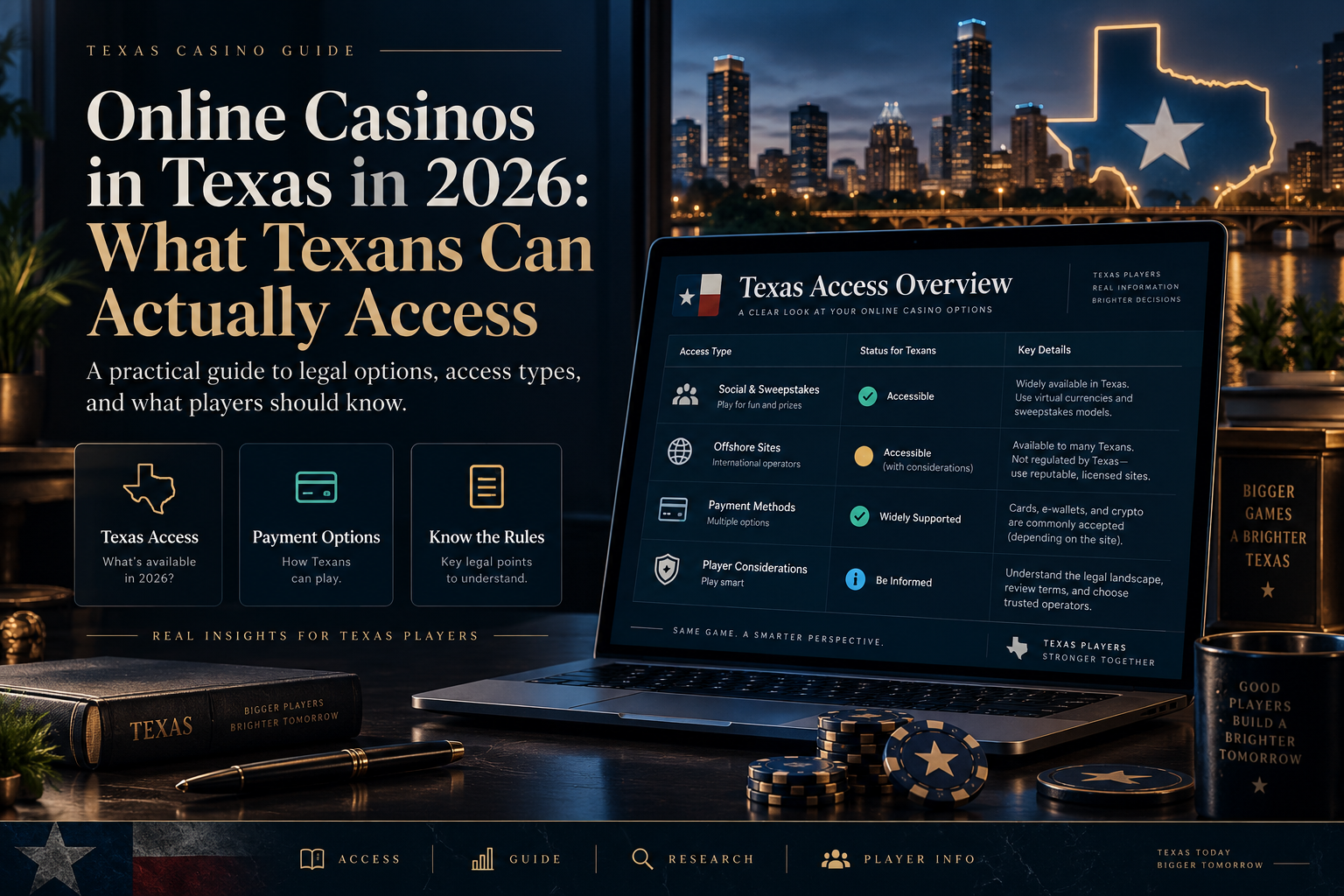
Texas does not have a state-licensed real-money online casino market as of September 19, 2026.
That distinction matters because many websites advertising “Texas online casinos” are actually referring to one of three different products: offshore casinos licensed outside Texas, sweepstakes-style casino platforms, or free-play social casinos. None should be described as a Texas-licensed real-money online casino.
Texas law also should not be reduced to “offshore sites accept Texans, therefore they are legal.” The state's gambling statute broadly covers betting for money or other things of value, while specific forms of authorized gambling operate under separate exceptions or legal frameworks.
Texas Online Casino Status at a Glance
| Type of platform | Texas-licensed? | Real-money wagering? | What Texas users should know |
| State-regulated online casino | No | N/A | Texas has not created a licensed iGaming market |
| Offshore online casino | No | Usually | May accept Texas users but is not regulated by Texas |
| Sweepstakes casino | No Texas casino license | Uses promotional/virtual-currency model | Structurally different from a conventional real-money casino |
| Social casino | No | No cash wagering/redemption in the ordinary model | Intended primarily for entertainment |
| Tribal gaming | Separate federal/tribal framework | Depends on gaming class | Not the same as a statewide commercial casino market |
| State lottery/charitable gaming | Authorized under specific Texas provisions | Yes, within applicable rules | Separate from commercial online casino gaming |
That is the framework readers should understand before comparing bonuses or payment methods.
Are Real-Money Online Casinos Legal in Texas?
Texas has not established a licensing system for commercial real-money online casinos.
Chapter 47 of the Texas Penal Code defines a “bet” as an agreement to win or lose something of value wholly or partly by chance. Section 47.02 makes specified gambling conduct an offense, including betting on a game or contest and playing certain games for money or another thing of value. The statute also contains specific defenses and exceptions.
You can review the current statute directly through Texas Penal Code Chapter 47.
The Texas Constitution also directs the Legislature to prohibit lotteries and gift enterprises except for specified categories such as the state lottery, charitable bingo and charitable raffles.
See Article III, Section 47 of the Texas Constitution.
The practical takeaway for this page is straightforward:
There is no Texas Gaming Commission licensing online blackjack, online slots, roulette or other commercial internet casino games for Texans in 2026.
That is different from saying that no gambling of any kind exists in Texas. The state has several separate permitted or federally governed forms of gaming.
Why Do So Many Websites List “Texas Online Casinos”?
Because some offshore gambling websites accept account registrations from people located in Texas.
That does not make them Texas casinos.
An offshore operator can be:
- Incorporated abroad.
- Licensed by a foreign gaming authority.
- Hosted outside the United States.
- Open to registrations from Texas IP addresses.
- Able to accept cryptocurrency from a Texas user.
None of those facts creates a Texas gaming license.
“Texas players accepted” and “licensed in Texas” mean different things
This is one of the most important distinctions missing from many ranking pages.
When an offshore site's terms say Texas residents are accepted, that is a statement about the operator's own eligibility policy.
It is not a statement from the State of Texas that the operator is authorized there.
Similarly, a Curaçao, Anjouan or other foreign license applies under that jurisdiction's framework. It should not be presented as equivalent to oversight by a U.S. state regulator.
Why This Guide Does Not Rank Offshore Sites as “The Best Texas Casinos”
A large portion of the current SERP ranks offshore platforms primarily by:
- Welcome bonus.
- Crypto withdrawal time.
- Game count.
- Minimum deposit.
- Foreign license.
- Mobile performance.
Those factors can help compare gambling products, but they do not solve the most important Texas-specific question: what regulatory protection applies to the user?
We also did not personally make deposits and withdrawals at every offshore operator appearing on competitor pages. Repeating another publisher's claimed 15-minute or 25-minute test result as our own would create false first-hand experience.
Instead, readers considering an offshore site should independently examine:
- Who legally operates the website.
- Which regulator actually issued the license.
- Whether the regulator's own database verifies it.
- Whether Texas is excluded or accepted under current terms.
- KYC rules.
- Withdrawal limits.
- Bonus conditions.
- Complaint procedures.
- Responsible-gambling controls.
- What recourse exists if a payment dispute cannot be resolved.
This is more useful than assuming the largest deposit bonus represents the strongest option.
Offshore Casinos vs. Texas-Regulated Gambling
The main distinction is regulatory accountability.
A hypothetical Texas-licensed online casino would have to operate under rules imposed by Texas regulators and legislation.
An offshore operator answers primarily to:
- Its foreign licensing authority.
- Its own terms.
- Applicable laws in the jurisdictions relevant to its operations.
That difference can affect:
- Complaints.
- Account disputes.
- KYC.
- Responsible-gambling rules.
- Player-fund safeguards.
- Advertising standards.
- Withdrawal disputes.
A foreign license can still represent regulatory oversight, but it is not Texas oversight.
What About Sweepstakes Casinos in Texas?
Sweepstakes casinos are different from conventional real-money casinos.
A typical model uses two virtual currencies.
Gold Coins
Gold Coins are generally used for entertainment-style play and normally do not have direct cash-redemption value.
Sweeps Coins
Eligible Sweeps Coins can be used under promotional sweepstakes rules and may potentially be redeemed for prizes if the player satisfies the operator's conditions.
Operators typically also provide a no-purchase method of obtaining eligible promotional entries.
Why the distinction matters
The player is not simply depositing $50 into a regulated Texas casino account and betting that $50 on slots.
The legal and commercial structure is different.
Sweepstakes platforms should therefore not be described as:
“Texas-licensed online casinos.”
They are not.
They also should not automatically be labeled “legal everywhere in Texas” solely because they accept a Texas registration. Sweepstakes eligibility rules, promotional structures and operator availability can change.
Before using one, check:
- Eligibility rules.
- Age requirement.
- No-purchase entry method.
- Sweeps Coin playthrough.
- Redemption minimum.
- Verification requirements.
- Restricted jurisdictions.
- Current official sweepstakes rules.
Sweepstakes Casinos vs. Offshore Real-Money Casinos
| Factor | Offshore real-money casino | Sweepstakes casino |
| Direct cash/crypto wagering | Usually | Structured around virtual promotional currencies |
| Texas gaming license | No | No conventional Texas casino license |
| Regulatory model | Foreign gaming jurisdiction where licensed | Sweepstakes/promotional model |
| Typical currencies | USD, BTC, ETH, USDT, others | Gold Coins + Sweeps Coins or similar |
| Withdrawal | Casino cash balance | Eligible prize redemption |
| KYC | Operator-specific | Often required for prize redemption |
| No-purchase route | Usually not relevant | Common feature of sweepstakes structure |
| Main legal consideration | Offshore gambling access | Sweepstakes/promotional compliance |
Readers should compare the two as different product categories, not interchangeable casino licenses.
Are Social Casinos the Same as Sweepstakes Casinos?
No.
A traditional social casino lets users play casino-style games with virtual currency but does not provide ordinary cash-prize redemption.
A sweepstakes casino may offer prize-eligible promotional currency under separate rules.
That distinction matters when reviewing:
- Purchase options.
- Redemption.
- KYC.
- Eligibility.
- Terms of play.
A site calling itself “social” does not tell you by itself whether any prize-redemption component exists.
What Gambling Is Available at Tribal Properties in Texas?
Tribal gaming follows a separate legal framework and should not be confused with Texas commercial casino licensing.
Texas has federally recognized tribes with gaming operations governed by combinations of federal law, tribal law and tribe-specific statutes.
The legal history is particularly important for the Ysleta del Sur Pueblo. In Ysleta del Sur Pueblo v. Texas, the U.S. Supreme Court ruled in 2022 on how federal restoration legislation interacts with Texas gaming law, rejecting the view that all of Texas's bingo regulations automatically became federal law governing the Pueblo.
Readers interested in the legal distinction can review Ysleta del Sur Pueblo v. Texas.
The key SEO/editorial point is simpler:
Tribal bingo or other federally governed tribal gaming does not mean Texas has legalized statewide commercial online casinos.
They are separate legal categories.
Does Using Cryptocurrency Make an Online Casino Legal in Texas?
No.
The payment method does not determine the legal status of the gambling product.
A casino accepting:
- Bitcoin.
- Ethereum.
- Litecoin.
- USDT.
- USDC.
- Solana.
does not become state-authorized simply because the transaction occurs on a blockchain.
Crypto changes the payment rail, not the underlying regulatory framework.
What crypto can change
Cryptocurrency can affect:
- Deposit processing.
- Withdrawal method.
- Network fees.
- Confirmation times.
- Exchange-rate exposure.
- Wallet custody.
- Transaction reversibility.
Those are payment questions.
They should be evaluated separately from:
- Texas gambling law.
- Operator licensing.
- Casino eligibility.
- Consumer recourse.
Crypto Casino Payments: What Texans Should Check
If a person is researching an offshore crypto casino, the cashier deserves just as much attention as the game lobby.
Before sending cryptocurrency, verify:
asset → network → address → amount
For example:
USDT → TRC20 → current deposit address → amount above minimum
Do not rely on a previous address simply because it worked before.
Also check:
- Minimum deposit.
- Minimum withdrawal.
- Withdrawal limits.
- Casino processing time.
- Network fees.
- KYC conditions.
- Wallet restrictions.
- Bonus restrictions.
A blockchain transfer can be irreversible even when a later casino dispute remains unresolved.
Are Crypto Withdrawals Always Faster?
No.
This is another area where ranking pages frequently overstate the evidence.
The blockchain component of a withdrawal can be quick, but a casino withdrawal can contain several stages:
withdrawal request → account review → approval → blockchain broadcast → confirmation → wallet receipt
A fast cryptocurrency network only affects some of those stages.
A withdrawal can still be delayed by:
- KYC.
- Security review.
- Bonus conditions.
- Daily or weekly limits.
- Manual approval.
- Payment-system maintenance.
Therefore, a site advertising “instant crypto withdrawals” should be evaluated against the actual terms rather than assumed to mean every withdrawal reaches every user instantly.
Do U.S. Banks Have to Block Every Offshore Casino Deposit?
No universal claim like that should be made without evidence.
A card transaction can fail because of:
- Bank policy.
- Card-network rules.
- Merchant processing.
- International transaction controls.
- Fraud detection.
- Operator payment configuration.
It is too broad to say that federal law requires every U.S. bank to automatically decline every offshore casino payment.
Likewise, it is not safe to assume a declined bank card makes cryptocurrency the legally preferable alternative.
Crypto simply uses a different payment mechanism.
How to Evaluate an Online Casino From Texas
Rather than beginning with the bonus percentage, use this order.
1. Identify the legal category
Determine whether you are looking at:
- State-regulated gambling.
- Offshore real-money gambling.
- Sweepstakes play.
- Social gaming.
- Tribal gaming.
If the publisher does not clearly identify the category, that is a weakness in the review.
2. Verify the operator
Find the company's:
- Legal name.
- Registered jurisdiction.
- License number.
- Regulator.
Then confirm the license independently.
Do not rely only on a logo in the footer.
3. Check geographic eligibility
A website being technically accessible does not mean its terms allow your location.
Read:
- Restricted countries.
- Restricted U.S. states.
- VPN policy.
- Residency rules.
4. Understand KYC before depositing
Determine whether verification is:
- Required at registration.
- Triggered at withdrawal.
- Triggered at particular limits.
- Required under other account-review circumstances.
“No KYC signup” does not necessarily mean identity documents can never be requested.
5. Read the withdrawal rules
Check:
- Minimum cashout.
- Maximum daily withdrawal.
- Weekly/monthly limit.
- Processing fee.
- Verification.
- Crypto-network restrictions.
- Pending period.
The headline payout speed means little without those conditions.
6. Evaluate bonuses mathematically
A 300% bonus can impose more restrictive conditions than a 50% bonus.
Check:
- Wagering requirement.
- Whether it applies to deposit, bonus or both.
- Game contribution.
- Maximum bet.
- Cashout cap.
- Expiration.
- Excluded games.
Our crypto casino bonus terms guide explains how those rules interact.
7. Check responsible-gambling controls
Useful tools can include:
- Deposit limits.
- Time-outs.
- Self-exclusion.
- Account closure.
- Session reminders.
An operator should not make it unusually difficult to stop gambling or withdraw the remaining eligible balance.
Online Casino Bonuses for Texas Users: Ignore the Headline Percentage First
SERP competitors routinely place the largest bonus number near the top of their rankings.
That can create the wrong comparison.
Suppose Casino A advertises:
400% bonus
while Casino B advertises:
80% bonus
Casino A is not automatically better.
Its offer could include:
- 50x deposit-plus-bonus wagering.
- $5 maximum bets.
- Restricted games.
- A withdrawal cap.
Meanwhile, the smaller offer could have substantially less wagering.
The relevant question is not:
Which bonus adds the largest displayed balance?
It is:
What conditions apply before any resulting balance becomes eligible for withdrawal?
Minimum Age at Texas-Facing Online Casinos
Because Texas does not license a real-money online casino market, there is no single Texas iGaming age rule that can simply be copied across every offshore or sweepstakes operator.
Operators can impose their own eligibility minimums, commonly 18+ or 21+ depending on the product and jurisdiction.
Do not assume a competitor's blanket “21+ Texas casino” label establishes a statewide licensed-online-casino rule.
Verify:
- Platform terms.
- Product type.
- Applicable state requirements.
- Prize-redemption rules.
Underage gambling should never be encouraged or facilitated.
Why Game Count Should Not Be the First Ranking Factor
A competitor may advertise:
- 400 games.
- 1,500 slots.
- 80 live tables.
- 5,000 titles.
The number tells you very little about regulatory protection or withdrawal reliability.
When comparing game libraries, more useful questions include:
- Are the providers identifiable?
- Are game rules accessible?
- Is RTP information available where appropriate?
- Are live games supplied by established studios?
- Are geo restrictions disclosed?
- Do bonus rules exclude major categories?
A smaller transparent library can be more useful to evaluate than a huge anonymous one.
What About Online Poker and Sports Betting?
They should be treated as separate products rather than folded automatically into a Texas online casino guide.
An operator offering:
casino + sportsbook + poker
under one offshore account does not mean Texas has authorized all three categories.
Each activity can raise its own legal and regulatory issues.
For this reason, this page focuses on online casino-style gaming rather than presenting sports betting or poker as interchangeable with casino regulation.
Responsible Gambling for Texas Casino Research
The absence of a Texas-licensed online casino market does not remove gambling-related risk from offshore or sweepstakes products.
If you choose to participate in any gambling or prize-play format:
- Set the dollar budget before starting.
- Never gamble with money required for bills.
- Do not borrow to gamble.
- Do not chase losses.
- Check bonus wagering before opting in.
- Use deposit/time limits where available.
- Stop if gambling stops being entertainment.
Crypto can make repeated deposits relatively easy, so separating a fixed gambling balance from long-term holdings can add useful friction.
Our responsible gambling guide covers wallet separation, limits and warning signs in more detail.
Final Takeaway
The phrase “best online casinos in Texas” is misleading when it is presented as though Texas has a licensed online casino market comparable with states that regulate real-money iGaming.
It does not.
As of September 19, 2026:
- Texas has no state-licensed real-money online casinos.
- Offshore casinos may accept Texas users but are not Texas-regulated casinos.
- Sweepstakes platforms use a different promotional model and should not be confused with conventional state-licensed iGaming.
- Social casinos are another separate category.
- Tribal gaming operates under distinct federal and tribal legal frameworks.
- Cryptocurrency does not change an operator's legal or licensing status.
For Texas readers, the most useful comparison therefore starts with regulatory category and consumer protection, then moves to withdrawals, KYC, games, bonuses and crypto support.
A 400% bonus or 15-minute payout claim should never come before the question:
Who regulates this platform, and what protections actually apply to me?
FAQs
Texas has not created a state-regulated real-money online casino market. The Texas Penal Code broadly regulates gambling conduct, while specified gambling activities operate through particular exceptions or separate frameworks. Offshore sites accepting Texas users should not be described as Texas-licensed casinos.
No. A foreign gambling license is not a Texas license. An offshore website can allow Texas registrations without being regulated by the State of Texas.
They offer casino-style games, but their promotional dual-currency model differs from a conventional real-money casino. They are not Texas-licensed commercial online casinos.
Some offshore platforms may accept Bitcoin from users they allow under their own terms. Bitcoin changes the payment method; it does not turn an unlicensed casino into a Texas-regulated operator.
Texas has tribal gaming conducted under distinct federal and tribal legal frameworks. The U.S. Supreme Court's Ysleta del Sur Pueblo v. Texas decision is an important part of that legal history. Tribal gaming should not be confused with a statewide commercial online-casino market.
At minimum, verify the operator, licensing authority, geographic eligibility, KYC rules, withdrawal limits, payment methods, bonus conditions and available complaint process. Do not rely on a publisher's bonus ranking alone.
No. Blockchain settlement may be fast, but the casino can have separate approval, KYC, bonus-review and security stages before broadcasting the transaction.