
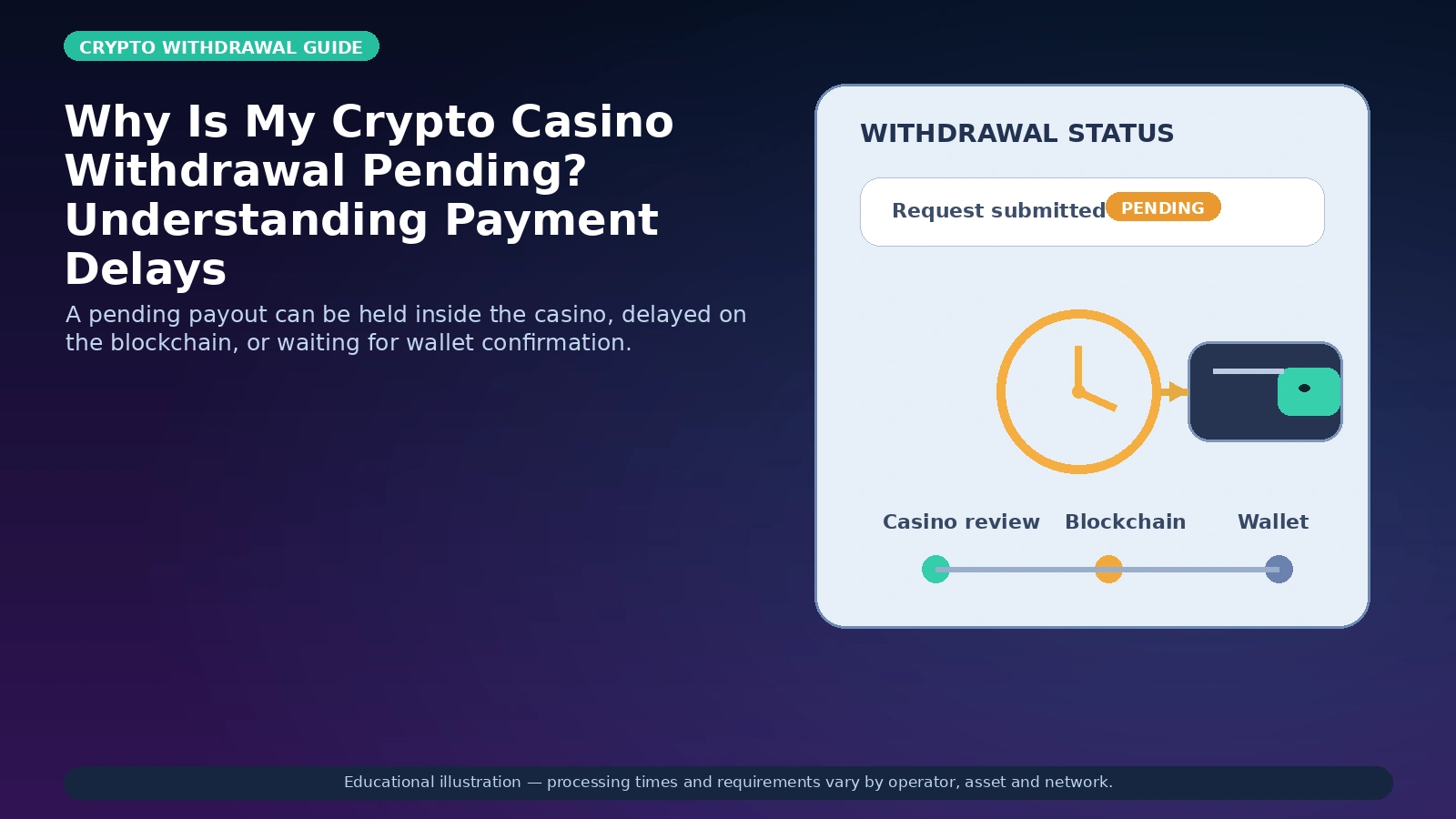
A crypto casino withdrawal usually remains pending for one of four broad reasons: the casino has not approved it, an account or bonus condition is unresolved, the payment has been broadcast but is waiting for blockchain confirmation, or the receiving wallet has not credited it.
The quickest way to identify the problem is to ask one question:
Has the casino provided a valid transaction ID, or TXID?
A TXID is the blockchain record created when an on-chain payment is broadcast. When no TXID exists, the withdrawal is normally still inside the casino’s payment system. When a valid TXID exists, the payment can be checked independently on the relevant blockchain explorer.
There are exceptions. Lightning Network payments may use an invoice or payment hash rather than a conventional on-chain TXID, and a custodial wallet may process some transfers internally. For a standard Bitcoin, Ethereum, Litecoin, Tron or stablecoin withdrawal, however, the transaction hash is the clearest dividing line between casino processing and network settlement.
Quick diagnosis: where is the withdrawal stuck?
| What you see | Most likely stage | What it usually means | Best next action |
| Pending or under review, with no TXID | Casino processing | The payment has not been publicly broadcast | Check KYC, bonus and withdrawal rules; request a status and estimated review time |
| Approved, but no TXID | Casino payment queue | Approval may be complete, but the transaction has not yet been sent | Ask when it will be broadcast and whether withdrawals are being batched |
| Valid TXID with zero confirmations | Blockchain network | The transaction is in a pending transaction pool or has not been widely accepted | Check the fee, network status and whether the sender can increase the fee |
| Valid TXID with confirmations | Receiving-wallet stage | The blockchain has processed the transfer | Confirm the correct network, address, memo and wallet crediting requirements |
| Rejected or returned to balance | Casino rules or account issue | A condition was not met or the payment failed before broadcast | Read the rejection reason and compare it with the published terms |
| Completed in the casino, but TXID cannot be found | Incorrect hash, wrong network or unsupported transfer type | The supplied information may not correspond to a public transaction | Confirm the asset, blockchain and transaction identifier with support |
How a crypto casino withdrawal actually works
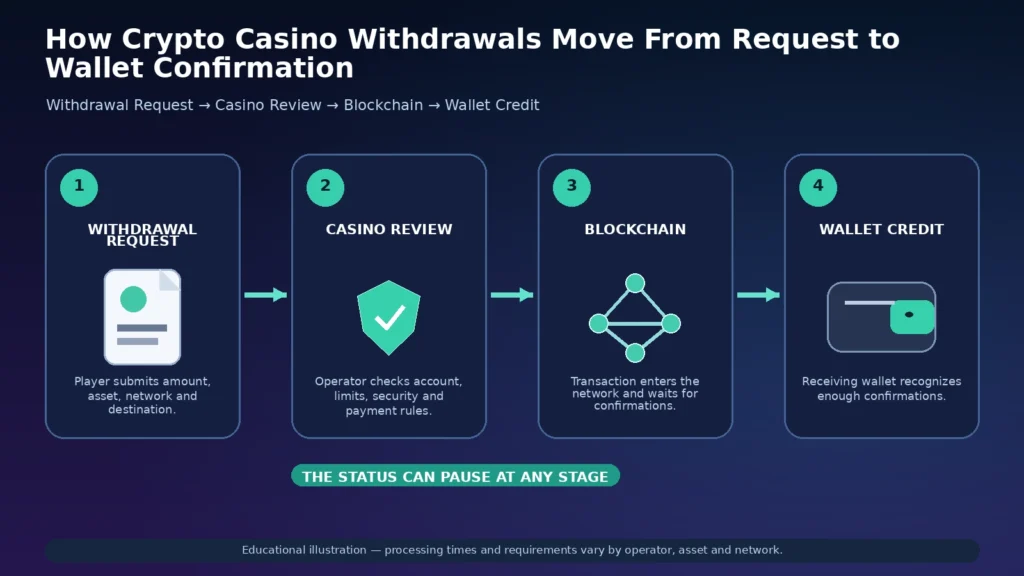
A withdrawal is not one single transaction. It is a sequence of separate stages.
Stage 1: The casino creates a withdrawal request
When the withdrawal button is pressed, the casino usually records:
- The amount.
- The selected cryptocurrency.
- The destination address.
- The chosen blockchain network.
- The account and bonus status.
- The time of the request.
At this point, no blockchain transaction necessarily exists.
Stage 2: The casino reviews and approves the request
Depending on the operator and account, this stage may include:
- Identity or account-ownership checks.
- Bonus-wagering verification.
- Payment-method validation.
- Withdrawal-limit checks.
- Location and restricted-jurisdiction checks.
- Multiple-account or security screening.
- Anti-money-laundering review.
- Manual approval for a first or unusually large cashout.
FATF guidance expects regulated virtual-asset service providers to apply risk-based customer due diligence, record keeping and suspicious-transaction controls. U.S. casinos covered by the Bank Secrecy Act must also maintain risk-based compliance programs, although the exact legal obligations of an offshore online casino depend on its licensing and operating jurisdictions.
Stage 3: The casino broadcasts the payment
After approval, the casino or its payment processor creates and sends the blockchain transaction.
This is normally when the TXID becomes available.
Before this stage, blockchain congestion cannot be the direct cause of an on-chain delay because no public transaction has entered the network.
Stage 4: The network confirms it and the wallet credits it
Validators or miners place the transaction in a block. The receiving wallet may then require a certain number of confirmations before showing the funds as available.
On Bitcoin, transaction fees reflect demand for limited block space, and miners may choose which transactions to include. Bitcoin’s developer documentation says a sufficiently funded transaction averages about ten minutes for its first confirmation, but a low fee or unusual transaction can take considerably longer.
Ethereum transactions also pay network fees. The amount offered as a priority fee can affect inclusion, while the base fee changes with network demand.
The receiving wallet or exchange may apply its own confirmation threshold and account checks after the blockchain has processed the payment.
10 common reasons a crypto casino withdrawal stays pending
1. The withdrawal is waiting in the casino’s processing queue
A status such as pending, requested, processing or under review often means the casino has received the request but has not yet released the cryptocurrency.
Possible reasons include:
- Manual payment approval.
- A first-withdrawal review.
- Limited finance-team hours.
- A large queue.
- Withdrawal batching.
- Wallet maintenance.
- A temporary payment-provider issue.
The casino’s processing time and the blockchain’s settlement time are separate. An operator can spend many hours reviewing a request even when the selected blockchain would deliver the payment quickly after broadcast.
Look for the casino’s published timeframe in its cashier, payment policy or terms. An advertised “instant withdrawal” may describe only what happens after approval rather than the complete request-to-wallet period.
For more context on that distinction, see the guide to instant withdrawal crypto casinos.
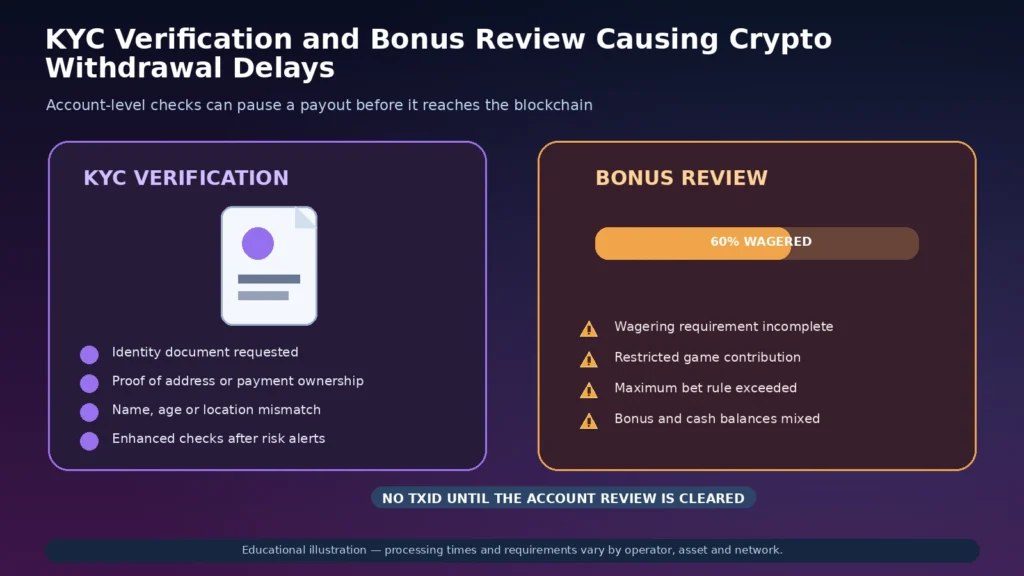
2. KYC documents are required
KYC means Know Your Customer. A casino may use it to verify identity, age, address, account ownership or payment information.
A document request may be triggered by:
- The first withdrawal.
- A high-value or unusual withdrawal.
- A change in account details.
- A new device, IP address or location.
- A mismatch between registration and payment information.
- A source-of-funds or transaction-history review.
- A licensing or compliance requirement.
A casino that did not request ID during registration may still reserve the right to request it later. “No KYC at sign-up” and “documents can never be requested” are not necessarily the same policy.
Check:
- The account-verification page.
- Email, including spam and junk folders.
- The casino’s internal message center.
- The withdrawal-status page.
- The version of the terms accepted when the account was opened.
Submit documents only through the casino’s official secure channel. Do not send identification to a social-media account, unofficial messaging contact or an unknown support address.
The site’s guide to no KYC crypto casinos can be used as contextual internal reading, but the operator’s current terms remain the controlling source for a particular account.
3. A bonus wagering requirement has not been completed
An active welcome bonus, reload offer, free-spin reward, cashback promotion or no-deposit bonus may restrict withdrawals.
Relevant terms can include:
- The wagering multiplier.
- Whether wagering applies to the bonus alone or the deposit plus bonus.
- Games that contribute fully, partly or not at all.
- A maximum permitted bet.
- An expiry period.
- A maximum cashout.
- A minimum deposit.
- A rule against withdrawing while free spins or bonus rounds remain active.
For example, a 40x requirement has very different consequences depending on its basis:
- 40x on a 100-USDT bonus: 4,000 USDT in eligible wagers.
- 40x on a 100-USDT deposit plus 100-USDT bonus: 8,000 USDT in eligible wagers.
A withdrawal submitted too early may be held, rejected, returned to the balance or processed only after the bonus is canceled. The exact outcome depends on the published promotion terms.
Review the site’s explanation of crypto casino bonus terms alongside the live terms of the actual promotion.
4. A maximum-bet or excluded-game rule was triggered
Completing the displayed wagering total does not always settle a bonus review.
The casino may also check whether:
- A bet exceeded the promotion’s maximum.
- A restricted game was played.
- Table games contributed at a reduced rate.
- Opposing or low-risk bets violated the promotion rules.
- The bonus was used across prohibited products.
- The offer was claimed more than once.
Ask support to identify the exact term under review rather than accepting a vague statement such as “bonus issue.”
A legitimate decision should be tied to a policy that was available when the promotion was claimed.
5. The withdrawal exceeds a limit or frequency restriction
Casinos may impose:
- Minimum withdrawals.
- Maximum single withdrawals.
- Daily, weekly or monthly limits.
- VIP-tier limits.
- A maximum number of requests within a set period.
- Installment payments for larger balances.
- Asset-specific limits.
A request above the available limit may be rejected, reduced or divided into multiple payments.
Confirm whether the displayed limit applies to:
- One transaction.
- One calendar day.
- A rolling 24-hour period.
- A seven-day period.
- The account’s current VIP tier.
- The cryptocurrency’s USD value at the time of processing.
Large published limits should not be treated as a guarantee that every account can immediately withdraw that amount without review.
6. The account has triggered a security or risk review
A manual review does not automatically mean wrongdoing. Automated systems may flag activity because it differs from the account’s normal pattern.
Possible triggers include:
- Several accounts using the same device or network.
- A rapid deposit followed by a withdrawal with little play.
- Login activity from inconsistent locations.
- A recent password, email or two-factor-authentication change.
- A deposit from one wallet and a withdrawal to an unrelated destination.
- Disputed deposits or chargeback history.
- A transaction linked to a wallet that the operator or payment provider considers high risk.
- Conflicting account information.
Ask what category of review is taking place, what information is required and when the next update should be expected. The casino may not disclose its entire fraud-detection process, but it should be able to explain what action is required from the account holder.
7. The casino is performing maintenance or batching payments
Some operators combine several user withdrawals into one blockchain transaction. Batching can reduce network costs, but it may create a wait before the transaction is broadcast.
Other operational causes include:
- Hot-wallet replenishment.
- Payment-processor maintenance.
- A temporarily disabled cryptocurrency.
- A blockchain upgrade.
- Node synchronization problems.
- A scheduled maintenance window.
A transparent operator should identify the affected asset or network and provide an estimated restoration time. Repeatedly citing maintenance without a status notice or specific explanation is less reassuring.
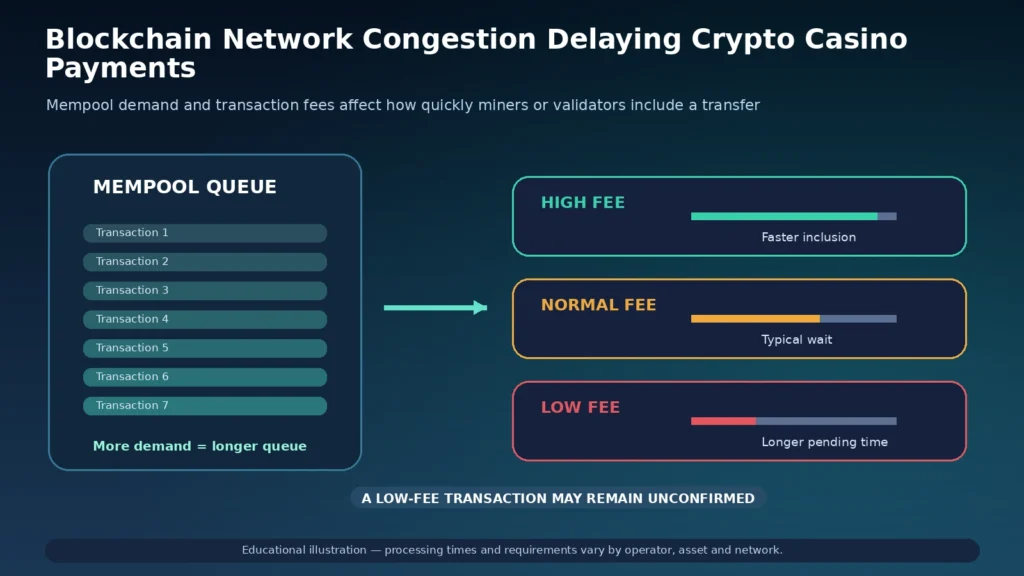
8. The transaction was sent with a low network fee
Once a valid TXID exists, a low fee can delay confirmation.
Bitcoin miners choose transactions partly according to fee rates and current demand for block space. When demand rises, lower-fee transactions may wait while higher-fee transactions are confirmed first.
Ethereum uses a base fee and priority-fee structure. A transaction whose maximum fee is too low for current conditions may remain pending until fees fall or the sender replaces it.
The key limitation is that the casino normally controls the sending wallet. The player generally cannot replace the transaction because they did not sign or broadcast it.
Ask the casino or payment processor whether it can:
- Increase the fee.
- Replace the transaction.
- Rebroadcast it.
- Confirm that the transaction has not been dropped or superseded.
9. The wrong network, address or memo was used
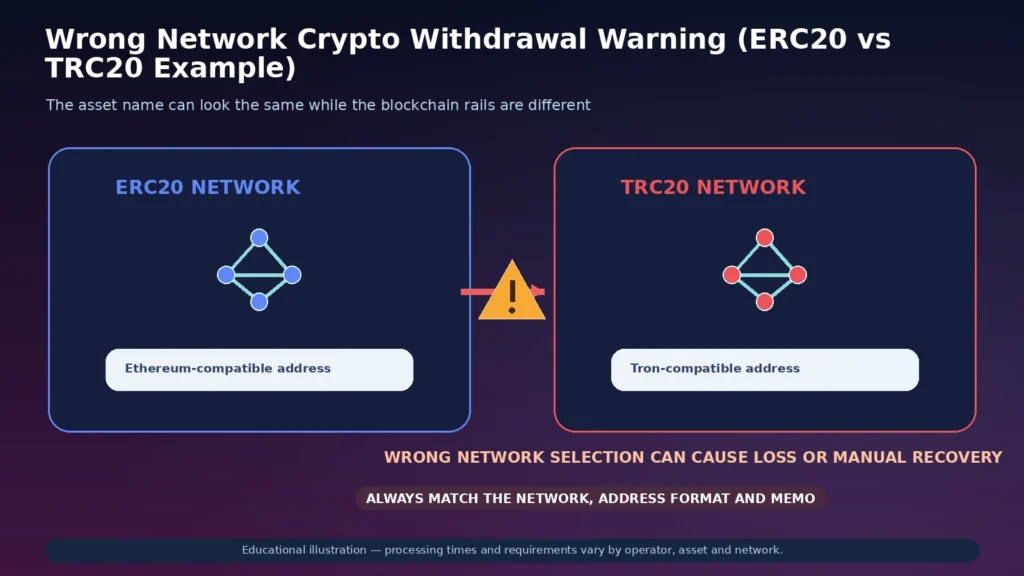
Cryptocurrencies with the same name can exist on different networks.
USDT, for example, may be transferred through Ethereum, Tron and other blockchains. An ERC20 address and a TRC20 address are not interchangeable simply because both represent USDT.
Some assets also require a destination tag or memo to identify the individual account behind a shared receiving address. Coinbase explains that an incorrect or missing memo can prevent funds from being credited to the intended account, while Kraken identifies unsupported networks and missing tags as common causes of missing deposits.
Before approving a withdrawal, verify:
- Cryptocurrency.
- Blockchain network.
- Complete destination address.
- Memo, tag or payment identifier.
- Whether the wallet supports that exact asset on that exact network.
- Whether the withdrawal amount exceeds the receiving wallet’s minimum.
Cryptocurrency transfers are generally irreversible. The FTC warns that crypto payments usually cannot be reversed unless the recipient voluntarily returns the funds.
10. The blockchain confirms the transfer, but the receiving platform holds it
A confirmed transaction does not always mean the balance will immediately become spendable.
An exchange or custodial wallet may delay credit because of:
- Its required number of confirmations.
- A missing memo.
- An unsupported network.
- Account verification.
- A travel-rule or sender-information request.
- A compliance review involving the sending address.
- Temporary deposit maintenance.
- A deposit minimum.
When the explorer shows the correct receiving address and sufficient confirmations, contact the receiving wallet or exchange, not only the casino.
Provide:
- TXID.
- Asset and network.
- Exact amount.
- Receiving address.
- Memo or destination tag.
- Confirmation count.
- Screenshot of the casino’s completed-withdrawal record.
Do not invent sender details to force a compliance form through. Provide accurate information and allow the receiving platform to review it.
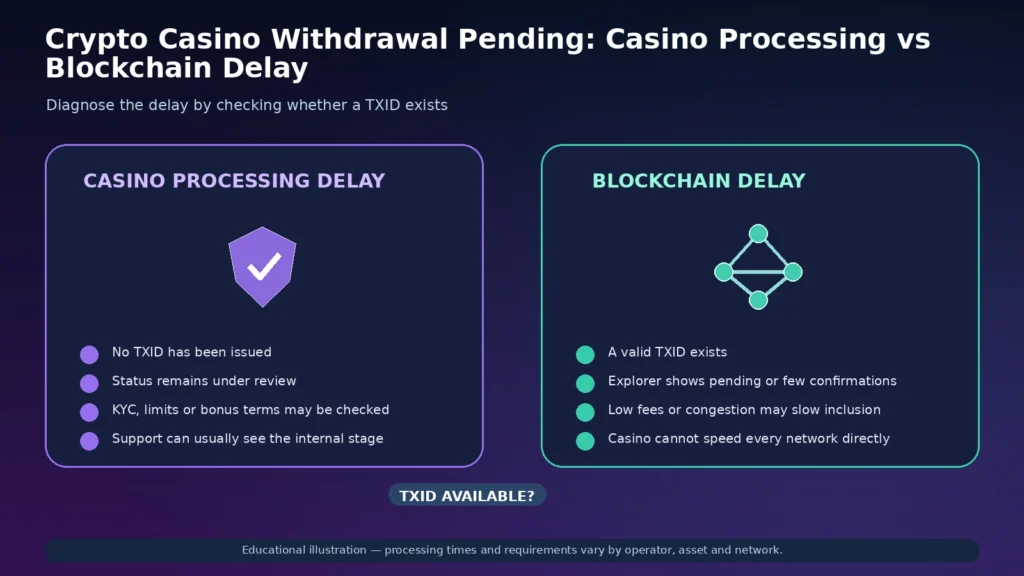
Casino processing delay versus blockchain delay
The two are easy to separate when the correct evidence is available.
Signs that the casino is still processing the withdrawal
- No TXID exists.
- The status says pending, requested or under review.
- Support mentions KYC, bonus verification or finance approval.
- The withdrawal can still be canceled.
- The funds have returned to the casino balance.
- The casino has not identified a blockchain network or transaction hash.
Signs that the delay is on-chain
- A valid TXID appears in the appropriate explorer.
- The destination address is correct.
- The transaction has zero or few confirmations.
- The transaction fee is low relative to current network conditions.
- The explorer identifies the transaction as pending, queued or replaced.
Signs that the receiving wallet is responsible
- The TXID has the required confirmations.
- The explorer shows the correct destination address and amount.
- The casino marks the withdrawal as completed.
- The receiving wallet has not credited the deposit.
- The wallet is requesting a memo, sender details or additional verification.
How long should a crypto casino withdrawal take?
There is no universal safe waiting time.
A useful estimate must separate:
- Casino review time.
- Time until broadcast.
- Blockchain confirmation time.
- Receiving-wallet crediting time.
Check the operator’s published complete withdrawal timeframe, not only a statement such as “funds arrive within ten minutes after approval.”
Bitcoin documentation states that a sufficiently funded transaction averages about ten minutes for its first confirmation, but actual timing can vary widely. Multiple confirmations require additional blocks.
Other networks may create blocks more frequently, but a fast blockchain does not remove casino review, KYC, bonus or receiving-wallet delays.
Use the following evidence-based thresholds rather than a universal number:
| Situation | Reasonable response |
| Still within the casino’s published processing period | Monitor the status and prepare transaction details |
| Published period has passed with a specific, documented review underway | Complete the requested action and obtain the next review date |
| Published period has passed with no explanation | Request escalation and a written reason |
| Casino says “sent” but provides no transaction evidence | Request the TXID, network and destination address |
| TXID is visible but unconfirmed | Monitor the explorer and ask the sender about fee replacement |
| TXID is confirmed but wallet balance is missing | Contact the receiving wallet or exchange |
| Support keeps changing its explanation | Preserve evidence and use the formal complaint process |
What to do when a crypto casino withdrawal is pending
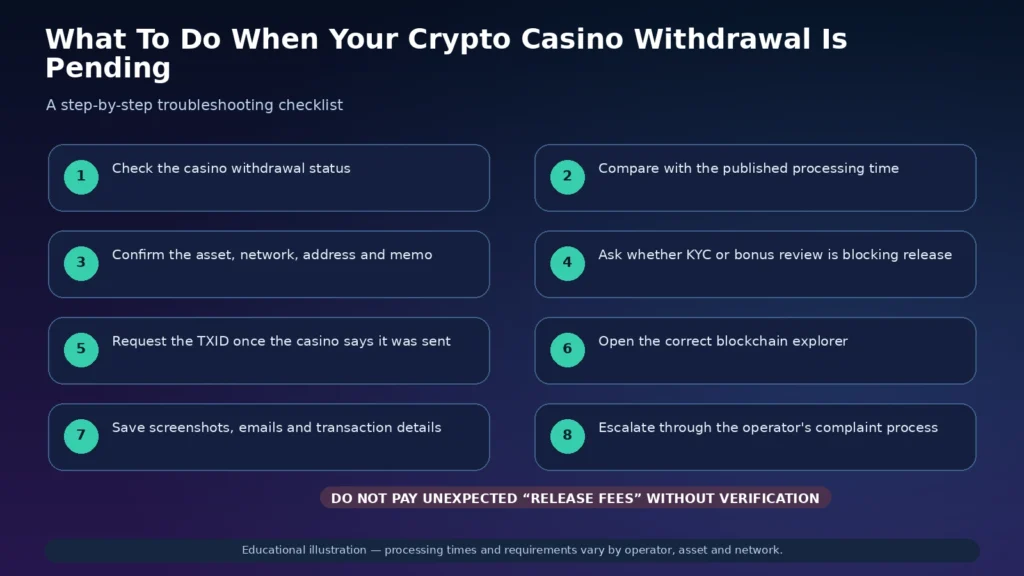
Step 1: Do not deposit more money
Do not send another deposit to “unlock,” “verify” or “speed up” a pending withdrawal unless that requirement was clearly documented before the original transaction and has been independently verified as legitimate.
Also avoid continuing to wager the balance while the issue is unresolved. Playing with funds returned from a canceled withdrawal can complicate bonus and balance records.
Step 2: Record the withdrawal details
Save:
- Casino name and website address.
- Account username or reference number.
- Withdrawal request ID.
- Date and exact time.
- Cryptocurrency and network.
- Amount requested.
- Destination address.
- Memo or tag.
- Current status.
- Published processing estimate.
- Relevant bonus and payment terms.
Take screenshots that show dates and full status information rather than cropped balance figures alone.
Step 3: Check the account for required actions
Review:
- Verification center.
- Email and spam folders.
- Bonus dashboard.
- Wagering-progress display.
- Withdrawal-limit page.
- Security notifications.
- Internal support messages.
Look for a specific unresolved action rather than assuming the blockchain is slow.
Step 4: Confirm the address and network
Compare the withdrawal record with the receiving wallet.
Verify the first and last characters of the address, but do not rely only on those characters when malware or clipboard replacement is a concern. Use the wallet’s copy function or QR code and inspect the full destination before a future withdrawal.
Confirm that the selected network is accepted by both sides.
For stablecoin-specific network information, the USDT casino guide explains why ERC20 and TRC20 transfers must not be mixed.
Step 5: Request the TXID
Use a direct question:
“Has this withdrawal been broadcast to the blockchain? If it has, please provide the complete TXID, cryptocurrency network and destination address used.”
A generic “processed” or “completed” message is not equivalent to independently verifiable transaction evidence.
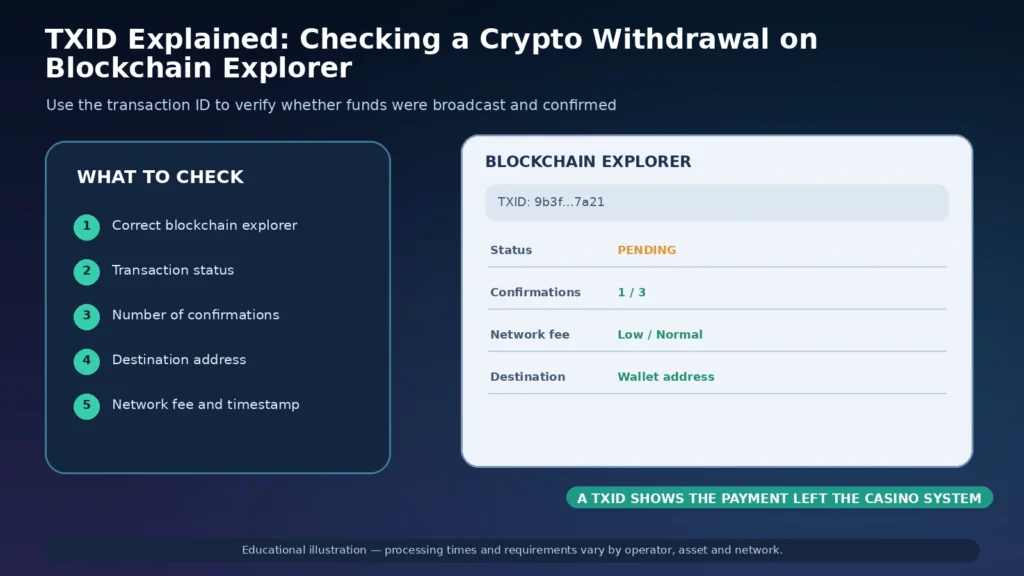
Step 6: Check the appropriate blockchain explorer
Search the TXID on an explorer designed for the correct network.
Check:
- Whether the transaction exists.
- Whether it is pending or confirmed.
- Confirmation count.
- Destination address.
- Amount.
- Network fee.
- Whether it was replaced, failed or dropped.
Do not paste a private key or seed phrase into an explorer. A legitimate explorer needs only public information such as a transaction hash or wallet address.
Step 7: Contact support with complete evidence
A precise support request is easier to investigate than repeated messages saying only that the withdrawal is missing.
Support-message template
Hello, I requested a withdrawal of [amount and cryptocurrency] on [date and time] using the [network] network.
The withdrawal reference is [request ID], and the destination address ends in [last six characters]. The current status is [status], which has remained unchanged for [time].
Please confirm:
- Whether the withdrawal is awaiting account, bonus, KYC or security review.
- Whether any action is required from me.
- The estimated date or time of the next update.
- The TXID if the payment has already been broadcast.
I have attached the withdrawal record and relevant confirmation details.
Keep communication in one ticket where possible so the full history remains visible.
Step 8: Use the formal complaint process when necessary
When the casino’s stated timeframe has passed and ordinary support has not resolved the case:
- Request escalation to the payments or compliance team.
- Ask for the operator’s final written position.
- Locate the formal complaints procedure in the terms.
- Verify the named licensing authority independently.
- Use the regulator or dispute service identified by the license, where available.
- Preserve the original terms, transaction history and support correspondence.
A license logo in a website footer is not sufficient verification. Confirm the operator and domain through the regulator’s own records.
For U.S. state-regulated gambling, complaints should be directed to the appropriate state regulator. Offshore casinos may provide different and sometimes more limited dispute options.
Step 9: Watch for recovery scams
People reporting a stuck withdrawal are sometimes approached by individuals claiming they can recover the funds, contact a blockchain miner or hack the casino.
The FTC warns that refund and recovery scammers commonly target people who have already lost or cannot access money, often asking for an upfront payment.
Never provide:
- Wallet seed phrase.
- Private key.
- Remote access to a device.
- Two-factor-authentication code.
- Password.
- An additional crypto payment for an unofficial recovery service.
Can a pending blockchain transaction be accelerated?
Sometimes—but control of the sending wallet matters.
Replace-by-Fee
Bitcoin’s Replace-by-Fee mechanism allows the sender of an eligible unconfirmed transaction to replace it with a version that pays a higher fee. Bitcoin Core describes RBF as a way for the spender to increase the transaction fee.
For a casino withdrawal, the casino or payment processor is normally the spender. The player generally cannot use RBF unless the player controls the sending wallet, which is unusual in this situation.
Ask support whether the sender can fee-bump or replace the transaction.
Child Pays for Parent
Child Pays for Parent, or CPFP, uses a new transaction with a sufficiently high fee to encourage confirmation of an unconfirmed parent transaction. Bitcoin Core notes that CPFP can allow a recipient to increase the effective fee, while RBF is controlled by the spender.
CPFP is not a universal solution. It may require:
- A spendable unconfirmed output.
- A compatible receiving wallet.
- Suitable transaction structure.
- Enough additional funds to pay the fee.
- Network policies that accept the transaction package.
It is an advanced wallet operation and should not be attempted without understanding the consequences.
Ethereum fee replacement
An unconfirmed Ethereum transaction may sometimes be replaced by the sending wallet using the same account nonce and a higher fee. Again, this normally requires action from the casino or its payment processor because it controls the sending account.
Transaction accelerators
Be cautious with third-party “accelerators.” They cannot guarantee confirmation, and fraudulent services may charge for an action they cannot perform.
Do not share private keys or pay an unknown individual who contacts you after a public complaint.
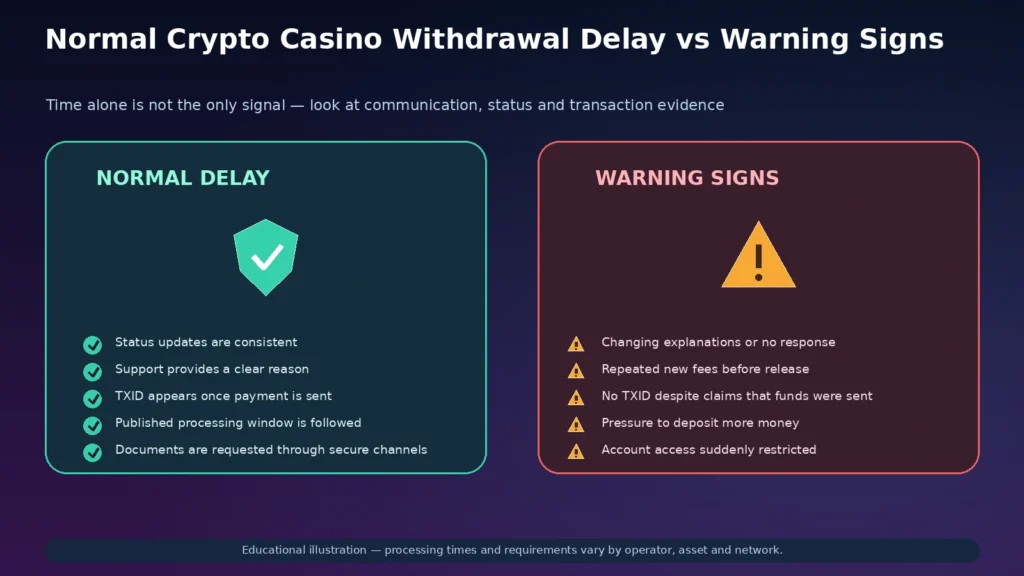
Normal delay or warning sign?
| More consistent with a normal delay | More concerning warning sign |
| The request is still within a clearly published processing window | The published timeframe passed with no specific explanation |
| The casino requests a defined document through its official verification portal | Support repeatedly requests new documents without explaining why earlier documents failed |
| A valid TXID is visible and waiting for confirmations | The casino claims the payment was sent but will not provide a TXID |
| A published withdrawal limit causes installment payments | A limit is introduced only after the withdrawal request |
| A scheduled maintenance notice identifies the affected network | “Maintenance” is repeatedly cited without a status notice or restoration estimate |
| Support gives a case number and next-update date | Support changes the reason each time it is contacted |
| A bonus review points to a specific term | The casino cannot identify the rule allegedly violated |
| The receiving exchange confirms a compliance review | An unofficial agent asks for a fee, private key or additional casino deposit |
| The withdrawal remains locked while it is investigated | The withdrawal is repeatedly canceled so the balance can be wagered again |
A pending status alone does not prove fraud. The concern increases when the operator cannot produce consistent evidence, identify a relevant term or provide a usable complaint route.
How to reduce withdrawal delays before depositing
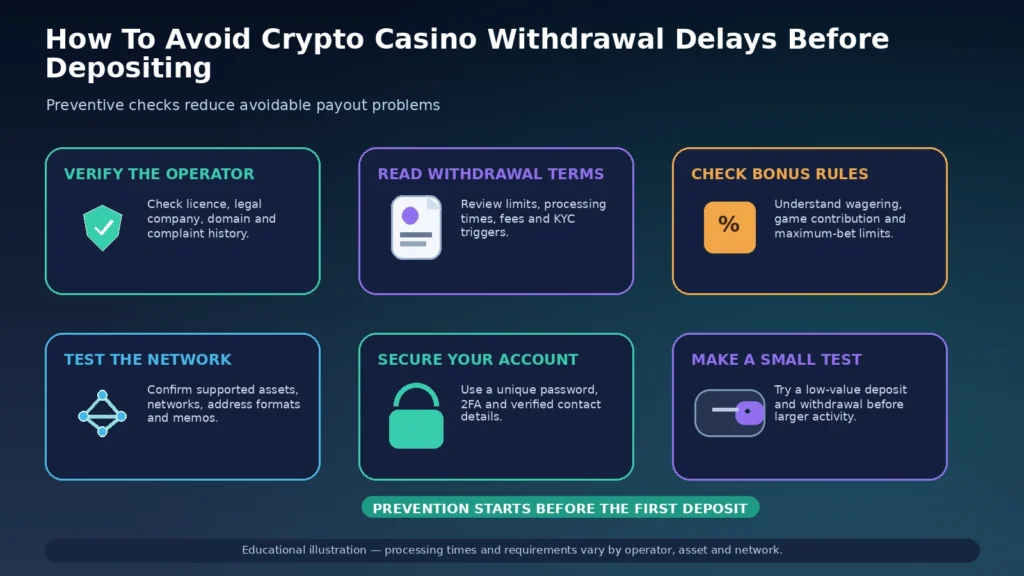
Read the withdrawal policy first
Check:
- Minimum and maximum withdrawals.
- Daily and weekly limits.
- Processing time.
- Supported networks.
- KYC policy.
- Bonus restrictions.
- Fees.
- Restricted locations.
- Complaint process.
Screenshots of current terms can be useful because promotions and payment rules may change.
Verify legal availability
Online casino law is state-specific in the United States. The American Gaming Association’s 2026 report says seven states operated lawful online casino markets during 2025. Offshore access is not equivalent to authorization by one of those state systems.
Before using a platform:
- Check the relevant state gaming regulator.
- Verify the operator list.
- Read restricted-state rules.
- Do not use false information or disguise location.
- Confirm the minimum legal gambling age in the jurisdiction.
The crypto casino USA guide can provide broader market context, but official state sources should determine legal authorization.
Understand KYC before sending funds
Determine whether verification occurs:
- At registration.
- Before the first deposit.
- At the first withdrawal.
- Above a threshold.
- Only when risk indicators appear.
- At the operator’s discretion.
Completing verification early may reduce delays at a trusted, regulated operator. However, uploading sensitive documents to an unverified offshore website creates its own privacy and identity-theft risk. Confirm the operator and secure submission method first.
Avoid claiming a bonus automatically
A bonus is not automatically beneficial.
Read:
- Wagering basis.
- Maximum bet.
- Game contribution.
- Maximum cashout.
- Expiry.
- Withdrawal restrictions.
- Whether cash and bonus funds are separated.
Decline the promotion when its conditions are not understood or do not fit the planned play.
Send a small test withdrawal
A successful small withdrawal can verify:
- The address format.
- The selected network.
- The casino’s processing flow.
- Whether KYC appears at withdrawal.
- Whether the receiving wallet accepts the funds.
It does not guarantee that a later large withdrawal will receive identical treatment, but it can identify basic technical problems before more money is exposed.
Use a compatible receiving wallet
Confirm the wallet supports the exact asset and network.
When withdrawing to an exchange, review the exchange’s policies on gambling-related transfers and sender-information requirements. Using a personal wallet between a casino and exchange may provide greater transaction control, but it must not be used to conceal information, evade restrictions or misrepresent the source of funds.
Keep accurate transaction records
Save:
- Deposits.
- Withdrawals.
- TXIDs.
- Wallet addresses.
- Cryptocurrency values.
- Bonus records.
- Account statements.
- Relevant tax records.
Public blockchain data does not replace personal documentation showing the reason for and ownership of a transaction.
Important U.S. consumer-protection context
Cryptocurrency can reduce traditional bank-processing delays, but it also removes many conventional payment protections.
The FTC notes that crypto transfers generally cannot be reversed and do not offer the same dispute protections as credit and debit cards.
That makes pre-deposit checks especially important:
- Verify the operator.
- Confirm legal availability.
- Check the withdrawal policy.
- Test the payment route.
- Avoid sending more money while a payout is unresolved.
- Keep complete records.
Gambling should be treated as paid entertainment, not as an income source or way to recover losses. Anyone concerned about their gambling can contact the U.S. National Problem Gambling Helpline by calling or texting 1-800-MY-RESET. The service connects people across all U.S. states and territories with local support resources.
Key takeaways
- A pending crypto casino withdrawal can be delayed before or after blockchain broadcast.
- No TXID normally means the payment is still being handled by the casino or payment processor.
- A valid TXID allows the transaction to be checked independently.
- KYC, bonus wagering, maximum-bet rules, limits and security reviews can all delay approval.
- Blockchain congestion matters only after the transaction has been broadcast.
- The player normally cannot use RBF on a casino withdrawal because the casino controls the sending wallet.
- A confirmed transaction can still be delayed by a receiving exchange, missing memo or unsupported network.
- Do not deposit more money to release a pending payment.
- Save the terms, withdrawal record, TXID and all support communication.
- A delay becomes more concerning when explanations change, evidence is withheld or new conditions appear after the request.
Conclusion
The correct response to a pending crypto casino withdrawal is not to guess how many hours it “should” take. First identify the delayed stage.
Start with the TXID:
- No TXID: investigate the casino’s processing, KYC, bonus and withdrawal rules.
- Unconfirmed TXID: investigate the network fee and ask the sender about replacement.
- Confirmed TXID: investigate the receiving wallet, network, address and memo.
Do not continue depositing or wagering while the issue is unresolved. Collect the transaction evidence, ask support precise questions and use the operator’s formal complaint process when its published timeframe has passed without a clear resolution.
FAQs
A withdrawal with no standard on-chain TXID is usually still inside the casino’s approval or payment queue. It may be awaiting KYC, bonus review, a security check, batching or manual processing. Ask whether the transaction has been broadcast and request the TXID, network and estimated approval time.
Lightning payments and internal custodial transfers may use different identifiers, so confirm the selected payment method before assuming a conventional TXID should exist.
No. A temporary delay can result from account review, bonus rules, maintenance or blockchain confirmation. Concern increases when the casino exceeds its own timeframe, changes the explanation, refuses to provide transaction evidence or introduces rules that were not disclosed before the withdrawal.
Not directly. Blockchain congestion affects transactions that have been created and broadcast. When no public transaction exists, the delay is still at the casino or payment-processor stage. An operator may postpone broadcasting because fees are high, but that is an internal payment decision rather than an already-pending blockchain transaction.
It may, depending on its actual terms, license and risk policy. Some platforms use “no KYC” to mean no routine document upload at registration, while retaining a right to request verification for security, location, payment ownership or compliance reasons. Review the operator’s complete verification policy rather than relying only on a promotional label.
Only in limited circumstances. If the casino has not sent it, only the casino can release it. If it has sent an eligible unconfirmed Bitcoin transaction, the sender may be able to use Replace-by-Fee. The recipient may sometimes use CPFP, but only when the receiving wallet and transaction structure support it. Random paid accelerators should be treated cautiously.
Confirm that the explorer shows the correct destination address, asset, network and amount. Then check the receiving wallet’s confirmation requirement, minimum deposit, memo requirement and supported networks. If everything matches, contact the receiving wallet or exchange with the TXID and confirmation count.
A casino may reject or modify a withdrawal when its published bonus rules have not been satisfied. Common issues include incomplete wagering, a maximum-bet violation, an excluded game or a maximum-cashout limit. Ask the casino to identify the exact term and transaction involved. A rule created or disclosed only after the withdrawal is a serious transparency concern.
Generally, no. Do not send another deposit merely because an agent claims it will release a pending payout. Verify any requirement against the terms that applied before the original transaction and communicate only through official support. Requests for an additional payment, “tax,” recovery charge or wallet-unlocking fee are common scam indicators.