

The Aviator game is a multiplayer crash game built around one decision: cash out before the rising multiplier stops. A round begins at or near 1.00x, the multiplier increases as the virtual plane travels across the screen, and any active bet is lost when the plane flies away. Cashing out before that point returns the stake multiplied by the displayed value.
The game is simple to operate but impossible to predict reliably. Previous crash points, other players’ bets and visual patterns do not reveal what will happen in the next round. Smart play therefore means controlling the stake, choosing a cashout target in advance and stopping at a predetermined limit – not trying to decode the flight history.
SPRIBE describes Aviator as a social multiplayer game with an increasing curve that can end at any time. Its official explanation confirms that the objective is to cash out before the plane flies away.
US gambling notice: Real-money online casino laws and game availability differ by state. Cryptocurrency does not make an otherwise unlawful gambling activity legal. Check the relevant state regulator and operator terms before depositing.
Aviator game quick facts
| Feature | Typical Aviator format |
| Developer | SPRIBE |
| Game type | Multiplayer crash game |
| Main objective | Cash out before the multiplier ends |
| Starting multiplier | Approximately 1.00x |
| Commonly listed RTP | 97% |
| Theoretical house edge | 3% |
| Cashout options | Manual and automatic |
| Simultaneous bets | Commonly two betting panels |
| Social features | Live bets, chat and recent results |
| Fairness model | Provably fair cryptographic system |
| Guaranteed strategy | None |
| Demo availability | Depends on casino or provider access |
Independent game references consistently list Aviator with a 97% RTP, while SPRIBE’s public game page focuses on the mechanics rather than publishing the percentage. The safest approach is to verify the RTP in the game’s own information panel.
What is the Aviator game?
Aviator belongs to the crash-game category. Instead of spinning reels or drawing cards, players watch a multiplier rise in real time.
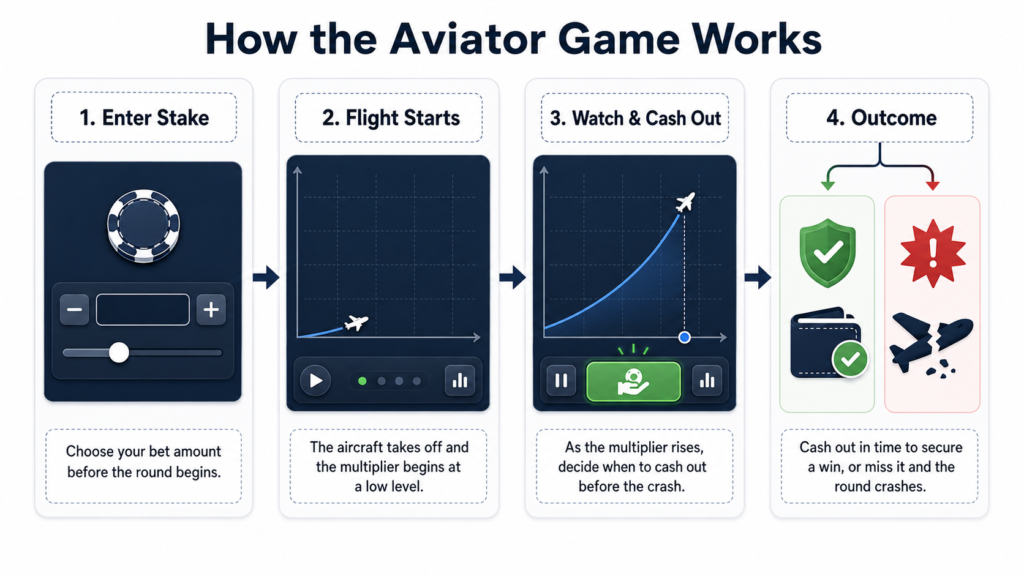
A typical round works like this:
- A betting window opens.
- The player enters a stake.
- The round starts and the multiplier rises.
- The player may cash out at any point.
- If the plane disappears first, the active bet is lost.
The outcome is not based on how quickly other players react. Everyone sees the same round, but each person chooses an individual cashout point.
The social interface can make the game feel communal. Live bets, chat messages and large wins may appear alongside the main game. They can be entertaining, but they do not provide advance knowledge of the next crash point.
Readers comparing Aviator with other crypto casino games can use the broader game guide to understand how crash titles differ from slots, table games and live-dealer products. Aviator is already discussed there as a provably fair crash option.
Understanding the Aviator interface
The precise layout can vary slightly between casinos, but current versions and published guides commonly show the following areas.
Multiplier display
The center of the screen shows the virtual plane and the multiplier. The number begins close to 1.00x and rises until the round ends.
Betting panels
Aviator commonly provides two betting panels. Each panel can hold a separate stake and cashout instruction.
Using two bets does not improve the underlying odds. It simply allows two positions in the same round and can double the total money exposed.
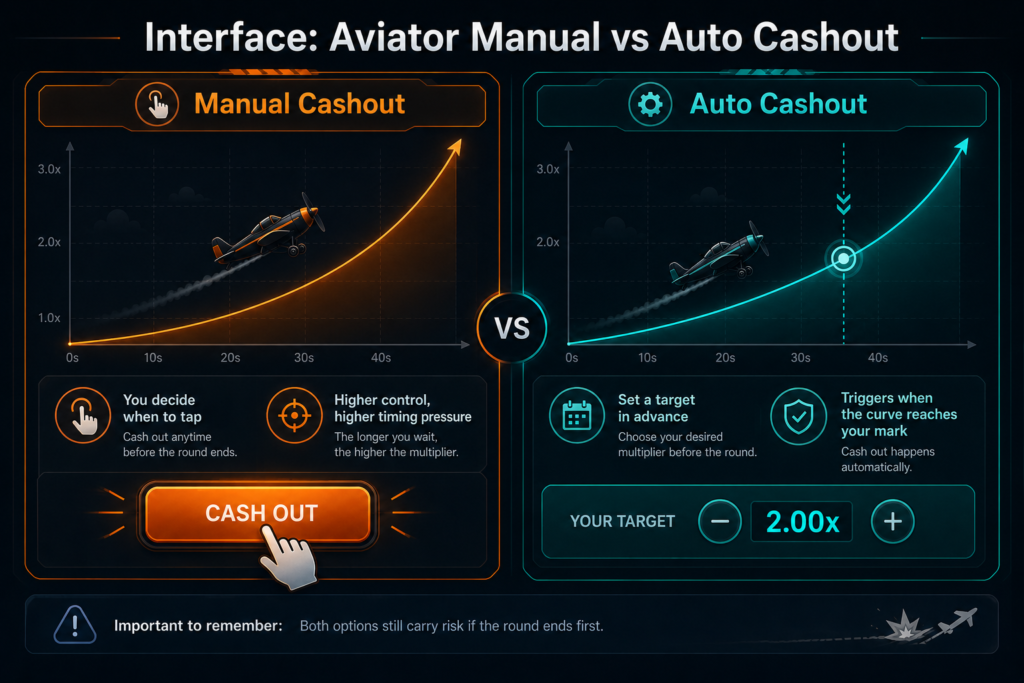
Manual cashout
Manual mode requires the player to press the cashout button before the plane flies away.
The advantage is control. The limitation is that hesitation, distraction or connection delays can prevent the intended action.
Automatic cashout
Auto cashout allows a target multiplier to be selected before the round.
For example, setting auto cashout at 1.50x means the system attempts to settle the bet when the multiplier reaches 1.50x. If the round ends at 1.49x or below, the bet loses.
Auto cashout reduces the need for a split-second manual decision. It does not improve RTP or make the target more likely.
Recent-results bar
The history bar displays previous crash multipliers.
It is useful as a record of what happened, but not as a forecast. A sequence of low results does not make a high result “due.”
Live bet list and chat
The live list shows other players’ stakes and successful cashouts. Chat adds a social element.
Neither feature should be treated as a strategy tool. Another player may use a different budget, target or risk tolerance, and their cashout cannot alter the round.
How to play the Aviator game step by step
1. Open the information panel
Before placing a bet, check:
- RTP
- Minimum and maximum stake
- Maximum payout
- Auto-play settings
- Cashout rules
- Provably fair information
These details can vary by casino even when the underlying game is the same.
2. Use demo mode first
A demo helps identify the bet controls, cashout button and speed of the multiplier without risking deposited funds.
Demo results should not be treated as evidence of future real-money performance.
3. Set the stake
Choose an amount that can be lost in full. A round can end before a preferred cashout value is reached.
4. Select manual or automatic cashout
Manual mode offers active control. Automatic mode follows a predetermined multiplier if that point is reached.
Beginners may find auto cashout useful for enforcing a plan, but technical or operator-specific terms should still be reviewed.
5. Place the bet during the betting window
Once the window closes, new bets cannot normally be added to that round.
6. Watch the multiplier
The multiplier increases while the plane remains on screen.
7. Cash out
In manual mode, press the button before the round ends. In auto mode, the game attempts to cash out at the selected target.
8. Review the round
Check whether the result and settlement match the game history. Where a fairness verifier is available, review the round data periodically.
9. Stop at the session limit
End the session when the planned loss, time or spending limit is reached. A new round is not more favorable because the previous one lost.
How Aviator payouts work
A successful payout is calculated as:
Stake × cashout multiplier = total return
For example:
| Stake | Cashout point | Total return | Net result |
| $1 | 1.20x | $1.20 | $0.20 profit |
| $2 | 1.50x | $3.00 | $1.00 profit |
| $5 | 2.00x | $10.00 | $5.00 profit |
| $5 | Crash before cashout | $0 | $5.00 loss |
The “total return” includes the original stake. A $5 bet cashed at 2.00x returns $10 in total, not $10 of profit plus the original $5.
A higher multiplier produces a larger successful payout but has a lower probability of being reached. There is no cashout target that simultaneously offers high frequency and high payout.
What does the Aviator RTP mean?
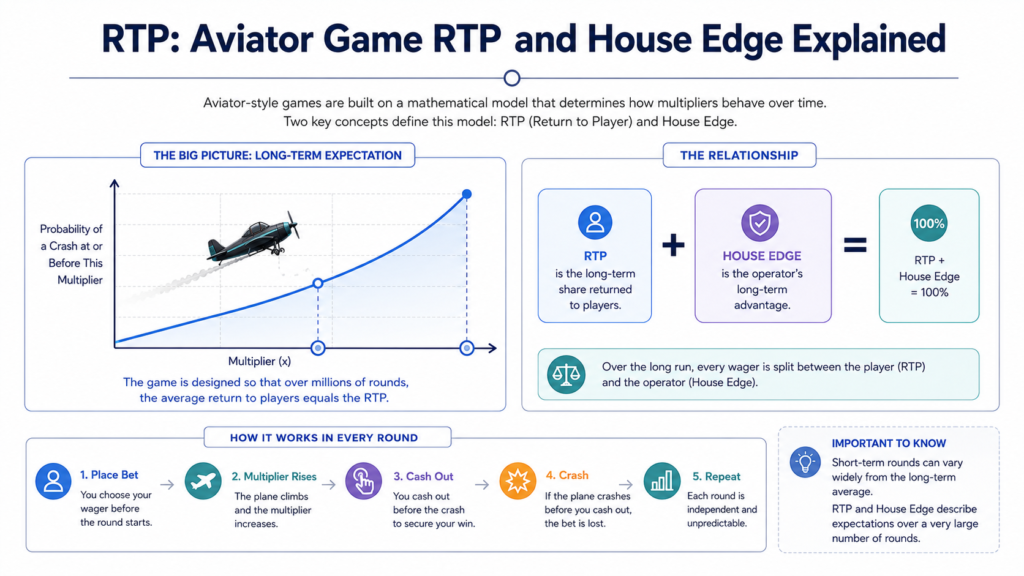
Aviator is widely listed with a 97% return to player, corresponding to a theoretical 3% house edge. This means that across an extremely large volume of wagers under the stated mathematical configuration, the game is designed to return about 97% of money wagered and retain about 3%. It does not mean that an individual who wagers $100 will receive $97.
The calculation is:
House edge = 100% − RTP
Therefore:
100% − 97% = 3% theoretical house edge
Short sessions can finish with a profit or a complete loss. RTP describes the long-run model, not a guaranteed session result.
Does a lower cashout target improve the RTP?
No. A lower target normally increases the proportion of rounds that reach the cashout point, but each successful return is smaller.
A higher target produces fewer successful cashouts but larger returns when reached.
The payout distribution changes, but the house edge remains built into the game.
Illustrative cashout probability model
In a simplified crash model calibrated to 97% RTP, the approximate probability of reaching a target may be represented as:
Approximate reach probability = 0.97 ÷ target multiplier
This is an educational model, not official SPRIBE documentation. Actual results may be affected by rounding, instant-crash rules and the game’s precise algorithm.
| Cashout target | Illustrative probability of reaching target |
| 1.20x | 80.83% |
| 1.50x | 64.67% |
| 2.00x | 48.50% |
| 3.00x | 32.33% |
| 5.00x | 19.40% |
| 10.00x | 9.70% |
The table explains the trade-off:
- Low target: more frequent small returns.
- High target: less frequent larger returns.
- Neither target removes the expected loss created by the house edge.
What is the best Aviator cashout multiplier?
There is no mathematically superior cashout multiplier that turns Aviator into a positive-expectation game.
A suitable target depends on the amount of volatility a player accepts:
| Playing preference | Illustrative target range | Main trade-off |
| Lower volatility | 1.20x–1.50x | More frequent returns, small profit per successful round |
| Moderate volatility | 1.50x–2.00x | Balanced frequency and payout size |
| Higher volatility | 3.00x or more | Long losing runs and occasional larger returns |
These ranges are not recommendations or profit systems. They simply describe different risk profiles.
The most disciplined target is the one selected before the round begins and followed consistently within a fixed entertainment budget.
Beginner strategies that support smarter play
No strategy can identify the crash point. The useful approaches below focus on controlling exposure and behavior.
Start with one small bet
A single low stake is easier to track than two simultaneous bets.
Using both betting panels immediately can make the interface feel more complex and may double the loss when a round ends early.
Choose the cashout target before betting
A preselected target removes the temptation to keep waiting because the plane “looks strong.”
For example:
Stake $1, auto cashout at 1.50x, maximum 20 rounds.
The plan still has negative long-run expectation, but its cost and duration are defined.
Use auto cashout to enforce – not optimize the plan
Auto cashout may reduce hesitation and emotional decision-making.
It should not be described as an algorithm that finds the best exit. It simply follows the number selected by the player.
Keep the stake fixed
Flat betting makes the session easier to measure.
Changing from $1 to $5 after a loss does not make the next round more favorable. It only places more money at risk.
Set a maximum number of rounds
Crash games move quickly. A round limit helps prevent an intended 10-minute session from becoming an open-ended one.
Separate the casino balance from the session budget
A larger account balance is not permission to risk all available funds.
Decide how much of the balance belongs to the current session and stop when that amount is gone.
Does a two-bet strategy work?
A common approach uses Aviator’s two betting panels:
- Bet one has a low auto-cashout target.
- Bet two remains active for a higher target.
For example:
- $1 at 1.50x
- $1 at 5.00x
This may feel balanced because the first position aims for frequent smaller returns while the second targets a larger result. However, it places $2 rather than $1 at risk in every round.
If both bets fail, the loss is doubled. If the first succeeds and the second fails, the return may still be below the total amount wagered.
Example:
- Total staked: $2
- First bet cashes at 1.50x: $1.50 returned
- Second bet loses: $0 returned
- Total returned: $1.50
- Net result: $0.50 loss
Dual betting changes the shape of the result. It does not create an edge.
Aviator strategies that do not work
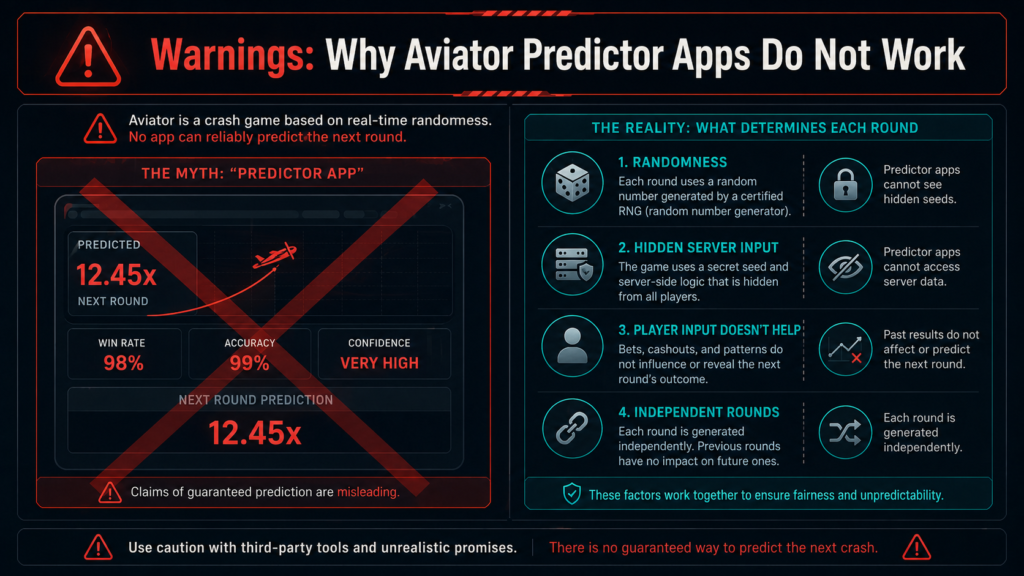
Reading patterns in previous multipliers
The history bar records previous rounds. It does not signal the next one.
Claims such as “five low multipliers mean a high flight is coming” are examples of the gambler’s fallacy.
Some competitor guides incorrectly suggest using previous results or other players’ behavior to estimate future crashes. More careful references correctly state that previous results do not predict independent future rounds.
Following other players’ cashouts
Other players cannot see the future crash point.
A large group cashing out at 1.50x does not make that target safe, and a leaderboard result does not establish a repeatable strategy.
Martingale betting
Martingale doubles the stake after each loss.
A progression starting at $1 becomes:
- $1
- $2
- $4
- $8
- $16
- $32
After six consecutive losses, $63 has been staked. The next required bet would be $64.
Martingale does not change the probability distribution. It magnifies the financial consequences of an ordinary losing sequence and eventually meets a bankroll or table limit.
Increasing the target after a loss
A failed 2.00x target does not make 5.00x more likely in the next round.
Increasing both the stake and target compounds risk rather than recovering it mathematically.
Aviator predictors and signal groups
Third-party apps, Telegram groups and websites may claim to predict future crash points.
SPRIBE describes Aviator as using provably fair cryptographic technology, meaning the outcome is generated through a process designed to be verifiable rather than publicly predictable in advance. A tool that could reliably reveal future results would undermine that system.
Avoid tools that ask for:
- Casino login credentials
- Wallet seed phrases
- Remote device access
- Upfront “activation” payments
- APK installation from unknown sources
- Guaranteed-profit subscriptions
How provably fair Aviator works
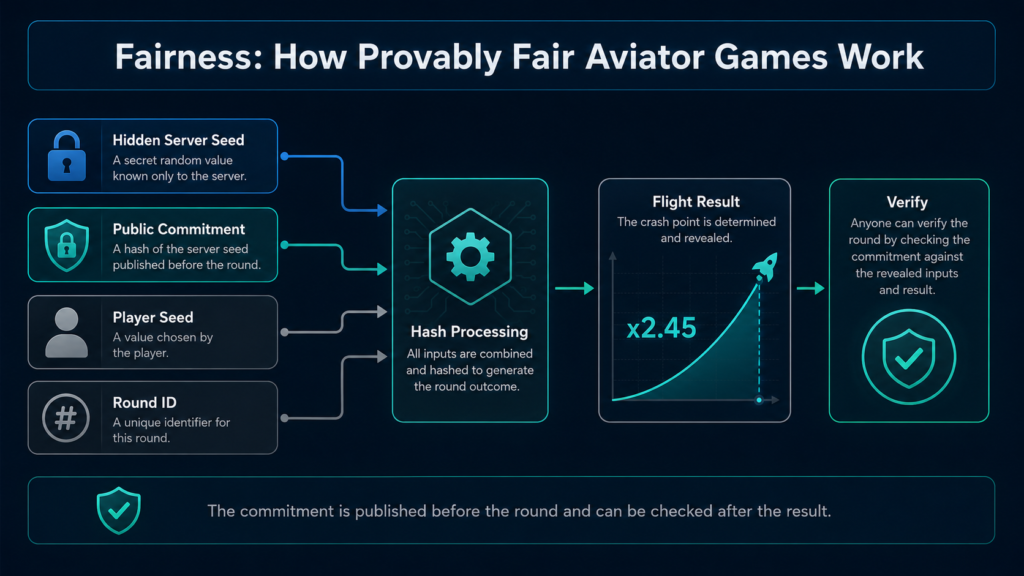
SPRIBE states that its games use cryptographic provably fair technology intended to prevent third-party interference with results.
The exact implementation should be checked in the game documentation, but a provably fair system commonly uses:
- A hidden server value.
- A cryptographic commitment or hash.
- Player-related inputs.
- A round identifier or nonce.
- A published method for reproducing or checking the result.
After the necessary data is revealed, the player can verify that the result matches the earlier commitment.
What provably fair proves
It can help establish that:
- The result corresponds to the committed cryptographic inputs.
- The operator did not simply change the result after seeing active bets.
- The published verification process reproduces the displayed outcome.
What it does not prove
Provably fair does not establish that:
- The casino is legally available in a particular state.
- The operator will process every withdrawal quickly.
- Bonus terms are reasonable.
- The game is profitable.
- A strategy can predict the next crash.
- Account verification will never be requested.
- The RTP is 100%.
Game fairness, casino licensing, account security and payment reliability are separate checks.
Aviator demo versus real-money play
A demo is the appropriate place to learn:
- How quickly the multiplier moves.
- Where the cashout button appears.
- How to configure auto cashout.
- How two betting panels operate.
- How the recent-results and live-bet areas are displayed.
- Whether the interface works comfortably on a mobile screen.
A demo cannot show whether a system is profitable. A favorable run reflects short-term variance, not developed skill.
When real money is introduced, the financial consequences change immediately. Set a session budget before depositing and assume that the entire amount could be lost.
How to choose an online casino offering Aviator
A casino should not be selected only because Aviator appears in its lobby.
Verify access from the player’s location
The site should clearly state its restricted countries and states.
US readers comparing a crypto casino USA should still confirm their own state law and whether the operator is domestically authorized or based offshore.
Confirm that it is the SPRIBE game
Look for the correct provider name rather than assuming every airplane-themed crash game is Aviator.
Check the RTP inside the game
Do not rely only on a review page. Open the help or rules panel and verify the displayed figure.
Review withdrawal conditions
Before depositing, check:
- Minimum withdrawal
- Maximum daily or monthly withdrawal
- Pending period
- Cryptocurrency network fees
- Required confirmations
- Account-verification triggers
- Bonus-related maximum cashout
- Restricted payment methods
Readers comparing instant withdrawal crypto casinos should distinguish fast blockchain settlement from the casino’s internal approval time. A transaction cannot reach the network until the operator releases it.
Evaluate the casino, not just the game
The site’s guide to the best crypto casinos includes Aviator among the games discussed, but any commercial comparison should still be checked against current licensing, withdrawal and account terms before registration.
Can US players play Aviator for real money?
Online casino gambling in the United States is regulated at state level.
The American Gaming Association’s 2026 report states that seven states operated lawful online casino markets during 2025. Even in those jurisdictions, an individual game must be approved and included in a licensed operator’s library.
Before playing:
- Check the state gaming regulator.
- Confirm that online casino gaming – not only sports betting is legal.
- Use the regulator’s authorized-operator list.
- Search the operator’s game library for SPRIBE Aviator.
- Confirm age and geolocation requirements.
- Do not use a VPN to bypass restrictions.
An offshore casino accepting a registration does not mean it is regulated by the player’s state.
Are Aviator winnings taxable in the US?
The IRS states that gambling winnings must be reported, including winnings that are not reported on Form W-2G. Loss deductions are subject to recordkeeping and itemization rules.
Keep records of:
- Deposits
- Bets
- Cashouts
- Wins and losses
- Withdrawals
- Casino statements
- Cryptocurrency transaction IDs
- USD value of cryptocurrency when received or disposed of
Tax treatment can depend on individual circumstances. Consult a qualified tax professional for personalized advice.
Can Aviator be played on mobile?
Aviator is commonly accessed through a casino’s mobile website or application interface. The controls should adapt to smaller screens, but the quality of the experience depends on the operator’s implementation and the device.
Before using real money on mobile:
- Test the demo.
- Confirm the cashout button is easy to reach.
- Use a stable connection.
- Disable distracting notifications.
- Avoid playing while moving or multitasking.
- Check whether an interrupted connection affects automatic and manual cashouts differently.
Avoid downloading unrelated apps simply because they use the Aviator name.
Aviator versus Plinko, Mines and traditional slots

| Game | Main decision | Player interaction | Typical risk control |
| Aviator | When to cash out | One timed decision per bet | Cashout multiplier |
| Mines | How many tiles to reveal | Multiple decisions per round | Mine count and target tiles |
| Plinko | Risk level, rows and stake | Limited after ball release | Risk-mode selection |
| Slots | Stake and spin controls | Outcome mostly automated | Stake and session limits |
Aviator creates timing pressure. Mines creates repeated decisions. Plinko asks players to choose a payout distribution before the drop.
Readers considering a less timing-focused alternative can compare current crypto Plinko gambling sites, although Plinko also carries a house edge and cannot be made risk-free through settings.
Common Aviator mistakes beginners make
Betting before learning the interface
A missed cashout caused by confusion is avoidable. Use demo mode first.
Choosing the target during the flight
The rising multiplier creates pressure. Decide the target before the round.
Treating frequent small cashouts as guaranteed profit
A low target wins more often but can still be erased by several failed rounds.
Using two bets without calculating total exposure
Two $5 bets mean $10 is at risk, not $5.
Increasing stakes after losses
The next result does not compensate for the previous one.
Trusting the recent-results bar
The display is historical, not predictive.
Following chat signals
Other players do not know the next outcome.
Confusing provably fair with risk-free
A verifiable result can still lose.
Playing without a stopping point
Fast rounds make it easy to exceed the intended time or budget.
Practical Aviator checklist
Before a real-money session, confirm:
- The game is legal and available in the current location.
- The casino’s regulatory status is understood.
- The correct SPRIBE game is loaded.
- The displayed RTP has been checked.
- A demo has been used.
- The cashout controls are familiar.
- The session budget is fixed.
- The stake is affordable.
- The cashout target is selected in advance.
- Only one or two planned betting panels are active.
- A maximum number of rounds is set.
- Withdrawal and verification terms are understood.
- No predictor, signal or Martingale system is being used.
- A time and loss limit are active.
Responsible-gambling guidance
Aviator’s rapid rounds, rising multiplier and social display can encourage repeated play. Treat the game as paid entertainment rather than a source of income.
Stop the session when:
- The predetermined loss limit is reached.
- The planned playing time ends.
- Stakes begin increasing after losses.
- A cashout target is repeatedly abandoned.
- Money intended for bills, savings or debt is at risk.
- Gambling no longer feels optional or enjoyable.
The National Problem Gambling Helpline provides confidential call, text and chat support across all US states and territories. It is available 24/7 at 1-800-MY-RESET.
Key takeaways
- Aviator is a crash game in which the player must cash out before the multiplier ends.
- SPRIBE describes it as a social multiplayer game using provably fair technology.
- The game is commonly listed with a 97% RTP and 3% house edge.
- Lower cashout targets produce more frequent but smaller successful returns.
- Higher targets produce less frequent but larger returns.
- No cashout target removes the house edge.
- Previous multipliers and other players’ actions do not predict the next round.
- Martingale, signals and predictor apps do not create a mathematical advantage.
- Auto cashout can enforce a plan but cannot improve the game’s probability.
- Two simultaneous bets increase total exposure.
- US players must confirm state law, operator authorization and game availability.
Conclusion
Aviator is easy to learn because the central choice never changes: cash out now or risk the entire active bet for a higher multiplier.
Playing smart does not require predicting the plane. It requires accepting that the crash point is uncertain, checking the stated RTP, using demo mode, setting an affordable stake and choosing the cashout target before the round begins.
The practical next step is to open a demo, practise with one betting panel and learn how manual and automatic cashouts behave. Real-money play should begin only after the casino, legal availability, withdrawal rules and session limits have been checked.
FAQs
Aviator is a multiplayer crash game developed by SPRIBE. A multiplier rises while a virtual plane remains on screen. Players must cash out before the plane flies away or lose the active stake.
Aviator is commonly listed with a 97% RTP, equivalent to a theoretical 3% house edge. Verify the figure inside the exact game version because the public SPRIBE product page does not display it.
No reliable method can predict the next crash point. Recent results, chat messages, player cashouts and visual patterns do not reveal the next independently generated outcome.
There is no mathematically best target. Lower targets such as 1.20x–1.50x generally produce more frequent but smaller returns, while higher targets produce fewer successful cashouts. Neither changes the house edge.
No. Auto cashout only attempts to settle a bet at the selected multiplier. It can support discipline and reduce hesitation, but it does not change the probability that the round reaches that point.
Not inherently. Two bets allow different cashout targets, but they also increase total money at risk. One successful low-target bet may not offset the loss of the second position.
SPRIBE states that Aviator uses provably fair cryptographic technology. This can help verify result generation, but it does not guarantee profit, licensing, fast withdrawals or legal availability.
It depends on the state, casino and approval of the specific game. Online casino gambling operates legally in a limited number of states, and players should use their state regulator’s authorized-operator list.