
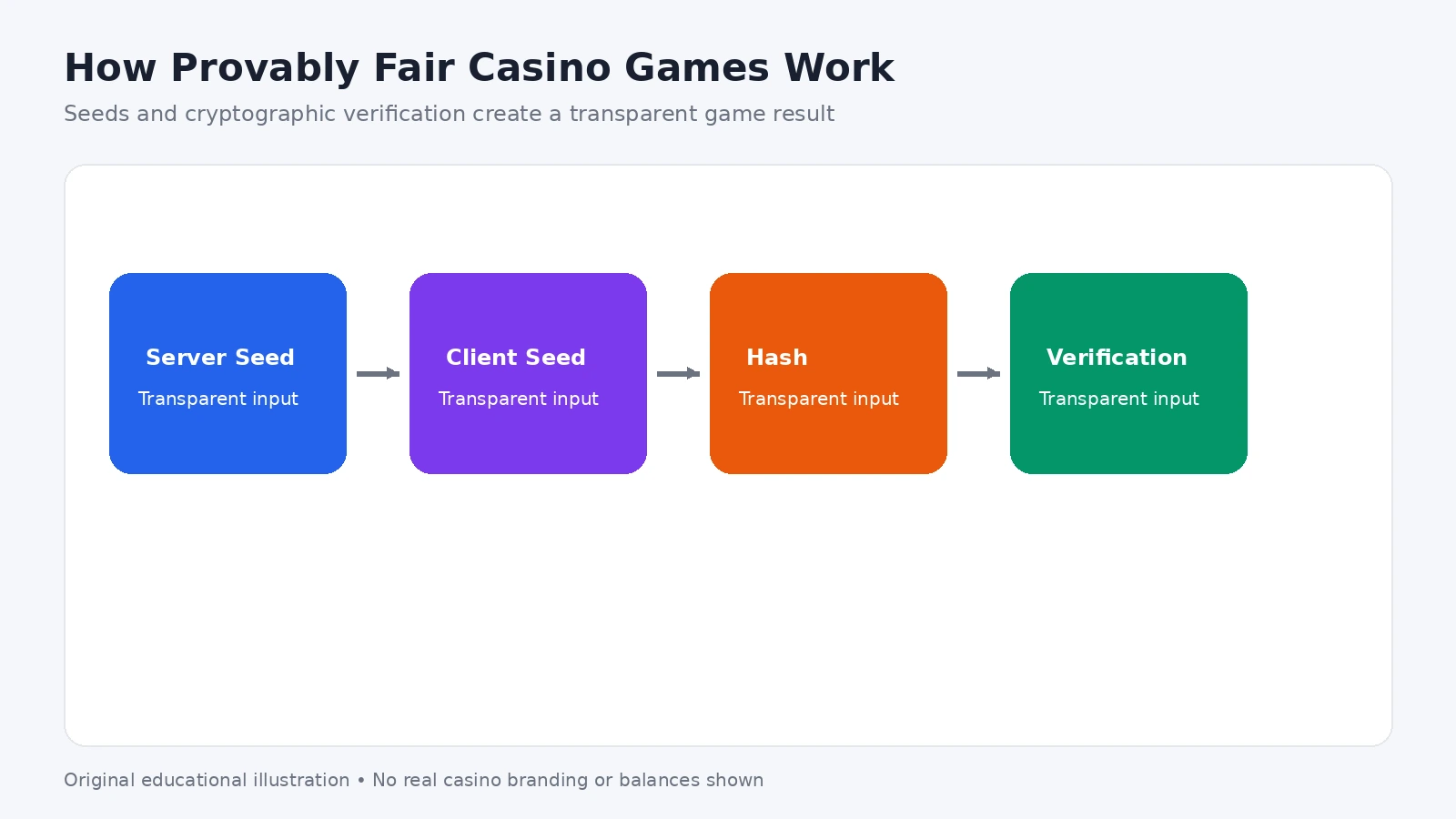
Provably fair casino games use cryptographic information that allows a player to independently reproduce or verify how a game result was generated. In a typical system, the casino commits to a secret server seed before play, the player contributes or receives a client seed, and a nonce identifies each wager. Those inputs are passed through a documented algorithm to generate the game result.
After the server seed is eventually revealed, the player can check that it matches the cryptographic commitment published earlier and recompute previous outcomes.
That is useful evidence.
But its scope is narrower than the phrase “provably fair” can make it sound.
A successful verification can provide evidence that a particular result followed the disclosed cryptographic process and that the committed server seed was not silently replaced afterward. It does not, by itself, prove that the casino is licensed, that its advertised RTP is favorable, that withdrawals will be paid promptly, that an account will never face KYC, that the site is legal where the player is located, or that every part of the casino's software is trustworthy.
Understanding that distinction is the most important part of understanding provably fair gambling.
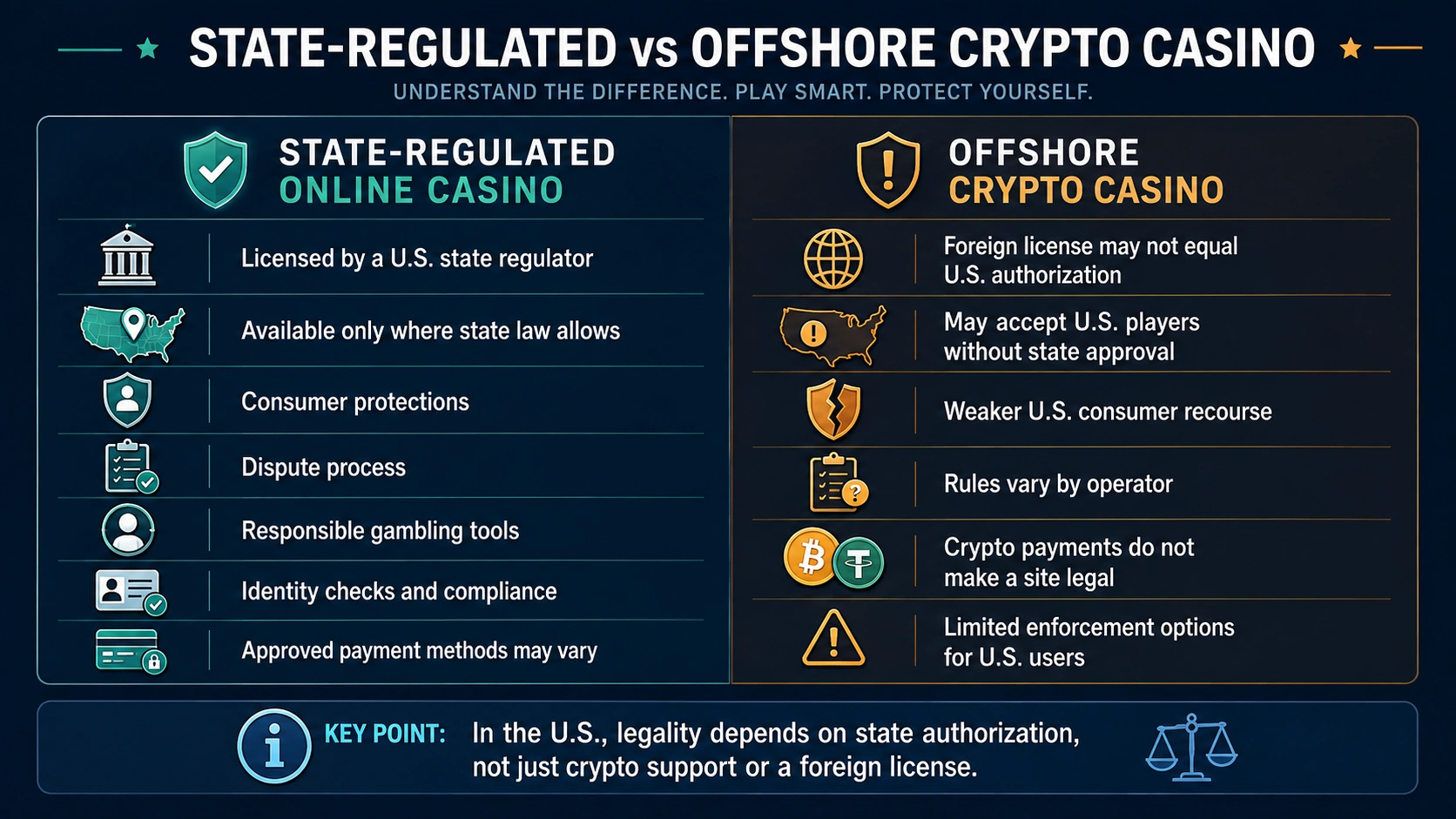
For U.S. readers, there is an additional consideration: online casino authorization is state-specific. A foreign license, cryptocurrency payment option or provably fair feature does not establish permission to operate in a particular U.S. state. That legal and licensing check is separate from provably fair verification.
What Does “Provably Fair” Actually Mean?
The term generally describes a game design in which enough cryptographic information is disclosed for a player or independent verifier to reproduce the calculation behind an outcome.
A traditional online game may tell players:
Trust our RNG and the independent laboratory that tested it.
A provably fair game attempts to offer another layer:
Here are the inputs and calculation rules. Check this specific result yourself.
Those are different approaches to establishing confidence.
Many modern implementations use a cryptographic commitment scheme. Stake, for example, describes its provably fair model as combining a commitment scheme with cryptographic hashing, while Shuffle documents a similar system involving a server seed, client seed and nonce.
The crucial word is verifiable.
A losing result does not become suspicious merely because it lost, and a winning result does not establish fairness merely because it won. The useful question is whether the documented inputs reproduce the outcome that the game displayed.
The Four Pieces Behind a Typical Provably Fair Game
Different casinos and game developers implement the idea differently, but four components appear frequently.
| Component | Purpose |
| Server seed | Secret value created by the operator or game server |
| Server-seed hash | Commitment to that server seed before it is revealed |
| Client seed | Additional input controlled by or assigned to the player |
| Nonce | Counter that distinguishes one wager from another |
Some systems also use a cursor when one wager needs several random values—for example, when generating several cards, Mines positions or Keno numbers.
Shuffle's published implementation uses server seed, client seed, nonce and cursor inputs with HMAC-SHA256 to produce random bytes.
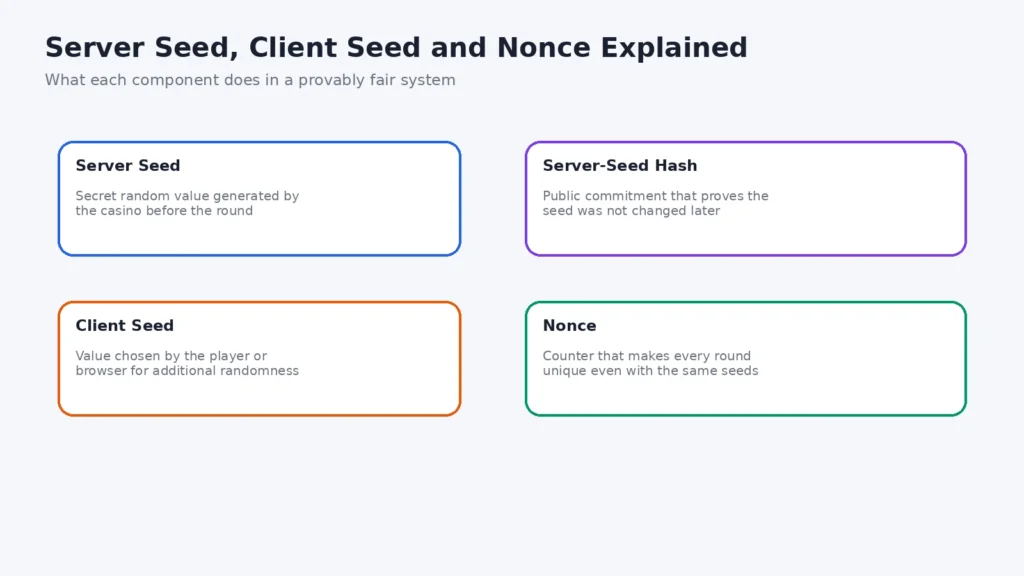
Server seed
The server seed is a secret value generated on the casino side.
Instead of revealing it immediately, the system first publishes a cryptographic hash of it.
Imagine a server seed such as:
SERVER-SEED-EXAMPLE-8942
The casino could calculate:
SHA256(SERVER-SEED-EXAMPLE-8942)
and publish the resulting digest.
The digest acts like a fingerprint of the original value.
Importantly, calling this an “encrypted seed” is technically imprecise. SHA-256 is a cryptographic hash function, not ordinary reversible encryption. NIST describes SHA-family functions as producing message digests that can reveal whether the underlying message has changed.
Client seed
The client seed provides another input to the calculation.
Some systems generate one automatically in the player's browser but allow it to be changed. Others give the player a direct field for selecting it.
Player control matters because it reduces reliance on an input selected entirely by the operator.
Shuffle, for example, explains that its client seed may initially be generated by the browser while allowing the player to replace it.
Nonce
A nonce is normally an incrementing counter.
A sequence may look like:
- Bet 1: nonce 0
- Bet 2: nonce 1
- Bet 3: nonce 2
- Bet 4: nonce 3
This prevents repeated wagers made with the same seed pair from using identical complete inputs.
The exact starting number is implementation-specific.
Cursor
A single casino round sometimes requires more than one pseudorandom value.
Mines may need multiple tile positions. A card game may need many cards. Keno may need a sequence of selected numbers.
Some implementations therefore use a cursor to request additional bytes from the random-number-generation process without changing the main nonce.
It is useful to know about the cursor because a verifier that ignores a game's documented cursor logic can produce a different result even when the seeds are correct.
How a Provably Fair Casino Round Works
A common implementation can be understood as six stages.
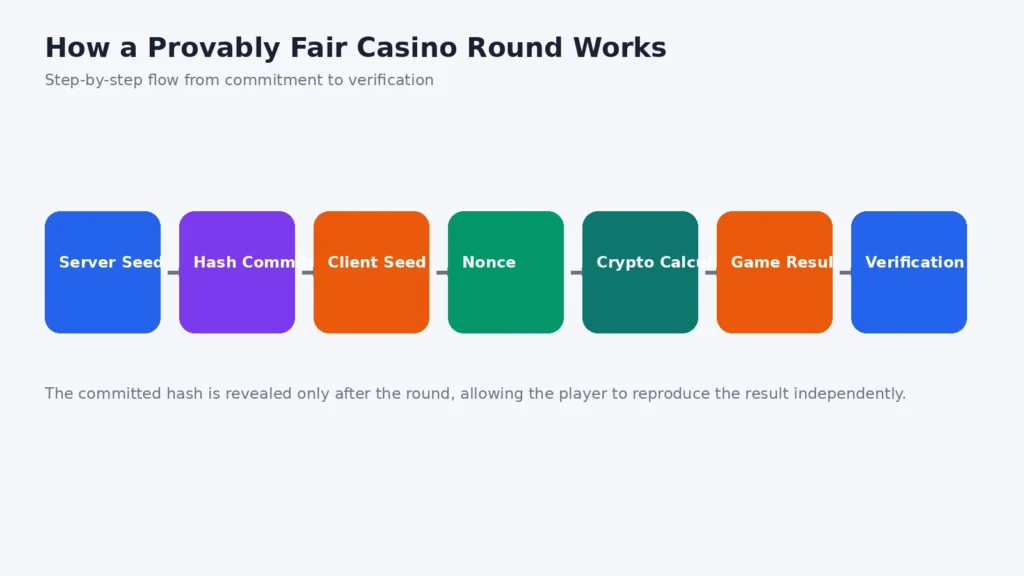
Step 1: The casino generates a server seed
The server creates a secret value.
For example:
server_seed = ABC123…
The real seed will normally be much longer and randomly generated.
Step 2: The casino publishes a commitment
Before eligible bets are generated from that seed, the casino calculates a cryptographic hash:
commitment = SHA256(server_seed)
The player sees the commitment but not the original server seed.
The purpose is to make changing the underlying server seed later detectable.
If the server reveals a different seed after play, hashing it should produce a different digest.
Step 3: A client seed is established
The player supplies, changes or accepts a client seed.
For example:
client_seed = my-random-seed
Exactly when the client seed is selected matters.
A model in which the player can choose an independent client seed after seeing the operator's commitment provides stronger protection against certain forms of seed selection than a system in which every relevant input is effectively chosen or known in advance by the operator.
Step 4: The nonce identifies the wager
Suppose the player's next bet has:
nonce = 37
Now the system has a unique combination of server seed, client seed and wager number.
Step 5: The inputs generate pseudorandom data
One documented implementation pattern is conceptually similar to:
HMAC_SHA256(server_seed, client_seed:nonce:cursor)
The result is a sequence of bytes.
HMAC is a standard cryptographic mechanism that combines a secret key with a hash function for message authentication. NIST FIPS 198-1 describes this keyed-hash construction.
The important caveat is that there is no single universal provably fair formula.
Stake and Shuffle publish particular implementations, but another game may organize the message, key, nonce or conversion rules differently.
Always use the documentation for the exact game being checked.
Step 6: Random bytes are mapped to the game outcome
Raw cryptographic output is not itself a roulette number, crash multiplier or Mines layout.
The game therefore needs a conversion rule.
Conceptually:
Seeds + nonce → cryptographic bytes → number → game event
For example, bytes might first be converted into a value between 0 and 1 and then mapped onto:
- a dice result;
- a shuffled deck;
- a crash multiplier;
- a Plinko path;
- Mines positions;
- Keno selections;
- or another game-specific event.
Stake's published documentation explicitly separates random-byte generation, conversion to floating-point values and conversion of those values into game events.
That separation matters because the mapping rule is part of what should be reviewed, not only the hash.
What Happens After the Game?
The original server seed must eventually become available if the player is going to verify it.
Some platforms reveal a seed after a round. Others continue using the same seed for multiple wagers and reveal it only when the player rotates to a new server seed.
That is why a player may sometimes be unable to complete verification immediately after one bet.
Once the seed is disclosed, two separate checks become possible.
Check 1: Verify the commitment
Calculate:
SHA256(revealed_server_seed)
Then compare it with the server-seed hash presented before play.
If they match, there is strong cryptographic evidence that the revealed seed corresponds to the committed seed.
Check 2: Reproduce the game outcome
Next, insert:
- the revealed server seed;
- the client seed;
- nonce;
- cursor, if required;
- and the documented game formula
into an independent implementation.
If the reproduced output matches the recorded casino result, the player has verified that the outcome follows the disclosed calculation.
How to Verify a Provably Fair Result Yourself
The exact interface varies, but the process usually looks like this.
1. Open the game or account fairness history
Look for labels such as:
- Fairness
- Provably Fair
- Verify
- Game History
- Seeds
- Bet Details
2. Record the original commitment
Save the server-seed hash shown while that seed is active.
This step is important.
If a player records only the final revealed seed but never confirms what commitment existed beforehand, the evidence is weaker.
3. Record the client seed
Check whether the player can change it.
For stronger independent participation, use a client seed that is not simply an operator-selected default.
4. Record the nonce
Make sure the nonce corresponds to the exact bet being checked.
A one-number error can generate a completely different result.
5. Rotate or reveal the server seed
Follow the platform's documented process.
Do not expect every implementation to expose the original server seed while it remains active.
6. Hash the revealed server seed
Use the algorithm specified in the game's documentation.
If SHA-256 is specified:
SHA256(revealed_server_seed)
Compare the result with the commitment recorded earlier.
7. Reproduce the outcome
Use either:
- the operator's documented verifier;
- published source code;
- an independent verifier implementing the same algorithm;
- or your own implementation if technically comfortable.
The same inputs should produce the same output because these calculations are deterministic.
8. Compare it with the actual game history
Check the result—not merely the seed hash.
A matching seed commitment alone does not prove that the on-screen game result was calculated from it correctly.
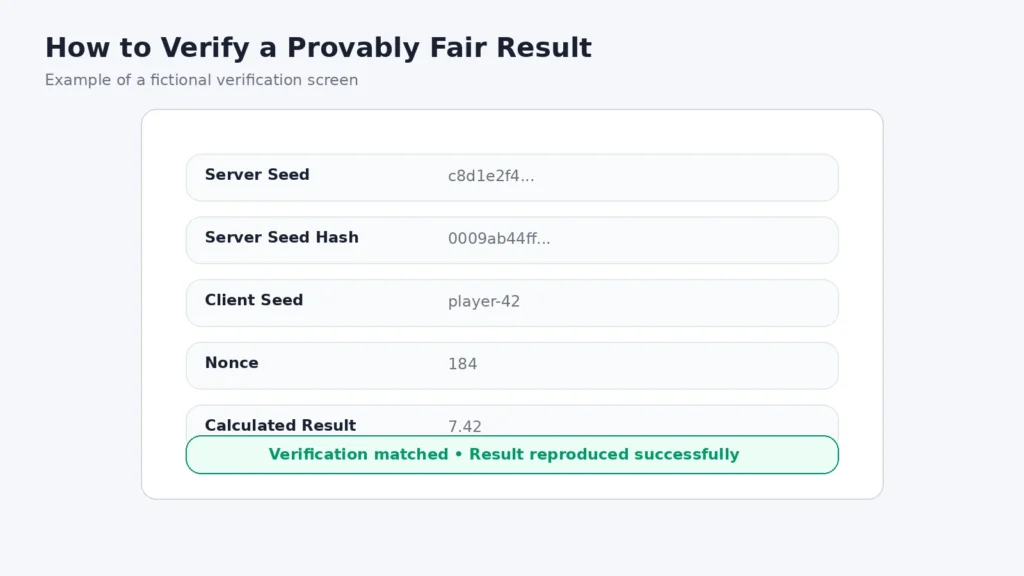
What Does a Successful Provably Fair Verification Actually Prove?
This is where careful wording matters.
When properly implemented and independently reproduced, a successful verification can provide evidence that:
The revealed server seed matches the earlier commitment
The operator has not simply substituted another server seed without producing a mismatch.
The same inputs reproduce the same result
If the disclosed server seed, client seed, nonce and algorithm reproduce the recorded outcome, the game result is cryptographically reproducible.
Altering a committed input would be detectable
Changing the server seed after publishing its hash should change its digest with overwhelming probability when a secure hash function is being used.
NIST's Secure Hash Standard describes precisely this integrity property of cryptographic hashes.
The result can be checked without merely trusting a visual animation
The wheel spin, rocket, dice animation or falling Plinko ball is presentation.
The verification concerns the underlying mathematical event.
That distinction is particularly useful in fast-moving crypto casino games where an animation may make a game feel random even though the real result comes from a deterministic calculation.
What Provably Fair Does Not Prove
A better way to evaluate the claim is to separate what can be verified from everything that remains outside the proof.
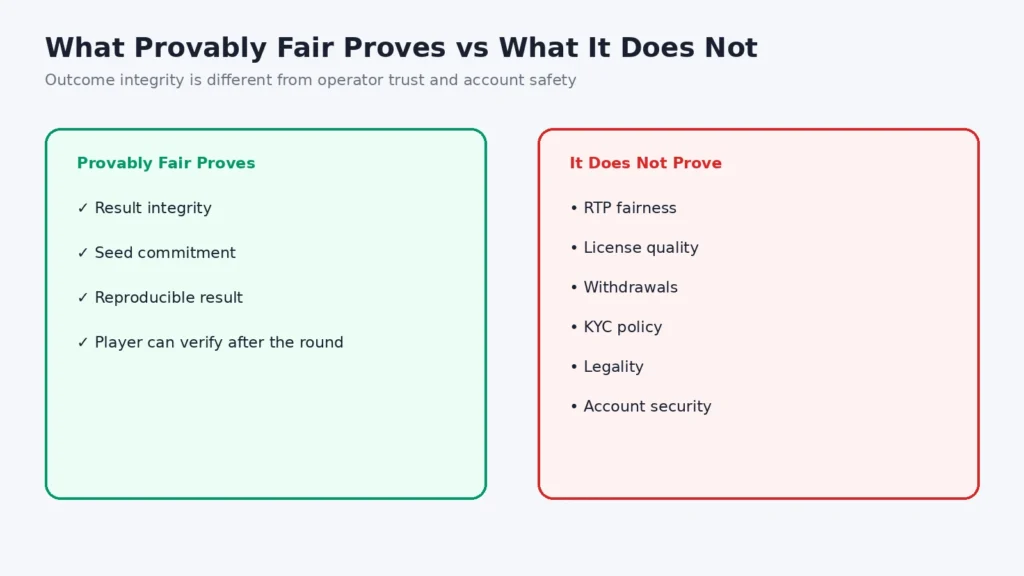
| Claim | Does provably fair establish it? |
| Revealed server seed matches earlier commitment | Yes, if correctly verified |
| Recorded result matches documented algorithm | Yes, if independently reproduced |
| Casino didn't secretly replace the committed server seed | Strong evidence |
| Server seed contained high-quality randomness | Not by the hash alone |
| Game has no house edge | No |
| RTP is favorable | No |
| Advertised RTP is implemented correctly | Not automatically |
| Payout table is fair | No |
| Casino is licensed | No |
| Casino is authorized in a U.S. state | No |
| Withdrawal will be paid | No |
| Withdrawal will be instant | No |
| KYC will never be requested | No |
| Player funds are protected | No |
| Website is secure from every attack | No |
| Every casino game on the site is provably fair | No |
| Casino will never change its terms | No |
This distinction prevents “provably fair” from becoming an all-purpose trust label.
A Provably Fair Game Can Still Have a House Edge
One of the easiest misconceptions to demonstrate involves a coin flip.
Imagine a game with a genuinely unbiased 50/50 cryptographic coin flip.
The player bets $10 on heads.
If heads wins, the casino returns 1.90× the bet, including the original stake.
The result generation can be perfectly verifiable.
But the expected return is:
50% × 1.90 = 0.95
That corresponds to a theoretical return of 95%, before considering other rules.
The implied house edge is:
100% − 95% = 5%
Nothing is contradictory about that.
The game can have:
- an honestly generated 50/50 outcome;
- a perfectly verifiable result;
- and a 5% mathematical house advantage.
Provably fair outcome generation and favorable gambling economics are separate questions.
Does Provably Fair Prove the Advertised RTP?
Not automatically.
Return to Player, or RTP, describes the theoretical proportion of wagered money returned under a game's mathematical model over a very large number of rounds.
Provably fair verification usually focuses on whether specific outcomes follow a predetermined cryptographic process.
To verify the whole economic model, additional information matters:
- How cryptographic bytes are converted to results.
- The probability of each result.
- The payout attached to each result.
- Bonus or feature probabilities.
- Rounding rules.
- Any edge built into the conversion.
- Whether the published RTP corresponds to those rules.
A player could successfully reproduce every outcome while still playing a game with a poor payout table.
Transparency about result generation is valuable, but it should not be confused with value.
Can the Randomness Still Be Weak?
Potentially.
A SHA-256 hash does not transform a badly generated server seed into strong randomness merely because SHA-256 is cryptographically strong.
Think of it this way:
Strong hash + predictable secret ≠ automatically unpredictable system.
The security of a complete implementation depends on:
- seed generation;
- seed length and entropy;
- storage;
- timing of commitments;
- client-seed handling;
- HMAC construction;
- nonce management;
- conversion logic;
- software implementation;
- and whether the published verifier reflects the production code.
This is why implementation documentation matters.
A strong provably fair design should explain more than “we use SHA-256.”
Can the Casino Know Future Results?
Provably fair is often described as though neither party can possibly know the outcome beforehand.
That statement is too broad.
Whether the casino can calculate a future result depends on exactly how the implementation works and when each input becomes known.
If the operator knows:
- the secret server seed;
- the current client seed;
- the upcoming nonce;
- and the complete calculation,
it may technically be able to calculate that future deterministic output.
What a proper commitment scheme is primarily designed to prevent is undetectably changing the committed input afterward.
Systems that incorporate independent player-controlled information after the operator commitment can provide stronger protection against operator seed selection.
So the important question is not simply:
“Can somebody compute the number?”
It is:
“Which inputs were committed when, who controlled them, and can any party change them after learning information that should have been unavailable at commitment time?”
Provably Fair vs RNG: They Are Not Exact Opposites
Many casino guides frame the subject as:
Provably Fair vs RNG
That is convenient, but technically incomplete.
An RNG is a mechanism for generating random or pseudorandom values.
Provably fair describes a mechanism for making the generation and use of values independently verifiable.
Gaming Laboratories International's GLI-19 standard recognizes multiple forms of RNG, including software, hardware and mechanical random-number generation.
Meanwhile, published provably fair casino implementations can generate their own bytes using cryptographic constructions such as HMAC-SHA256.
A more accurate comparison is therefore:
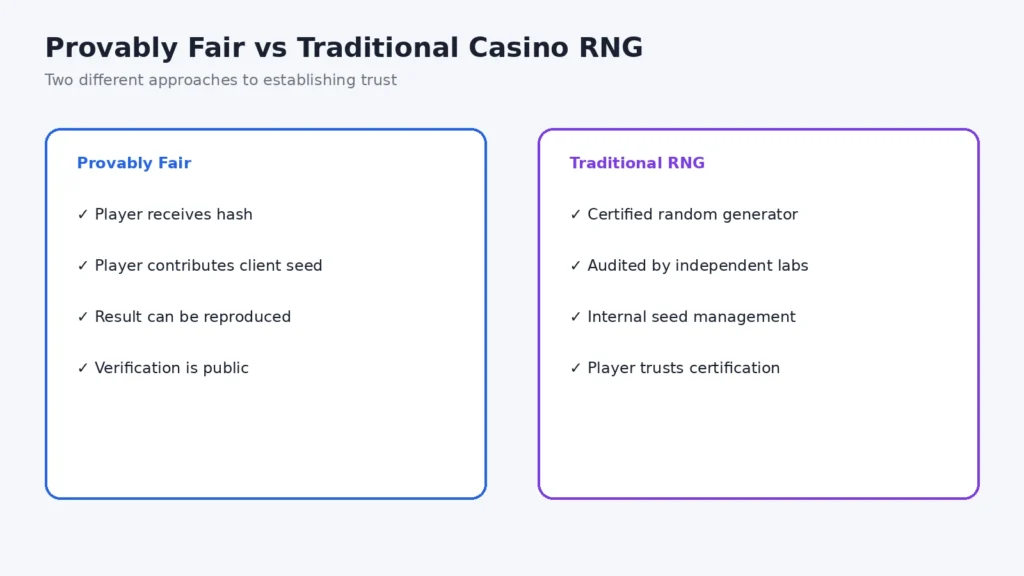
| Traditional certified RNG model | Provably fair model |
| Player usually cannot reproduce each result | Player may be able to reproduce each result |
| Assurance often relies on developer testing and independent labs | Assurance can include player-verifiable cryptographic data |
| Internal RNG details may not be public | Verification algorithm should be documented |
| Testing considers statistical behavior and implementation | Verification often focuses on a particular round |
| Common in regulated slots and online casino software | Common in crypto-native original and instant games |
One system is not automatically superior in every respect.
Independent certification can evaluate statistical properties and wider software controls that a simple seed check does not address. Provably fair verification gives players transparency into individual outcomes that conventional black-box RNGs may not provide.
The strongest evaluation asks what evidence exists at both levels.
Is Blockchain Required for Provably Fair Gambling?
No.
This is another common misconception.
Bitcoin helped popularize cryptographic transparency in online gambling, and many provably fair games appear at crypto casinos. But the mechanism itself does not require Bitcoin, Ethereum or another blockchain.
A standard system can operate using:
- cryptographically secure seeds;
- SHA-256 or another suitable hash;
- HMAC;
- a nonce;
- documented conversion rules;
- and an off-chain verifier.
Stake and Shuffle, for example, describe implementations based around cryptographic seed inputs and HMAC-SHA256.
A blockchain can provide additional features, such as timestamping or immutable public records, depending on the design.
It is an optional architectural layer—not the definition of provably fair.
Which Crypto Casino Games Commonly Use Provably Fair Systems?
The technology is particularly convenient where an outcome can be mapped cleanly from cryptographic numbers.
Dice
Dice is one of the easiest examples.
Cryptographic bytes can be converted into a number inside the allowed roll range.
Players interested in the broader category can compare how crypto dice games work alongside RTP and house-edge considerations.
Crash games
A cryptographic value can be mapped to the point at which the multiplier stops.
The verification can establish whether the recorded crash point follows the documented formula.
It cannot make the next crash predictable to a player who does not have the secret inputs.
Mines
The generated numbers determine tile positions or an equivalent ordered result.
Because several values may be required in one round, implementation details such as cursors and duplicate-handling rules become especially important.
Plinko
A provably fair Plinko game may use generated values to determine the path or final bucket.
The visual animation itself is not the cryptographic proof.
Readers comparing this format can see the site's guide to crypto Plinko games.
Keno
A series of pseudorandom values can select the drawn numbers.
The verifier must reproduce not only the cryptographic bytes but also the game's method for selecting unique numbers.
Card games
Provably fair algorithms can generate a deterministic deck order.
Verifying a card game may require considerably more conversion logic than verifying one dice result.
Crash-style multiplayer games
Games involving a shared multiplier can also publish verification information.
However, a branded crash game should be checked against its own documentation rather than assuming every game with similar visuals uses the same fairness architecture.
The site's Aviator game guide provides additional background on how crash-style gameplay works.
Are All Crypto Casino Games Provably Fair?
No.
A casino may have:
- proprietary provably fair games;
- conventional third-party slots;
- RNG table games;
- live dealer titles;
- sportsbook products;
- and provably fair originals
inside the same account.
“Provably fair casino” therefore does not necessarily mean every game in its lobby is independently verifiable using seeds.
Check the individual game.
What About Live Dealer Games?
Live dealer games present a different problem.
Their primary outcome may involve:
- physical cards;
- a physical roulette wheel;
- a dealer;
- cameras;
- shuffling equipment;
- or other mechanical processes.
A simple server-seed/client-seed verification model is therefore not naturally equivalent to verifying the entire physical event.
Regulated live games generally depend on wider game-control, equipment and testing requirements.
Do not assume that lack of a seed verifier means a legitimate live dealer game is automatically unfair—or that adding a cryptographic hash would prove every aspect of the live operation.
Warning Signs in a “Provably Fair” Claim
The phrase itself is easy to place on a webpage.
The underlying evidence matters more.
No pre-game commitment
If there is no way to record the server-seed hash before relevant play, later disclosure provides much weaker evidence.
No server-seed reveal
A permanent secret cannot normally be checked against its commitment by the player.
No client-seed information
A vague reference to “blockchain randomness” is not a substitute for explaining the actual inputs.
No nonce or round identifier
Players need to know which values generated which wager.
No documented calculation
A pile of hashes is not useful if the transformation from hash to game result remains undisclosed.
Only the casino's own verifier exists
An integrated verifier is convenient.
But if independent reproduction is impossible because the algorithm is unpublished, the user is still being asked to trust part of the operator's black box.
The hash matches but the result cannot be reproduced
The server-seed commitment and the game calculation are different checks.
Both matter.
“Provably fair” is used as proof of licensing
It is not.
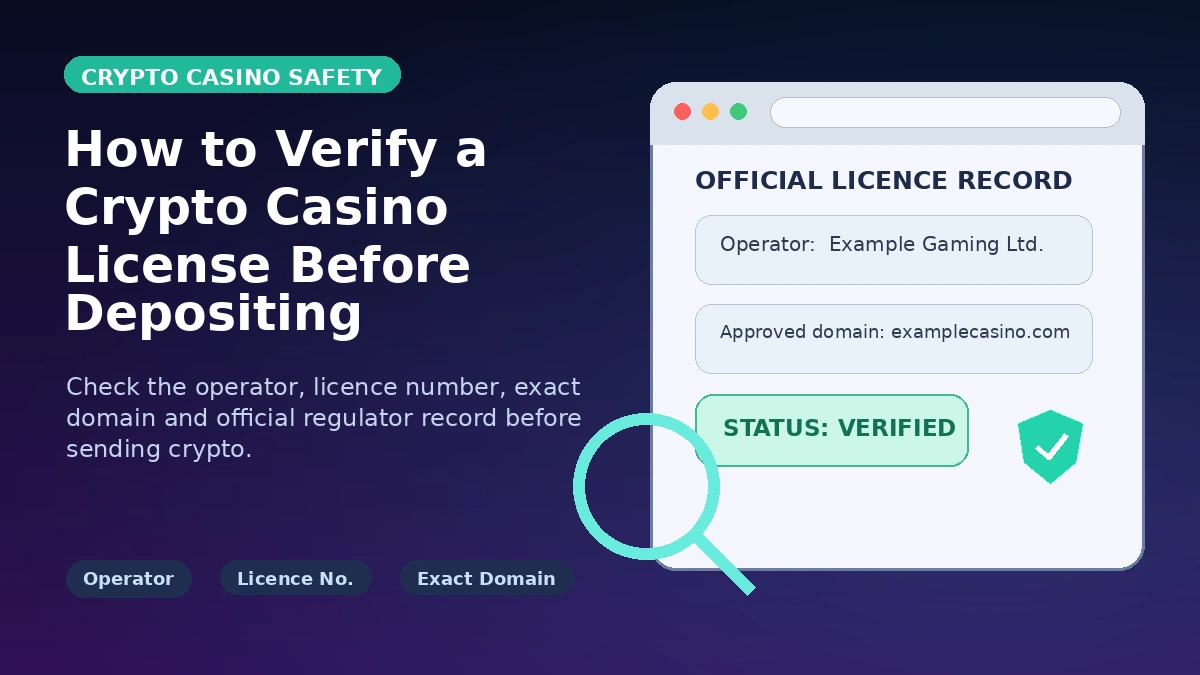
A player should verify regulatory claims independently through the relevant regulator and confirm the exact operator, domain and license record.
“Provably fair” is used as proof of safe withdrawals
It says nothing about cashier processing.
An honest cryptographic dice roll cannot force an operator to approve a withdrawal.
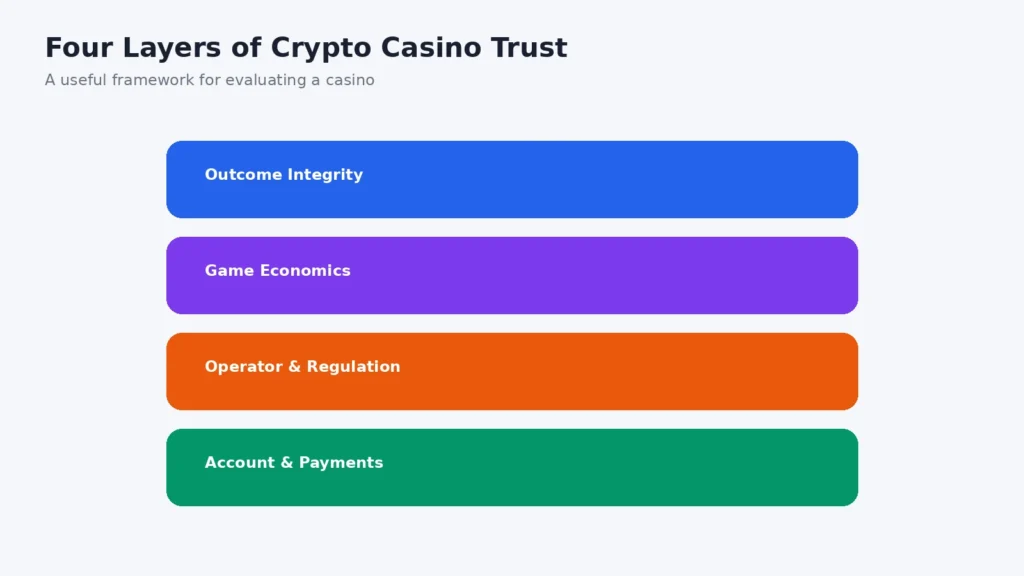
A Four-Layer Framework for Evaluating a Provably Fair Casino
Instead of asking whether a casino is “fair,” separate the decision into four layers.
Layer 1: Outcome integrity
Ask:
- Is a server commitment visible before play?
- Can I control or inspect the client seed?
- Is the nonce available?
- Is the server seed eventually revealed?
- Can I reproduce the outcome independently?
This is the layer provably fair technology addresses most directly.
Layer 2: Game economics
Check:
- RTP;
- house edge;
- payout table;
- volatility;
- maximum multiplier;
- rounding;
- bonus contribution;
- side-bet odds.
Provably fair does not replace this analysis.
Layer 3: Operator and regulatory trust
Verify:
- legal company;
- gambling license;
- approved domain;
- state authorization where applicable;
- complaint route;
- responsible-gambling controls.
A cryptographic game result cannot supply this information.
Layer 4: Account and payment risk
Review:
- withdrawal rules;
- KYC triggers;
- account restrictions;
- bonus terms;
- wallet network requirements;
- payment fees;
- account security.
Only after all four layers have been considered does “provably fair” sit in its proper context.
What U.S. Players Should Know
For an American reader, provably fair technology and gambling authorization are completely separate questions.
U.S. real-money online casino regulation is primarily state-based. The American Gaming Association's 2026 State of the States report describes lawful iGaming markets and the continuing enforcement focus on unregulated online gambling.
A site can therefore have a technically reproducible game while still failing other checks relevant to a U.S. player.
Before depositing, independently determine:
- Whether the type of online gambling is permitted where the player is physically located.
- Whether the operator is authorized by the appropriate regulator where such authorization is required.
- Whether the exact domain is covered.
- Which dispute process applies.
- Whether the site's terms permit U.S. or state-level access.
- Which KYC rules apply.
- Which withdrawal rules apply.
Accessibility is not the same thing as authorization.
Neither is cryptography.
Practical Provably Fair Checklist
Before relying on a game's fairness claim, check the following.
Before playing
- Find the fairness documentation.
- Identify the hash or HMAC algorithm.
- Record the active server-seed commitment.
- Find the client seed.
- Change the client seed if player control is supported.
- Confirm how the nonce works.
- Check whether a cursor is used.
- Find the game-result conversion formula.
After playing
- Save the bet ID.
- Save the nonce.
- Save the displayed result.
- Rotate or reveal the server seed when appropriate.
- Hash the revealed seed.
- Compare it with the original commitment.
- Recalculate the game outcome.
- Compare the independently generated result with the casino history.
Separately
- Check RTP.
- Check house edge.
- Verify the casino license independently.
- Check legal eligibility.
- Read withdrawal rules.
- Read KYC rules.
- Read bonus terms.
- Use appropriate responsible-gambling controls.
Key Takeaways
- Provably fair technology lets players verify game outcomes using cryptographic information rather than relying solely on the casino's claim.
- A typical system uses a server seed, server-seed hash, client seed and nonce.
- Some implementations also require a cursor.
- SHA-256 hashing is not the same as encryption.
- HMAC-SHA256 is used by some published casino implementations to generate deterministic pseudorandom bytes.
- Blockchain is not required.
- A matching server-seed hash proves only one part of the process; the game outcome should also be reproduced.
- Provably fair does not mean zero house edge.
- It does not automatically verify RTP.
- It does not prove licensing, U.S. legality, KYC policy or withdrawal reliability.
- Provably fair and conventional RNG testing address different aspects of casino-game assurance.
- The most useful approach is to treat provably fair verification as one layer of a broader due-diligence process.
Conclusion
Provably fair casino games solve a specific trust problem remarkably well when the system is implemented transparently: instead of asking players to accept that an individual digital result was generated honestly, they can be given the information needed to check it.
The mistake is turning that narrow cryptographic proof into a broader promise.
A server-seed hash is not a gambling license. A matching nonce is not a withdrawal guarantee. SHA-256 does not tell a player whether the payout table is favorable. And a reproducible game result does not establish whether an online casino is authorized in a particular U.S. state.
The right question is therefore not simply:
“Is this casino provably fair?”
It is:
“What exactly can I verify, and what still requires separate evidence?”
That distinction turns “provably fair” from a marketing phrase into a useful technical tool.
Frequently Asked Questions
They can provide strong evidence that individual outcomes followed a disclosed cryptographic process and that a committed server seed was not silently replaced. That is narrower than proving every aspect of a game or casino is fair.
House edge, RTP, licensing, payments and operator conduct require separate evaluation.
A properly designed commitment system makes changing the committed server seed afterward detectable.
If the casino reveals another server seed, hashing it should no longer match the commitment recorded earlier. The player should also reproduce the actual result rather than stopping after the seed-hash comparison.
A server seed is a secret input generated on the game or casino side.
A cryptographic hash of that value is normally disclosed before eligible gameplay. The original seed is eventually revealed so the player can verify the previous commitment and reproduce outcomes.
A client seed is an additional input associated with the player.
Good implementations may allow the player to change it rather than relying entirely on an automatically selected default. The server seed, client seed and other values are combined according to the game's documented calculation.
A nonce is normally an incrementing counter used to distinguish wagers generated with the same seed pair.
If one wager uses nonce 50, the next may use 51. The exact starting value and behavior depend on the implementation.
Because knowing the active secret server seed may allow someone with the other required inputs and formula to calculate upcoming deterministic outputs.
Instead, the system publishes a hash commitment first and reveals the server seed later.
Some casinos reveal it only after the player rotates to a new seed.
No.
SHA-256 is a cryptographic hash function. It converts input into a fixed-length message digest and is designed to be one-way. It is not ordinary reversible encryption, so describing the later disclosure of a server seed as “decrypting the hash” is misleading.
It can make certain types of outcome manipulation detectable, but it does not make every possible form of misconduct impossible.
It does not prevent misleading bonus terms, withdrawal disputes, account closures, incorrect licensing claims or insecure account systems.
The appropriate conclusion is narrower: a correctly reproduced round gives evidence about that round's documented cryptographic generation process.