
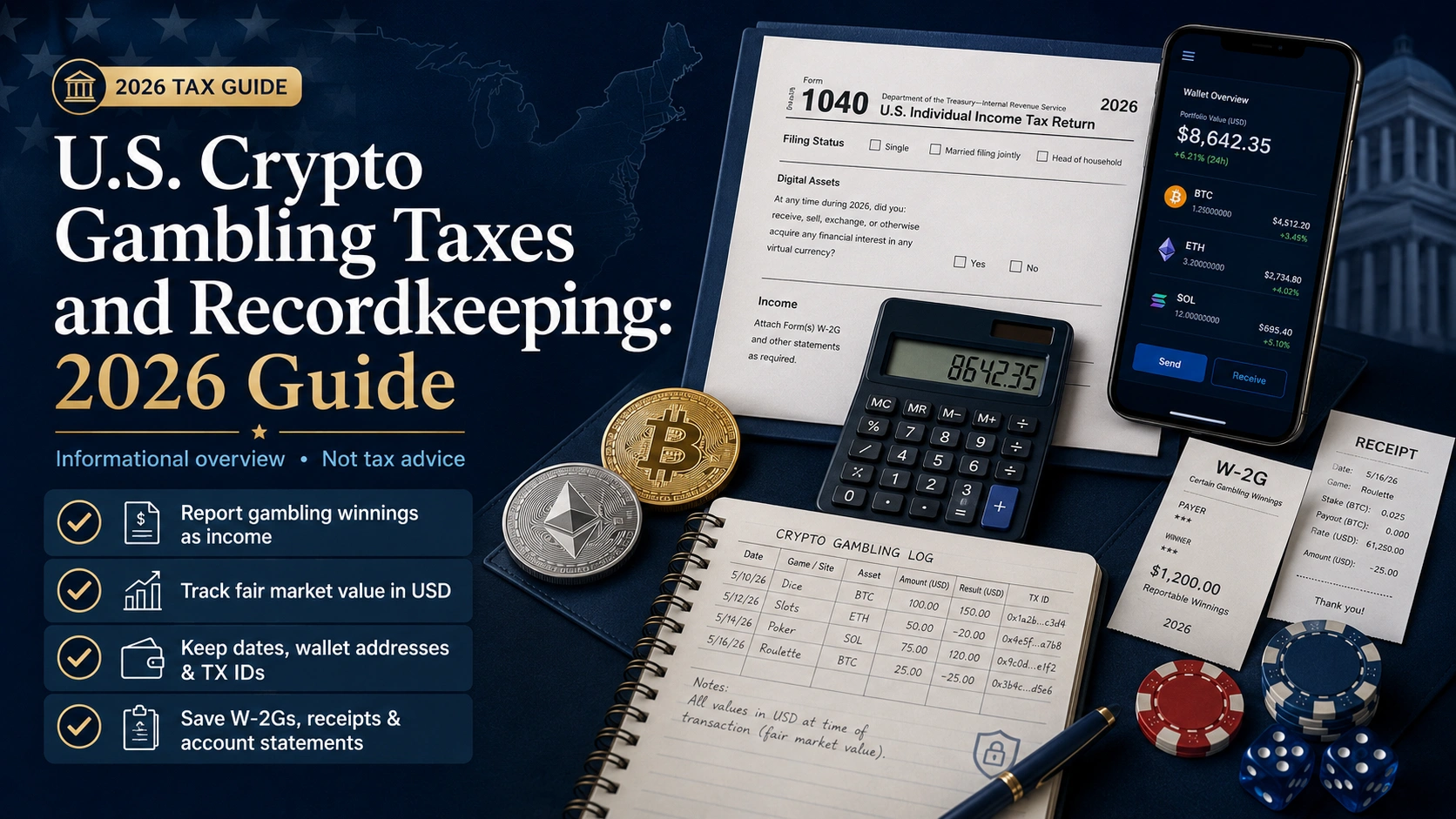
Yes. U.S. taxpayers generally have to report taxable gambling winnings even when the winnings are paid in Bitcoin, Ethereum, USDT, or another digital asset—and even when the gambling operator never sends a Form W-2G.
Crypto makes the recordkeeping more complicated because two tax systems can overlap. There is the gambling side, where winnings and allowable losses are reported, and the digital-asset side, where selling, swapping, spending, or otherwise disposing of cryptocurrency may create a separate capital gain or loss.
There is another major change for 2026: federal law now limits the wagering-loss deduction to 90% of wagering losses, and only to the extent of wagering gains. That can create taxable gambling income even when someone's economic wins and losses appear to break even.
This guide explains the federal framework and, just as importantly, how to build records that can support the numbers reported on a tax return.
Important: This is general educational information, not individualized tax or legal advice. State and local tax rules can differ, professional-gambler status is fact-specific, and taxpayers should use the final IRS forms and instructions applicable when they file.
Key Takeaways
| Issue | General Federal Treatment |
| Crypto gambling winnings | Generally taxable gambling income |
| No W-2G received | Winnings can still be reportable |
| Value of crypto winnings | Record fair market value in U.S. dollars |
| 2026 gambling losses | Deduction generally limited to the lesser of 90% of wagering losses or wagering gains |
| Casual gambler losses | Generally require itemizing deductions |
| Selling won crypto later | May create a separate capital gain or loss |
| Swapping one crypto for another | Can be a digital-asset disposition |
| Moving crypto between wallets you own | Generally a transfer rather than a sale, but preserve records proving ownership |
| Using crypto to fund wagers | Requires careful transaction-level analysis; specific IRS guidance on every crypto wager is limited |
| Casino or sportsbook records | Should be reconciled with wallet and exchange records |
| 1099-DA | May document certain broker digital-asset transactions but does not replace gambling records |
How Are Crypto Gambling Winnings Taxed in the U.S.?
The starting rule is straightforward: gambling winnings are taxable income. IRS guidance tells taxpayers to report gambling winnings even if the payer did not issue a Form W-2G. Noncash prizes are generally valued at fair market value, which is why cryptocurrency winnings need a U.S.-dollar value.
Suppose a player receives a crypto gambling winning worth $2,500 when it becomes available to them. The relevant gambling-income figure is generally the dollar value of that winning at the applicable time—not merely whatever the crypto is worth months later when the player sells it.
The important point is that withdrawing to a bank is not what determines whether the original gambling winning was income.
That distinction matters particularly with cryptocurrency because the token can continue moving in value after the gambling event.
Crypto Gambling Can Involve Two Different Tax Calculations
A clean way to understand crypto gambling taxes is to keep the gambling calculation separate from the cryptocurrency calculation.
1. The gambling calculation
This deals with:
- gambling winnings;
- wagering losses;
- whether losses are deductible;
- the 2026 90% limitation;
- whether the taxpayer is a casual or professional gambler.
2. The digital-asset calculation
This deals with:
- cost basis;
- acquisition date;
- later sale;
- crypto-to-crypto exchange;
- spending cryptocurrency;
- other dispositions.
The IRS treats digital assets as property, not U.S. currency. A later sale or exchange can therefore produce a capital gain or loss depending on the asset's basis and value when disposed of.
Keeping these calculations separate prevents one of the most common mistakes in crypto gambling records: treating a gambling loss and a cryptocurrency capital loss as though they were the same thing.
They are not.
When Can Crypto Gambling Create a Tax Event?
Crypto gambling activity can contain several different transaction types. They should not automatically be classified the same way.
Receiving a gambling winning in cryptocurrency
A gambling winning paid in cryptocurrency generally needs to be recorded in U.S. dollars. The value used for income reporting also becomes highly important for establishing the crypto's tax basis.
For example, if a player receives cryptocurrency worth $4,000 as taxable gambling income, $4,000 generally becomes the starting basis for analyzing a later disposition of those particular assets.
Selling the crypto later
Assume that crypto later sells for $4,700.
Ignoring fees and other adjustments, the later crypto transaction would potentially create a $700 capital gain:
$4,700 sale proceeds – $4,000 basis = $700 gain
The original $4,000 gambling income does not disappear. The $700 is a separate digital-asset gain.
If the token instead sells for $3,500, the subsequent transaction may create a $500 capital loss, again separate from the gambling result.
Swapping the winning into another cryptocurrency
Exchanging one digital asset for another can also be a taxable disposition under the IRS digital-asset property framework. A player who receives Bitcoin and later swaps it for USDT should therefore not assume that nothing happened for tax purposes simply because no dollars reached a bank account.
Moving crypto between wallets
A transfer between wallets or accounts controlled by the same taxpayer generally should not be confused with a sale or exchange.
The practical problem is proof.
If Wallet A sends 0.1 BTC to Wallet B and both belong to the taxpayer, the records should identify the transfer as an own-wallet transfer. Otherwise, imported tax software may interpret the outbound transaction as an unknown disposal and the receiving transaction as newly acquired crypto.
Keep both wallet addresses, TXIDs, dates, amounts and any network fees.
Is Every Crypto Wager Automatically a Taxable Disposal?
This is an area where tax articles sometimes sound more certain than the published IRS guidance supports.
The IRS clearly says digital assets are property and provides rules for recognizing gain or loss when digital assets are sold, exchanged, or used in transactions. Some crypto-tax practitioners therefore treat the use of appreciated cryptocurrency to make a wager as a separate property disposition.
That interpretation can be material. Suppose someone originally bought cryptocurrency for $2,000 and later uses it in a transaction when it is worth $3,000. Depending on the legal and economic mechanics of that transaction, there could be a $1,000 property gain in addition to whatever happens on the gambling side.
However, the IRS has not published a crypto-gambling-specific rule stating that every individual casino wager must always be treated as a separate §1001 disposition in every platform structure.
That matters because casino balances, deposits, custodial accounts, chips or credits, individual wagers, and on-chain smart-contract transactions do not necessarily operate in the same way.
For high-volume activity, preserve enough lot-level information to analyze the issue rather than assuming either:
- every wager definitely creates a capital transaction; or
- no wager ever creates one.
This is an area where a tax professional familiar with both digital assets and gambling can add value.
The 2026 Gambling-Loss Rule: Why Breaking Even May Not Mean Zero Taxable Gambling Income
A major federal change applies to tax years beginning after December 31, 2025.
Under current §165(d), the allowable deduction for wagering losses is generally 90% of the amount of wagering losses, but only to the extent of wagering gains. IRS proposed regulations published in May 2026 reflect the statutory change.
In simplified form:
Maximum deduction = lesser of:
90% × wagering losses
or
wagering gains
Example: $10,000 won and $10,000 lost
Suppose a casual gambler has:
- $10,000 of gambling winnings;
- $10,000 of documented wagering losses.
Ninety percent of the $10,000 losses is $9,000.
Assuming the taxpayer qualifies to claim the deduction and itemizes:
- Gambling winnings: $10,000
- Potentially allowable loss deduction: $9,000
- Difference: $1,000
Economically, the player may describe the year as break-even. For federal income-tax purposes, however, the 2026 limitation can leave $1,000 that is not offset by the wagering-loss deduction.
Example: $10,000 won and $6,000 lost
Ninety percent of $6,000 is $5,400.
In the simplified example:
- Gambling winnings: $10,000
- Potential loss deduction: $5,400
- Remaining difference: $4,600
These examples isolate the gambling-loss rule and do not calculate the taxpayer's final tax bill, standard/itemized deduction decision, state taxes, crypto capital gains, credits, or other income.
Casual Gamblers and Professional Gamblers Are Not Treated Identically
Most recreational players are casual gamblers.
Casual gamblers
IRS guidance generally has casual gamblers:
- report gambling winnings as income;
- claim allowable gambling losses as an itemized deduction on Schedule A;
- retain records supporting both.
A taxpayer taking the standard deduction generally does not obtain a separate federal benefit from a Schedule A gambling-loss deduction, even though the gambling winnings still need to be reported.
Professional gamblers
A taxpayer whose gambling activity rises to the level of a trade or business may use Schedule C, but professional status is not created merely because someone wagers frequently or loses substantial amounts.
The classification is fact-specific.
Another 2026 complication is important. Current §165(d) says “losses from wagering transactions” include otherwise allowable deductions incurred in carrying on wagering transactions. In other words, professional gamblers should not assume that ordinary business expenses automatically sit outside the new wagering-loss limitation based on older pre-2026 explanations.
Anyone considering professional-gambler treatment should obtain advice based on the current 2026 statutory language rather than relying on older articles.
Which Tax Forms Can Be Relevant?
No single form tells the full crypto-gambling story.
| Form/Record | What It May Cover | What It Does Not Replace |
| Form 1040 / Schedule 1 | Gambling income for casual gamblers | Detailed gambling ledger |
| Schedule A | Allowable itemized gambling-loss deduction | Evidence supporting losses |
| Schedule C | Trade/business gambling activity when professional status applies | Proof that professional status is appropriate |
| Form W-2G | Certain reportable gambling winnings and withholding | Winnings that were taxable but below/nonapplicable reporting thresholds |
| Form 8949 / Schedule D | Certain digital-asset capital gains and losses | Gambling-income calculation |
| Form 1099-DA | Certain digital-asset transactions reported by brokers | Casino wager history or complete gambling records |
| Casino account history | Bets, wins, losses, deposits and withdrawals | Outside-wallet basis |
| Wallet/exchange exports | Transfers, purchases, sales and swaps | Detailed gambling outcomes occurring inside a custodial casino account |
The goal is therefore not to find one perfect document. It is to reconcile multiple record sets.
No W-2G Does Not Mean No Taxable Winnings
A Form W-2G is an information-reporting form. Its reporting requirements depend on factors such as the type of gambling, the amount won and, in some categories, the relationship between the winnings and wager.
Those payer-reporting rules should not be mistaken for a general tax-free threshold.
The IRS specifically instructs taxpayers to report gambling winnings even when they were not reported to them on Form W-2G.
That is particularly relevant to users of platforms that do not provide U.S. tax forms.
Offshore Casino Status and Tax Reporting Are Separate Questions
Whether a particular casino is regulated or legally available in a player's state is a separate question from whether the taxpayer has reportable income.
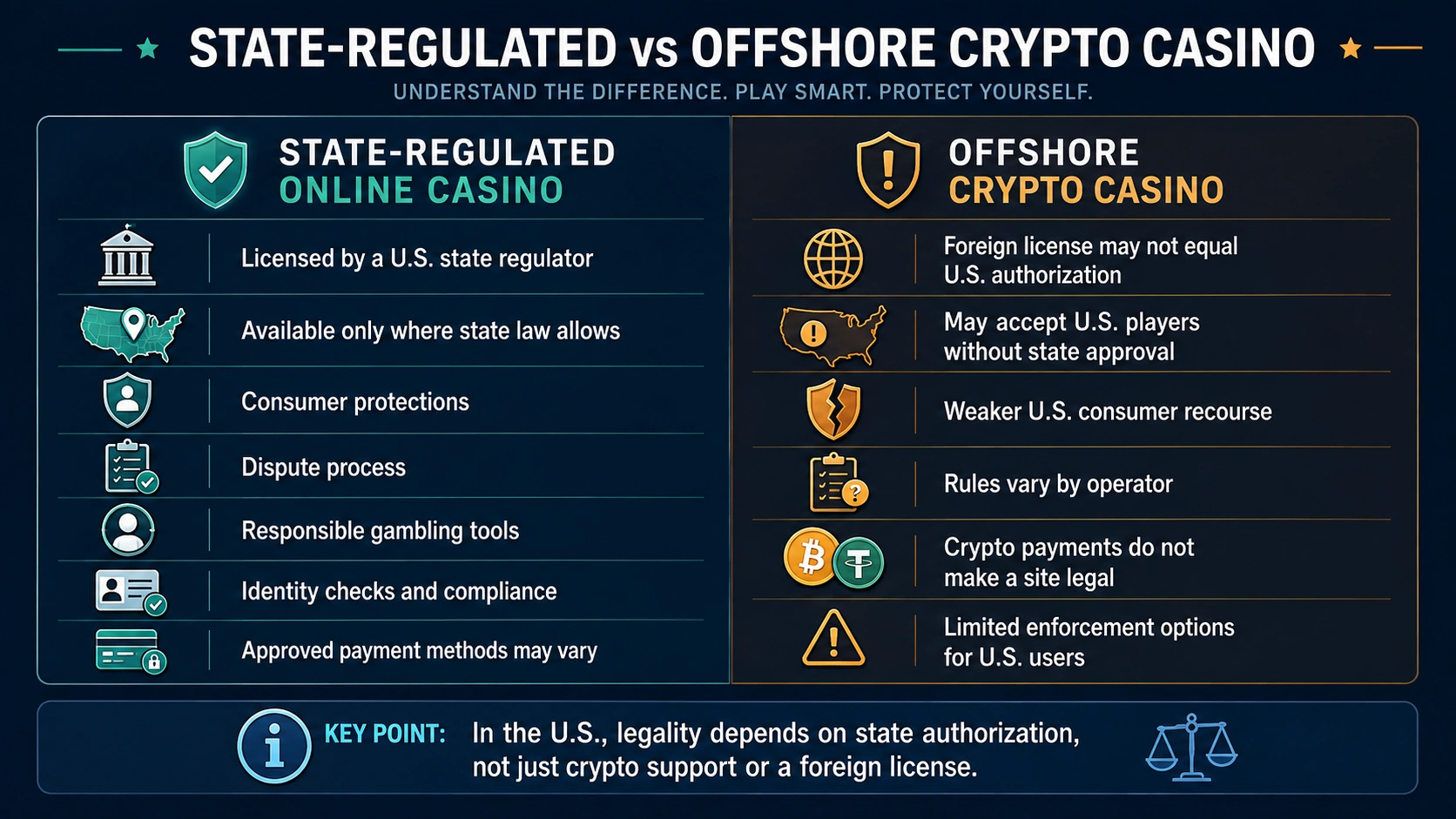
Readers evaluating the underlying platform distinction can review how state-regulated and offshore crypto casinos differ before assuming that the absence of U.S. licensing or tax paperwork eliminates federal reporting obligations.
Similarly, a site's license should not be treated as tax advice. Players who need to assess operator credentials separately can review the site's guide to crypto casino licensing.
For tax purposes, keep the questions separate:
Question 1: Was the platform legally available and appropriately regulated?
Question 2: Did the taxpayer receive taxable gambling income or enter into reportable digital-asset transactions?
One answer does not resolve the other.
How Should Crypto Gambling Winnings Be Valued?
U.S. tax records require dollar values.
For digital assets received as income, the IRS expects taxpayers to maintain records documenting the fair market value in U.S. dollars.
A practical crypto-gambling ledger should therefore record both:
- 0.025 BTC, and
- its relevant USD fair market value.
Recording only “0.025 BTC” is incomplete for federal tax preparation.
Use a consistent valuation method
For each relevant transaction, preserve:
- token;
- number of units;
- date;
- precise timestamp where available;
- USD valuation;
- price source;
- exchange or market used;
- transaction ID or platform reference.
For actively traded cryptocurrencies, historical prices are usually accessible. For thinly traded tokens, NFTs or unusual casino assets, valuation can be more difficult and documentation becomes more important.
Do not retroactively switch among price sources merely to obtain a preferable tax result.
Do Stablecoins Such as USDT Eliminate the Crypto Tax Problem?
No.
A stablecoin may reduce the amount of price movement between transactions, but digital assets such as stablecoins remain within the IRS digital-asset framework.
That means a USDT user should still keep:
- amount received;
- USD value;
- basis;
- timestamp;
- transaction history;
- transaction fees;
- subsequent disposition information.
Someone specifically comparing the payment mechanics can review how USDT casino payments work, but using a dollar-pegged asset does not by itself remove federal recordkeeping obligations.
A stablecoin's economic gain or loss may often be small. The documentation requirement and transaction classification are separate questions.
A Four-Ledger System for Crypto Gambling Recordkeeping
The easiest way to make crypto gambling records auditable is to stop trying to force every transaction into one spreadsheet column.
Maintain four linked record categories.
Ledger 1: Gambling activity
Capture the economic gambling result.
Useful fields include:
| Field | Example |
| Date/time | 2026-06-12 19:42 UTC |
| Platform | Casino/sportsbook name |
| Game/bet | Blackjack, slot, sports wager |
| Bet/reference ID | Operator's identifier |
| Asset | BTC |
| Amount wagered | 0.002 BTC |
| Gross payout/result | Platform record |
| Win/loss classification | Win / Loss |
| USD value | Value using documented method |
| Session/reference notes | Any grouping method used |
Do not delete raw exports after producing summarized totals.
Ledger 2: Digital-asset tax lots
This tracks cryptocurrency basis.
Include:
- token;
- network;
- acquisition date;
- units;
- acquisition method;
- original basis;
- USD fair market value;
- lot-identification method;
- later disposition date;
- disposition proceeds/value;
- resulting gain or loss.
A crypto gambling win may therefore appear in both Ledger 1 and Ledger 2 for different reasons:
Ledger 1: Why did you receive the asset?
Ledger 2: What is the basis of the asset you now own?
Ledger 3: Wallet and custody movements
This establishes where the crypto moved.
Include:
- sending address/account;
- receiving address/account;
- exchange account;
- casino account;
- TXID;
- token;
- network;
- units;
- network fee;
- timestamp;
- transfer purpose;
- whether both sides were owned by the taxpayer.
A label such as “own-wallet transfer” can prevent a later preparer from confusing a custody movement with a sale.
Ledger 4: Tax forms and reconciliation evidence
Store documents that support the return:
- W-2G forms;
- 1099-DA forms;
- casino statements;
- casino CSV exports;
- exchange transaction exports;
- wallet history;
- deposit confirmations;
- withdrawal confirmations;
- bank records where relevant;
- historical pricing source documentation;
- screenshots of records that cannot be exported;
- notes explaining manual corrections.
This fourth ledger is the bridge between raw activity and the numbers ultimately reported.
Seven Steps to Reconcile Crypto Gambling Activity
Step 1: Export casino records before they disappear
Download available:
- account statements;
- wagering history;
- deposit records;
- withdrawal records;
- bonus or promotional transaction records;
- tax documents.
Do this during the year rather than assuming an offshore or crypto-focused service will retain an accessible history indefinitely.
Step 2: Export every exchange and wallet involved
A casino export alone does not show where the deposited cryptocurrency originally came from or its basis.
Collect activity from:
- centralized exchanges;
- self-custody wallets;
- hardware wallets;
- other gambling accounts;
- relevant blockchain addresses.
Preserve raw files before manipulating them.
Step 3: Classify transactions by what actually happened
Useful classifications include:
- crypto purchase;
- own-wallet transfer;
- casino deposit;
- wager;
- gambling win;
- gambling loss;
- casino withdrawal;
- crypto sale;
- crypto-to-crypto swap;
- payment/spending transaction;
- network fee.
Classification is more useful than simply labeling everything “sent” or “received.”
Step 4: Assign USD values where needed
Document the fair market value used for:
- crypto gambling income;
- asset acquisitions;
- sales;
- swaps;
- other relevant dispositions.
For large datasets, establish one consistent timestamp and price-source methodology before calculating the final return.
Step 5: Reconcile units, not just dollars
For each cryptocurrency, perform a basic unit reconciliation:
**Beginning units
- acquired/received units
– sold/spent/transferred-out units
= expected ending units**
Then reconcile own-wallet transfers so that moving an asset between wallets does not create an artificial acquisition or disposal.
Perform a similar check against casino balances.
Step 6: Separate gambling calculations from capital gains
Produce at least two summaries:
Gambling summary
- gambling winnings;
- gambling losses;
- potentially allowable 2026 deduction;
- supporting casino records.
Digital-asset summary
- proceeds/value from dispositions;
- cost basis;
- short- or long-term holding period where relevant;
- gains or losses;
- Form 8949/Schedule D support.
Do not use one loss to offset both systems.
Step 7: Build a filing support package
Before filing, archive:
- raw source files;
- cleaned transaction ledger;
- valuation methodology;
- reconciliation worksheet;
- tax forms received;
- final tax-report totals;
- explanations for material manual adjustments.
If a preparer asks six months later where a number came from, the answer should not depend on remembering a particular wallet transaction.
Worked Crypto Gambling Tax Examples
These examples are intentionally simplified to demonstrate the mechanics. Actual reporting can depend on facts, the nature of the game, transaction structure, accounting method and taxpayer status.
Example 1: Crypto winning followed by a price increase
A player receives a taxable crypto gambling winning worth $5,000.
That amount is recorded as gambling income.
The same $5,000 valuation generally becomes relevant to the basis of the crypto received.
Later, the player sells those assets for $6,200.
Potential results:
- gambling income: $5,000;
- subsequent crypto capital gain: $1,200.
The fact that $6,200 ultimately reached the exchange does not mean the entire $6,200 is a capital gain.
Example 2: Crypto winning falls in value before sale
A player receives cryptocurrency worth $5,000 and later sells it for $4,100.
Potentially:
- gambling income remains $5,000;
- later crypto transaction produces a $900 capital loss.
The decline in the cryptocurrency's value does not retroactively erase the original gambling income.
Example 3: A break-even gambling year in 2026
A qualifying taxpayer has:
- $20,000 wagering gains;
- $20,000 wagering losses.
Ninety percent of $20,000 is $18,000.
Under the simplified federal calculation, the 2026 §165(d) limitation may therefore leave $2,000 of gambling gains not offset by the wagering-loss deduction, even though the taxpayer regards the gambling activity as economically break-even.
Example 4: Appreciated crypto is used in gambling activity
A player originally acquired crypto for $2,500.
When the assets are worth $3,200, they are transferred or used as part of gambling activity.
The records should preserve:
- original $2,500 basis;
- $3,200 value at the relevant time;
- deposit/wager mechanics;
- casino-account credit;
- resulting wagers;
- later withdrawals.
The $700 appreciation could become important if the underlying transaction constitutes a disposition under the digital-asset property rules.
Because published IRS guidance does not specifically resolve every crypto-casino deposit/wager structure, the correct response is not to delete the information because the issue looks inconvenient. Preserve it so the transaction can be analyzed properly.
What About Gambling Sessions Instead of Every Individual Bet?
Another area deserving care is the unit used to calculate gambling gains and losses.
IRS material has historically recognized session-based analysis in certain slot-machine contexts, while also indicating that session treatment has been particularly associated with slot play. It should therefore not be assumed that one universal “daily session” method automatically applies to every sportsbook, table game, crypto casino, or on-chain betting protocol.
That is another reason to keep granular records even when the final return uses a properly supported aggregation method.
Raw data can be summarized later. Missing data cannot.
Does Form 1099-DA Solve Crypto Gambling Recordkeeping?
No.
Form 1099-DA is part of the digital-asset broker-reporting framework. Depending on the transaction and reporting rules, a taxpayer may receive broker information about digital-asset dispositions.
That can help with the crypto side of the return.
It does not necessarily identify:
- which casino wager produced a winning;
- total gambling winnings;
- wagering losses;
- casino account balances;
- whether an outbound transfer went to the taxpayer's own wallet;
- how an offshore casino internally accounted for bets.
Treat a 1099-DA as one source document, not a replacement for casino and wallet records.
Common Crypto Gambling Tax Mistakes
1. Reporting only the amount withdrawn
A bank or exchange cash-out is not a complete gambling ledger.
The taxpayer may have earned gambling income earlier and may also have incurred later crypto gains or losses.
2. Reporting only net annual gambling results
Casual-gambler reporting generally separates gambling winnings from the allowable loss deduction. IRS guidance also requires records showing winnings and losses.
The 2026 90% limitation makes premature netting particularly risky.
3. Assuming no W-2G means no tax
Information reporting by the casino and income reporting by the taxpayer are separate obligations.
4. Treating gambling losses as cryptocurrency capital losses
A losing wager and a decline in the market price of Bitcoin are different economic events governed by different tax rules.
5. Forgetting basis for won crypto
Without basis, a later exchange transaction can appear to have an artificially large capital gain.
6. Treating an own-wallet transfer as a sale
Label transfers between accounts you control and preserve TXIDs linking both sides.
7. Assuming a stablecoin requires no records
Price stability does not remove transaction classification or documentation requirements.
8. Applying pre-2026 gambling-loss articles to a 2026 return
Older explanations commonly describe a 100%-of-losses deduction up to gambling winnings. That is no longer the current federal rule for tax years beginning after December 31, 2025.
9. Assuming old professional-gambler expense rules are unchanged
The current statute's definition of wagering losses includes otherwise allowable deductions incurred in carrying on wagering transactions. High-volume or professional gamblers should use current-year advice rather than relying on older summaries.
10. Waiting until tax season to export records
Wallets may remain visible on-chain, but casino interfaces, account histories, bonus details and CSV exports can become harder to retrieve.
Download records periodically.
How Long Should Crypto Gamblers Keep Tax Records?
IRS record-retention periods depend on the issue involved.
A common federal limitations period is three years, while certain circumstances can create longer periods—for example, a substantial omission of income can extend the period to six years. No limitations period applies in certain situations involving a fraudulent return or failure to file.
Property records also need to be maintained long enough to substantiate basis when the property is eventually disposed of.
That matters for crypto gambling because a token won in 2026 may not be sold until 2029 or later. Discarding the 2026 valuation records simply because three calendar years have passed could destroy the basis evidence needed for the eventual disposition.
Practical approach:
Keep digital-asset acquisition and basis records through the asset's disposal and the applicable limitations period for the return reporting that disposal.
When Is Professional Tax Help Particularly Useful?
Not every person who makes a small number of crypto wagers needs a specialized accountant.
Professional assistance becomes more valuable when the activity includes:
- high wagering volume;
- several casinos or sportsbooks;
- multiple exchanges and self-custody wallets;
- missing casino records;
- prior-year reporting problems;
- material appreciated cryptocurrency used for betting;
- uncertain wager-disposition treatment;
- professional-gambler status;
- on-chain gambling protocols;
- NFTs or thinly traded prize assets;
- cross-state or international filing questions;
- large 2026 wagering losses;
- discrepancies between Forms 1099-DA and wallet records.
The more fragmented the data becomes, the more valuable reconciliation is before tax calculations begin.
A Tax Ledger Is Also a Reality Check
Good recordkeeping should not be viewed only as an IRS exercise.
Separating deposits, wagers, losses, withdrawals and cryptocurrency price changes gives a player a clearer picture of actual gambling performance. A wallet balance rising because Bitcoin appreciated is not the same as gambling profit.
Readers who want a separate framework for setting limits and monitoring activity can also review these responsible gambling controls.
Final Takeaway
The central rule behind U.S. crypto gambling taxes is simple, but the records are not.
Gambling winnings can create taxable income. Cryptocurrency can create separate gain or loss when it is later disposed of. For 2026, the federal wagering-loss deduction is limited to 90% of wagering losses and only to the extent of wagering gains.
The most useful step a crypto gambler can take is therefore not to wait for a tax form. Build a record trail that connects:
casino activity → wallet movements → USD valuations → crypto basis → disposals → tax-return totals.
Keep gambling wins and losses separate from cryptocurrency capital gains and losses, preserve raw transaction evidence, and avoid treating unsettled crypto-wager questions as though the IRS has already published a universal answer.
For anyone with significant volume or incomplete records, reconstructing the activity before filing is usually much easier than trying to explain unexplained totals afterward.
FAQs
Yes. The IRS states that taxpayers must report gambling winnings even if the winnings were not reported on Form W-2G. The form is an information-reporting document; it does not create the underlying tax liability.
Keep casino statements, wager records, wallet records and USD valuations even when no tax form arrives.
Generally, no. Gambling winnings can be taxable before the cryptocurrency is converted to dollars.
If the crypto is later sold or exchanged, that later transaction can create a separate cryptocurrency capital gain or loss.
Potentially, but the rules changed.
For tax years beginning after December 31, 2025, §165(d) limits the deduction to 90% of wagering losses and only to the extent of wagering gains. Casual gamblers generally must itemize to claim the allowable gambling-loss deduction.
Not necessarily.
In a simplified example, 90% of $10,000 in wagering losses is $9,000. If the taxpayer otherwise qualifies for the deduction, $1,000 of the $10,000 of gambling gains would remain unoffset by the wagering-loss deduction.
Other tax circumstances still affect the taxpayer's final liability.
No.
Using a stablecoin can reduce price volatility, but stablecoins remain digital assets for federal tax purposes. Transactions still need proper classification, USD values and basis records.
It should not be answered with a universal yes or no without examining the transaction.
The IRS clearly treats cryptocurrency as property and recognizes gains or losses on sales, exchanges and other dispositions. However, published IRS guidance does not specifically declare that every individual crypto casino deposit or wager is automatically a §1001 disposition in every casino structure.
Preserve basis and fair-market-value records so the transaction can be analyzed according to its actual mechanics.
No.
A Form 1099-DA can contain information related to digital-asset transactions reported by a broker, but it generally cannot reconstruct your individual wagers, gambling wins, gambling losses or internal casino balance changes.
Use it as one source in the reconciliation rather than as the gambling ledger.
At minimum, keep:
- wager and casino activity history;
- deposits and withdrawals;
- wallet addresses and TXIDs;
- exchange exports;
- token amounts;
- timestamps;
- USD fair market values;
- valuation sources;
- crypto basis;
- W-2Gs and other tax forms;
- 1099-DA forms where applicable;
- evidence linking transfers between wallets you own;
- reconciliation worksheets used to produce the final tax-return figures.
The IRS specifically expects gambling-loss claims to be supported by an accurate diary or similar record plus appropriate supporting documentation.