
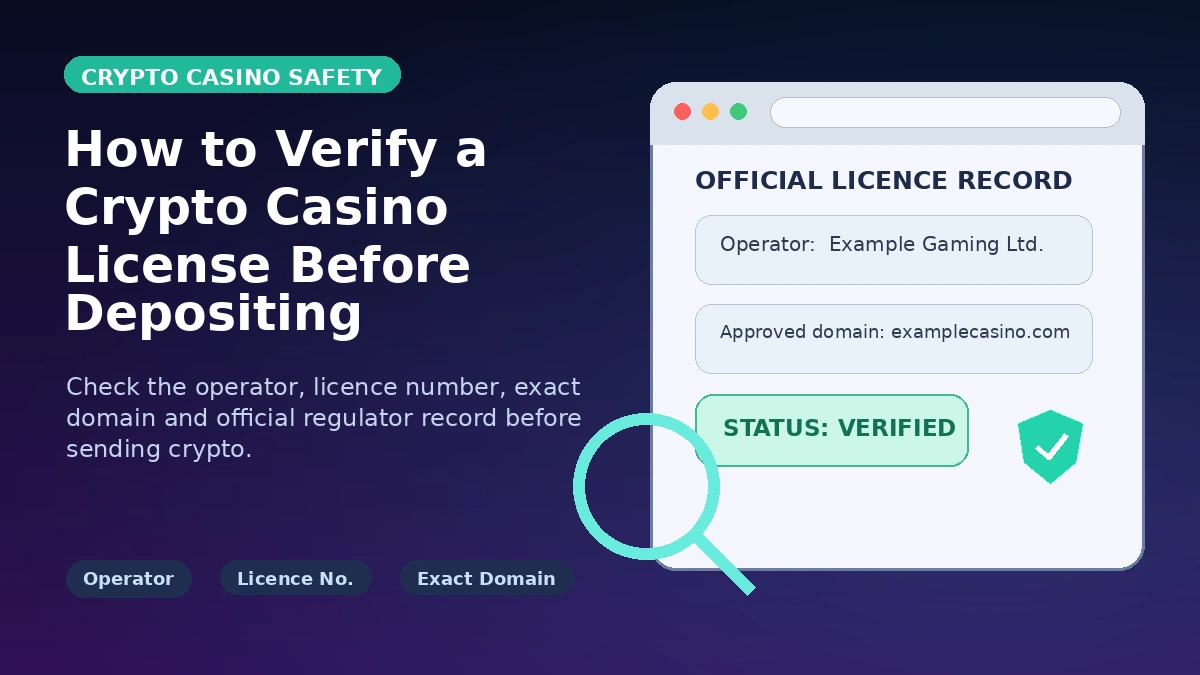
A crypto casino license should be verified by matching seven separate facts:
- The casino brand.
- The legal company operating it.
- The license number.
- The current license status.
- The exact website domain.
- The activity covered by the authorization.
- The regulator or complaint route.
A badge in the footer is not enough.
The safest process is to copy the operator and license details from the casino’s footer and Terms, open the regulator’s official register independently, and compare the company, license status, domain and B2C scope. If the official record does not list the domain being used—or the Terms name a different company—the licensing claim is incomplete until the mismatch is explained.
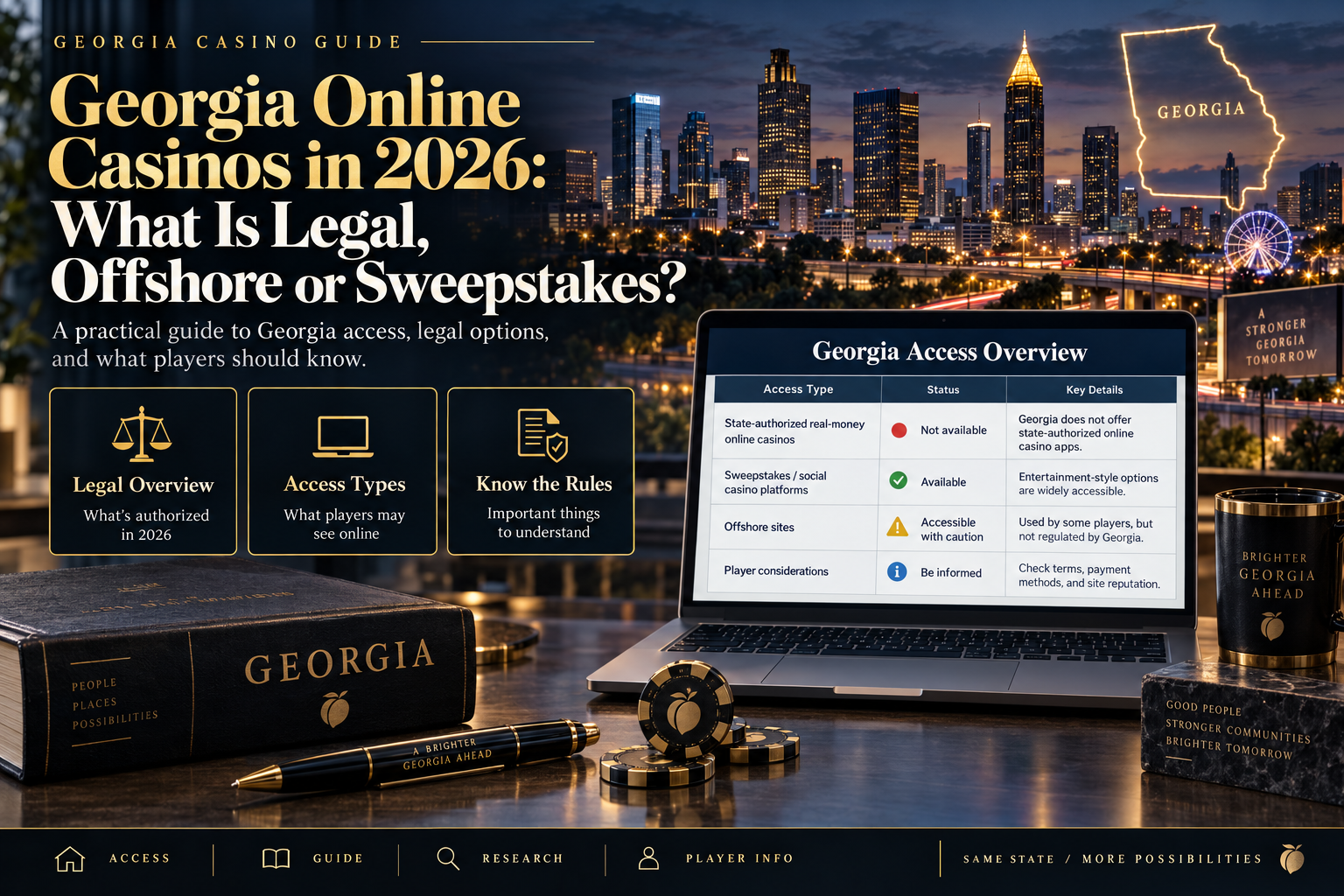
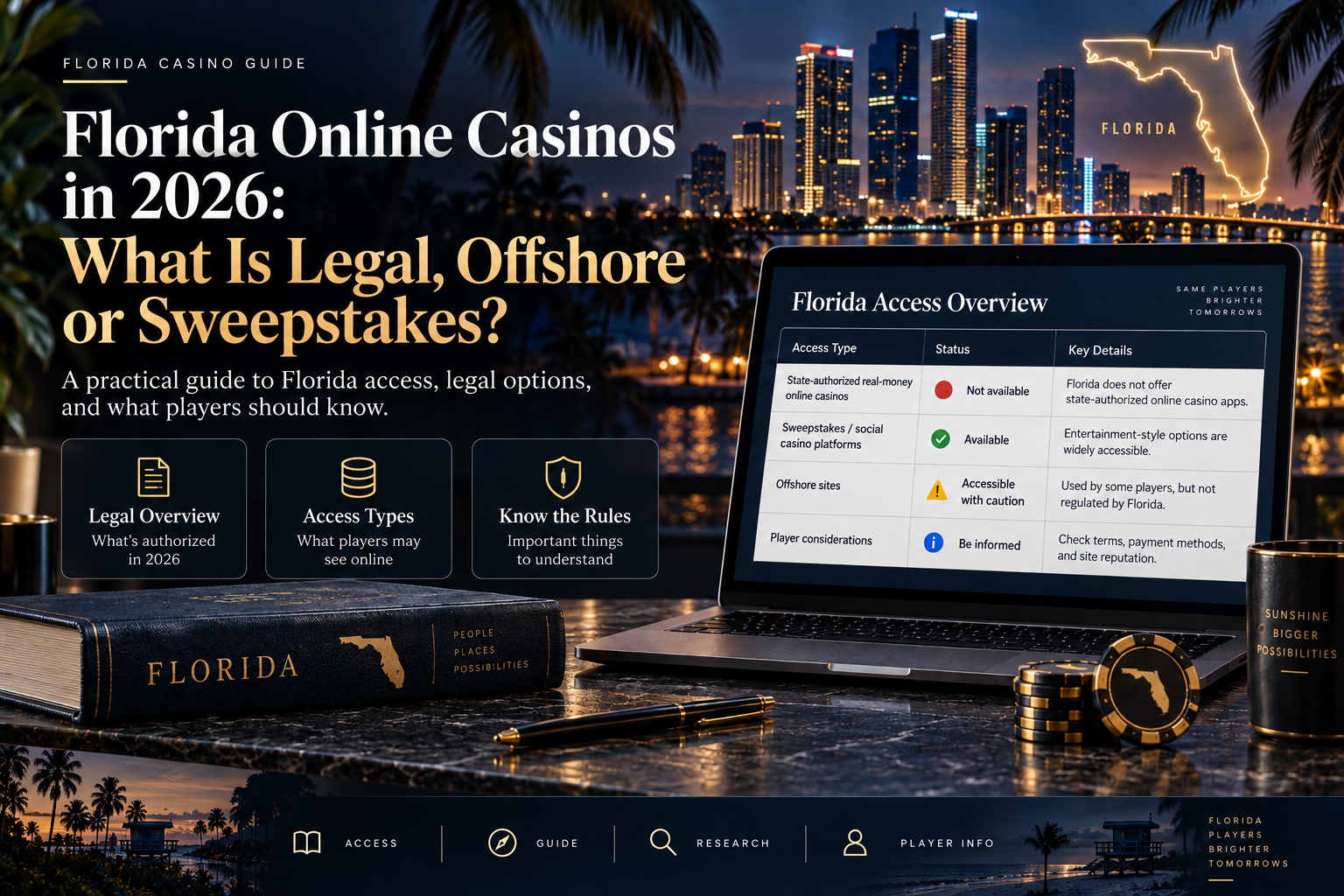
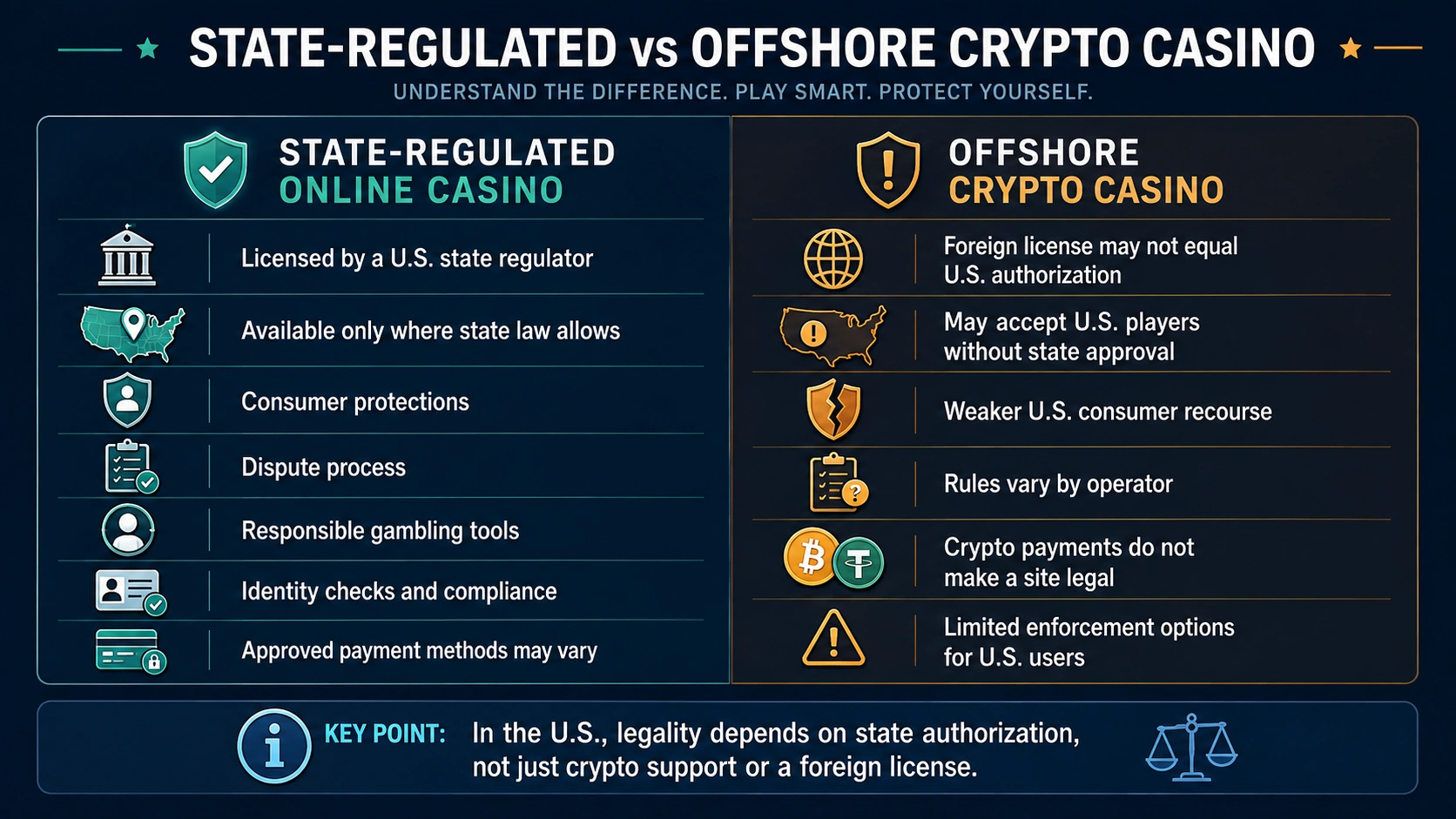
A valid offshore license also does not make a crypto casino legal throughout the United States. US online-casino authorization is state-specific, and only seven states operated lawful online-casino markets during 2025.
Crypto casino license verification at a glance
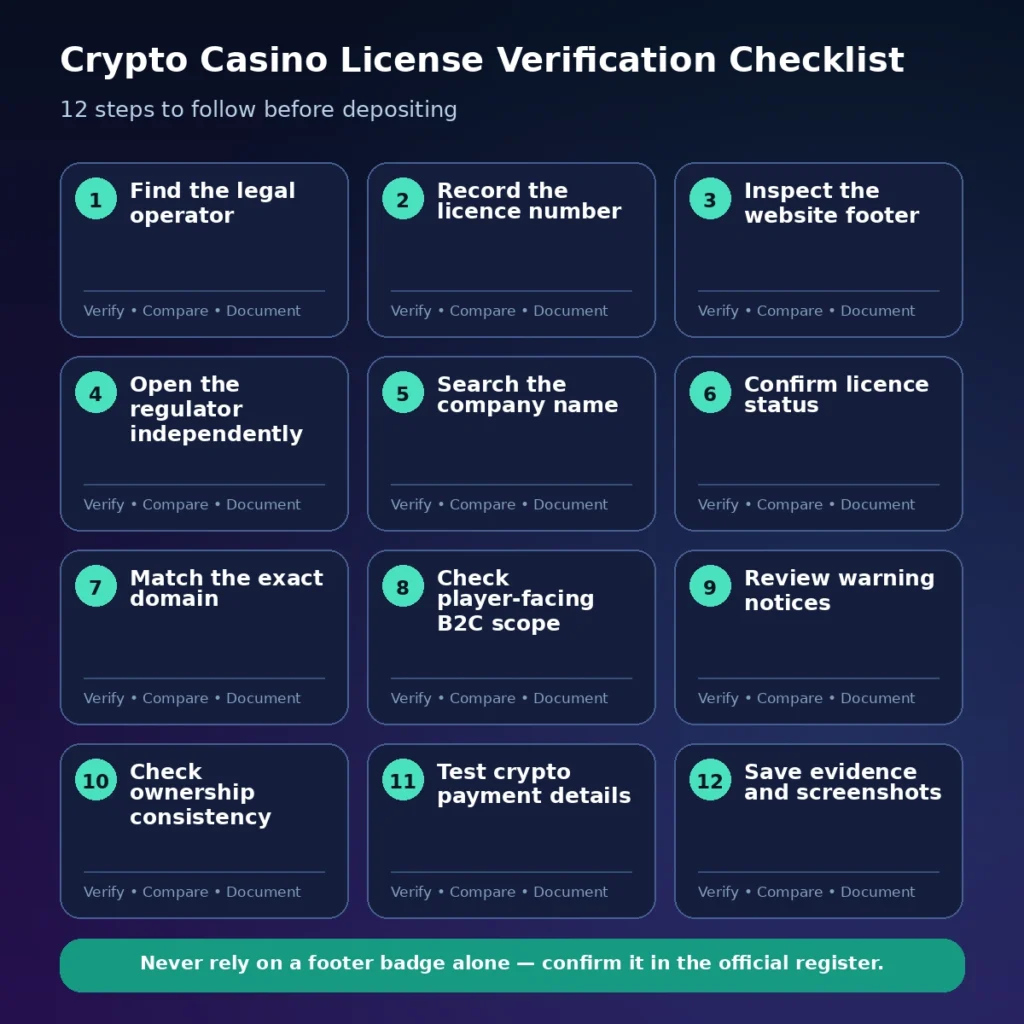
| Check | Pass condition | Warning condition |
| Legal operator | Same company appears in footer, Terms and official record | Different or missing companies |
| License number | Exact number appears in regulator record | Number cannot be found |
| Status | Active, licensed or current | Suspended, revoked, surrendered, expired or unclear |
| Domain | Exact casino domain is approved | Different brand or domain appears |
| License type | B2C or player-facing authorization | B2B or software-only authorization |
| Product scope | Casino activity is covered | Only sports, poker, supplier or another activity |
| Complaint path | Regulator or ADR route is clearly stated | Support is the only route |
| KYC policy | Document triggers are disclosed | “No KYC ever” conflicts with Terms |
| Withdrawal rules | Limits, fees and reviews are published | Rules appear only after a win |
| Crypto network | Supported coin and chain are identified | Vague “USDT accepted” wording |
| Responsible gambling | Limits and self-exclusion are accessible | Tools are missing |
| US eligibility | State authorization or lawful eligibility is confirmed | “US friendly” is the only evidence |
What a crypto casino license can tell you
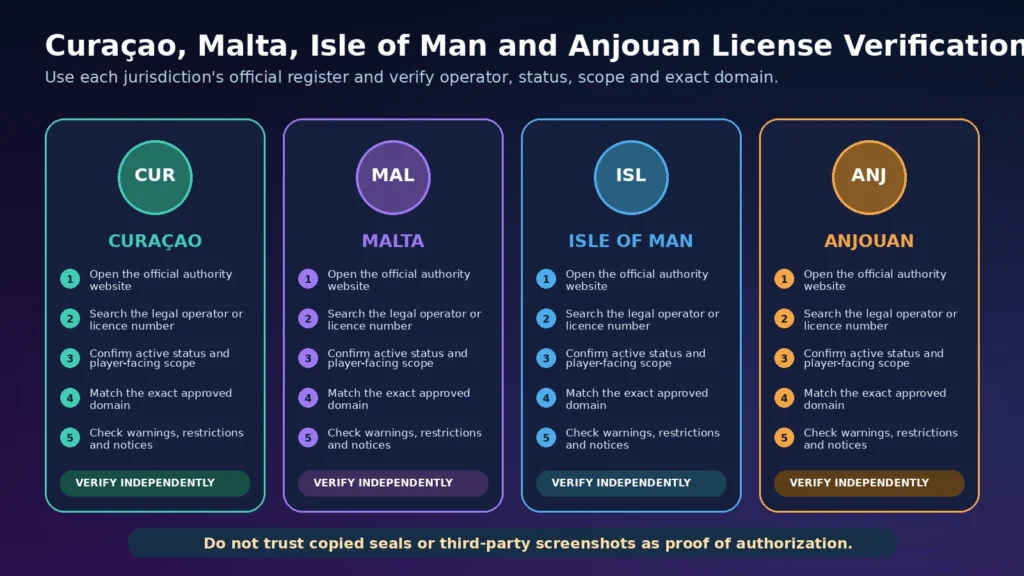
A useful register record may establish:
- The licensed legal company.
- A license or authorization number.
- The current regulatory status.
- The approved website or operational domain.
- Whether the license is B2C or B2B.
- The gambling products or services covered.
- The authorization start date.
- A complaint, enforcement or alternative-dispute route.
- Whether the regulator recognizes the operator behind the brand.
For example, the MGA register can be searched by licensee name, status, URL or gaming service, while its dynamic seals provide additional authorization details.
The Isle of Man GSC’s register lists the license holder, status, valid-from information, license type and website where relevant. Its current register was last updated on July 8, 2026.
What a license cannot guarantee
A license does not guarantee:
- That every withdrawal will be immediate.
- That an account will never be reviewed.
- That KYC will never be requested.
- That a bonus has favorable terms.
- That the casino is lawful in the player’s state.
- That cryptocurrency can be recovered after a wrong transfer.
- That the operator will never receive complaints.
- That a dispute will be decided in the player’s favor.
- That a game has no house edge.
- That the player will win.
- That the website is not a clone using another operator’s certificate.
Anjouan’s own public-register page explicitly states that verification confirms the license and status but does not endorse the holder’s services, products or business practices.
Offshore licensing and US authorization are different checks
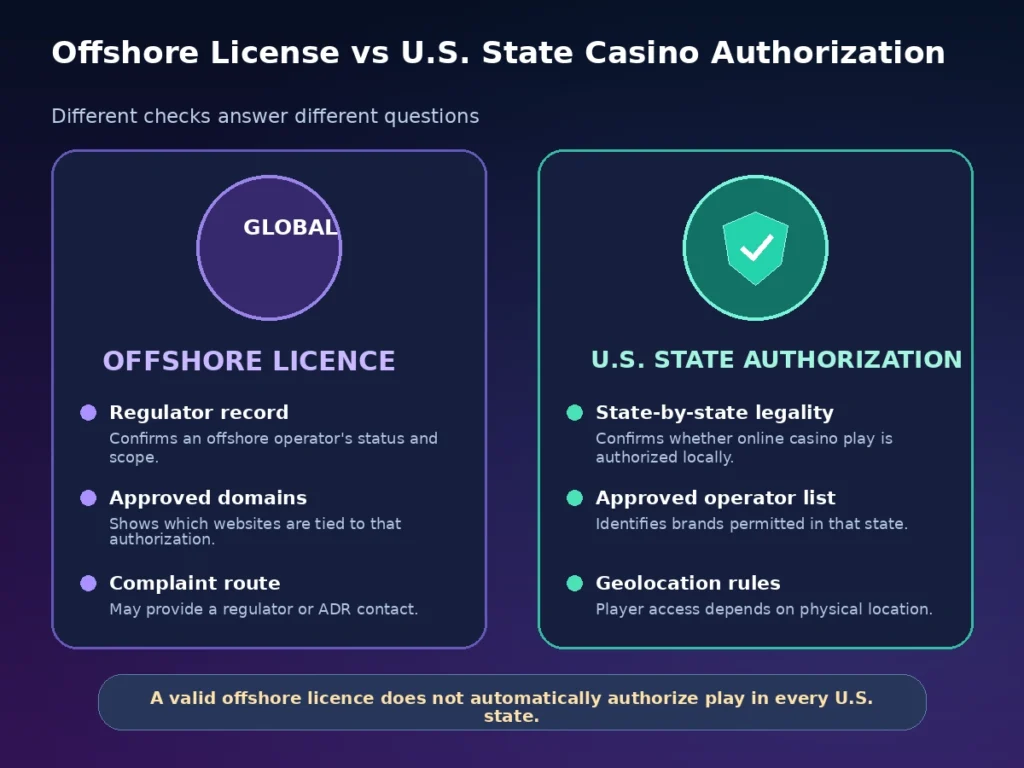
A crypto casino may hold a valid foreign license and still lack authorization from a US state regulator.
For a US reader, verification should happen in this order:
- Check whether real-money online casino gaming is regulated in the state.
- Check the state regulator’s authorized operator or website list.
- Check the casino’s restricted-state terms.
- Then examine any foreign license claimed by the operator.
Pennsylvania’s Gaming Control Board instructs players to verify sites against its regulated interactive-gaming operator list. Its licensed-operator documents identify certificate holders, operators and authorized websites.
A platform being accessible from a US IP address, accepting a US phone number or using the phrase crypto casino USA does not establish state authorization.
Readers comparing market types can use the site’s broader crypto casino USA guide, but a state regulator remains the controlling source for authorization.
Step 1: Identify what type of platform it is
Before checking a license, determine what the website is actually offering.
It may be:
- A state-regulated real-money casino.
- An offshore real-money crypto casino.
- A fiat casino that also accepts cryptocurrency.
- A social casino.
- A sweepstakes platform.
- A sportsbook with casino games.
- A B2B game supplier.
- A decentralized gambling application.
- A Telegram or messaging-platform casino.
- A fake or cloned website.
These models use different legal, payment and dispute structures.
A sweepstakes casino should not be verified as though it were an ordinary offshore real-money casino. A software provider should not be treated as the operator holding player balances.
Step 2: Record the exact domain before checking anything else
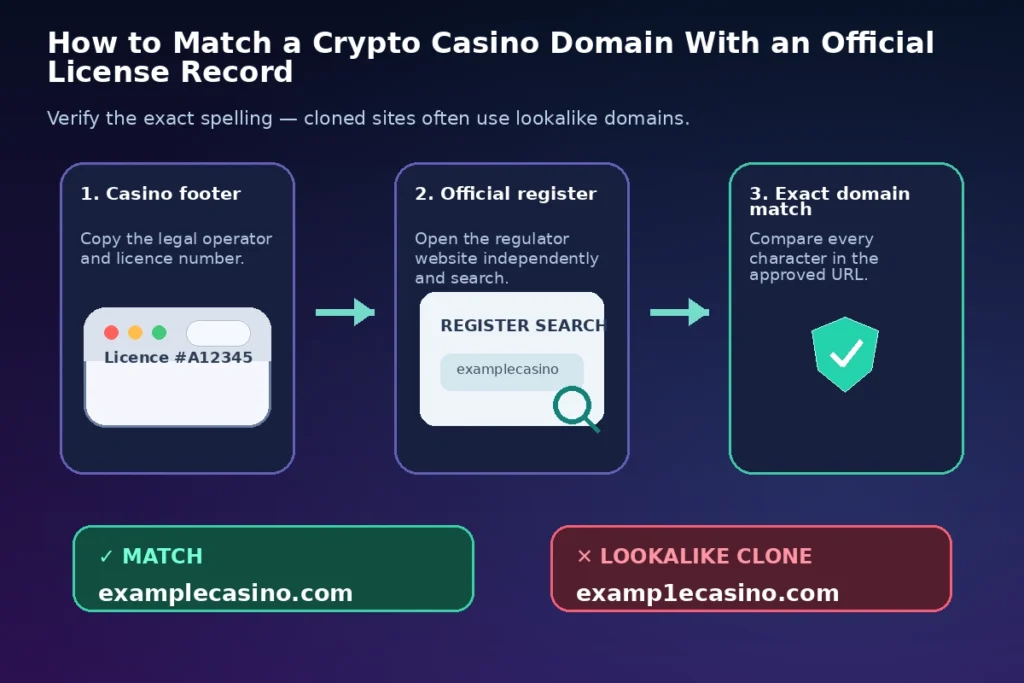
Copy the casino URL exactly as it appears in the browser.
Record:
- The registrable domain.
- Any subdomain.
- The top-level domain, such as .com, .io or .bet.
- Whether the site redirects elsewhere.
- Whether the cashier opens on another domain.
- Whether the login link changes the domain.
- Whether the certificate link names the same site.
Small changes matter:
- examplecasino.com is different from example-casino.com.
- examplecasino.io is different from examplecasino.com.
- casino.example.com belongs to example.com.
- examplecasino-support.com is a separate domain.
- An alternate spelling may be a spoofed website.
The FBI warns that spoofed domains commonly use alternate spellings or different top-level domains to impersonate legitimate websites.
Do not assume the top paid search result is authentic. FBI and FTC guidance recommends accessing known official websites directly and checking destination URLs carefully because fraudulent advertisements and search results can imitate legitimate companies.
Step 3: Inspect the casino footer
Look for:
- Regulator name.
- License number.
- Legal company.
- Registered address.
- Certificate or dynamic-seal link.
- Minimum-age statement.
- Responsible-gambling link.
- Terms and Conditions.
- Privacy policy.
- AML or KYC policy.
- Complaint information.
- Restricted jurisdictions.
A strong footer
A useful footer might state:
The website is operated by Example N.V., company number 123456, under B2C gaming license OGL/2025/000/0000.
The seal should open an official regulator-hosted certificate that lists the same company and domain.
A weak footer
Examples include:
- “Licensed and regulated” with no authority named.
- A regulator logo without a link.
- A license number shown only as an image.
- “Registered in Costa Rica” presented as a remote-gambling license.
- A Curaçao master-license number from the old system without current CGA evidence.
- A supplier badge presented as the casino’s operator license.
- A certificate link hosted on the casino’s own domain.
A footer is the starting point, not the final proof.
Step 4: Compare the footer with the Terms and Conditions
Open the Terms and search for:
- “Operator”
- “Company”
- “License”
- “Governing law”
- “Disputes”
- “Restricted”
- “Verification”
- “AML”
- “Withdrawal”
- “Payment”
The legal operator in the Terms should match the company in the official register.
Treat these mismatches as serious
- Footer names Company A; Terms name Company B.
- Certificate covers Company A; deposits are contracted through Company C.
- License number differs between footer and Terms.
- Terms belong to another casino brand.
- Terms refer to an old domain.
- The governing company is not mentioned anywhere in the register.
- The casino claims one jurisdiction but the Terms rely on another.
White-label arrangements can involve several companies, so a mismatch is not automatic proof of fraud. It does require a clear explanation of which company accepts deposits, operates the games and owes the player’s balance.
Step 5: open the official regulator register independently
Do not rely solely on the certificate link provided by the casino.
A safer method is:
- Find the regulator’s official website independently.
- Open its licensee register.
- Search the company name.
- Search the license number.
- Search the casino domain.
- Compare all available results.
This reduces the risk of following a copied or spoofed certificate link.
Official verification routes covered in this guide
| Jurisdiction | Public verification method | Main information available |
| Malta | MGA Licensee Register and Dynamic Seal | Licensee, status, authorization, URLs, gaming service and additional details |
| Isle of Man | GSC Online Gambling Licensee Register | Company, status, validity, OGRA license type and website |
| Curaçao | CGA dynamic seal and Certificate of Operation | Operator, approved domain, license number and current status |
| Anjouan | Public register search | Company, number, B2C/B2B type and current status |
| US state market | State regulator operator or website list | State-authorized operator and approved website |
| Costa Rica | Corporate, tax and municipal evidence | Business structure; not an equivalent remote-casino register |
Official sources support the verification methods above.
Step 6: Check the current license status
Common statuses include:
- Active.
- Licensed.
- Current.
- Provisional.
- Suspended.
- Revoked.
- Cancelled.
- Surrendered.
- Expired.
- Former license holder.
- Pending.
Only a current authorization should be treated as active evidence.
A casino may continue displaying an old badge after a license is surrendered or cancelled. The Isle of Man GSC maintains both current and former-license-holder pages, while the MGA separately publishes enforcement information.
Provisional does not mean final
A provisional license may authorize limited or transitional activity under specific conditions. Do not rewrite “provisional” as “fully licensed.”
Suspended means stop
A suspended license should not be treated as active simply because the casino remains reachable.
Step 7: Match the exact approved domain
This is one of the most important checks.
A genuine license held by the correct company does not automatically cover every domain using that company’s name.
Confirm that:
- The domain appears in the official record.
- The spelling matches exactly.
- The top-level domain matches.
- The certificate is generated for that domain.
- Redirects remain within listed or clearly related authorized domains.
- The cashier domain is explained.
- The mobile website is covered where relevant.
Curaçao’s current system specifically links dynamic seals to authorized domains approved by the CGA, and each seal corresponds to the operator’s Certificate of Operation.
An authentic CGA Certificate of Operation can list the domain, legal operator, company number, license number, grant date and current status.
Domain-match outcomes
| Result | Interpretation |
| Exact domain listed | Stronger evidence |
| Official record lists brand and company but not domain | Incomplete; seek confirmation |
| Domain differs only because of a documented regional version | Verify the regional domain separately |
| Certificate lists another casino | Fail |
| Domain redirects to an unlisted site | High caution |
| Badge opens a certificate hosted by the casino itself | Unverified |
| Certificate opens on regulator domain but names another operator | Fail |
Step 8: Confirm that the authorization is player-facing
A casino may display a genuine B2B or supplier license.
That proves something about the supplier, but it may not prove that the brand taking deposits has a B2C authorization.
B2C license
Generally relates to a business offering gambling services to players.
B2B license
Generally relates to:
- Game development.
- Platform supply.
- Software.
- Aggregation.
- Technical services.
- Live-dealer supply.
- Payment or infrastructure services.
The MGA states that a B2C Gaming Service Licence is required for entities offering gaming services under the covered circumstances. Its dynamic seals distinguish license types.
The CGA similarly distinguishes B2C licensing to offer games of chance from B2B licensing to supply services to licensed operators.
The Isle of Man register includes Full, Network Services and Software Supply license types, making it necessary to check whether the listed activity matches the casino’s player-facing role.
Ask one practical question
Which authorized company has the contract with the player and holds the account balance?
A game supplier’s logo does not answer that question.
Step 9: Check enforcement, complaints and player-protection routes
A stronger verification process looks beyond active status.
Check for:
- Enforcement register.
- Former-license-holder list.
- Public statements.
- Regulator complaint form.
- Approved ADR provider.
- Casino internal complaint procedure.
- Escalation deadline.
- Required supporting evidence.
- Responsible-gambling rules.
The MGA’s player-protection information requires license details, a dynamic seal or kite mark, responsible-gambling information and access to safer-gambling tools.
The Isle of Man GSC publishes public statements and a complaint route for license holders.
A complaint route is useful, but it does not promise reimbursement or a favorable decision.
Step 10: Review KYC, withdrawal and bonus terms
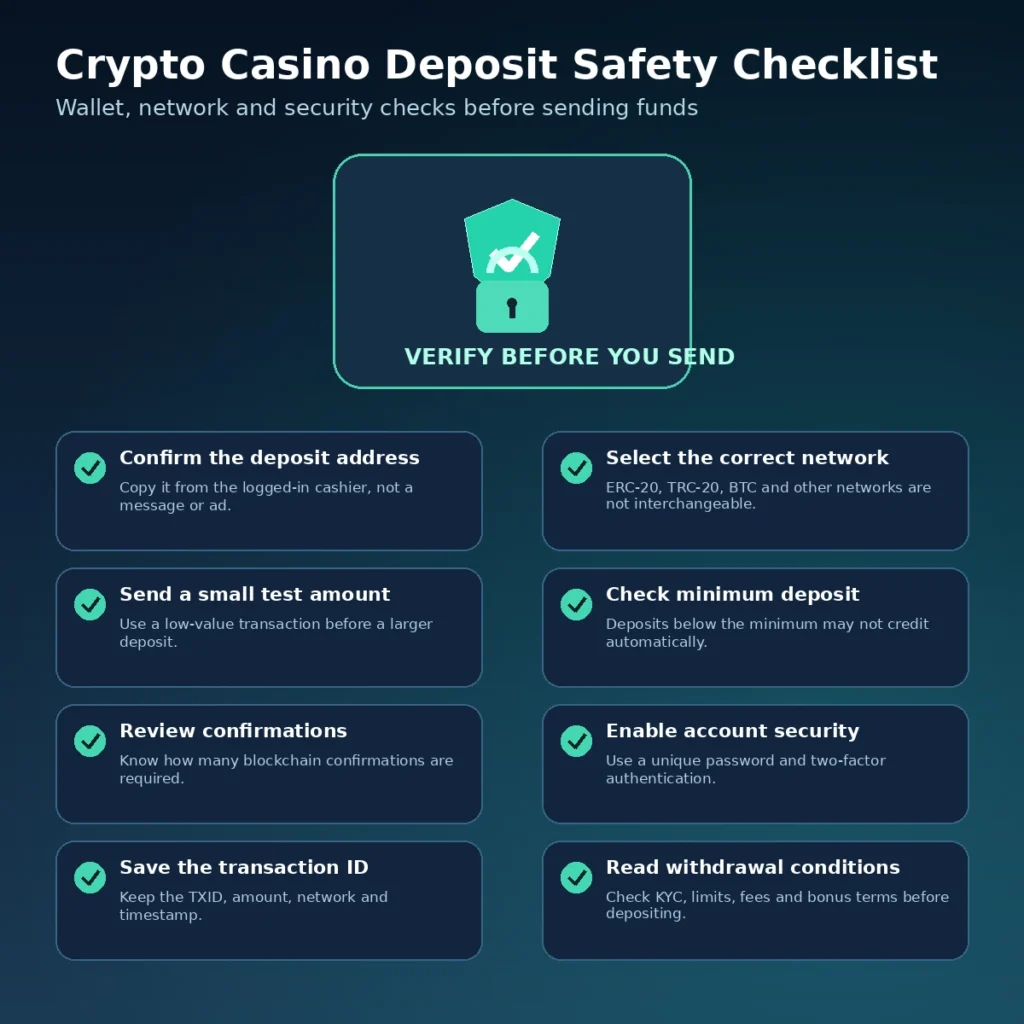
License verification should never be separated from account terms.
KYC questions
Check whether the casino can request:
- Government identification.
- Proof of address.
- Payment-ownership evidence.
- Wallet-ownership evidence.
- Source-of-funds information.
- Selfie or liveness check.
- Enhanced due diligence.
- Location verification.
A site marketed as a no KYC crypto casino may mean only that documents are not requested at registration. If the Terms permit checks during withdrawals or security reviews, it is not an unconditional no-verification service.
The referenced market research follows the same approach: no-KYC claims should be checked against the Terms, AML policy and withdrawal rules rather than homepage marketing.
Withdrawal questions
Record:
- Minimum withdrawal.
- Maximum transaction.
- Daily, weekly or monthly limits.
- Internal processing period.
- Pending or cooling-off period.
- KYC triggers.
- Bonus review.
- Withdrawal fees.
- Supported networks.
- Account-closure rules.
- Dormant-account fees.
“Instant withdrawal” may describe the blockchain stage after casino approval. It does not necessarily mean that the operator performs no internal review.
The site’s instant withdrawal crypto casinos guide discusses the distinction between casino approval and blockchain settlement.
Bonus questions
Before accepting a crypto casino no deposit bonus or welcome match, verify:
- Wagering requirement.
- Whether wagering applies to bonus only or deposit plus bonus.
- Maximum bet.
- Eligible games.
- Excluded payment methods.
- Bonus expiry.
- Maximum cashout.
- Verification conditions.
- Country restrictions.
- Withdrawal forfeiture rules.
Readers comparing offers can review the site’s crypto casino bonuses guide after verifying the license and legal operator.
Step 11: Perform crypto-specific payment checks
A gambling license is only one part of crypto-casino due diligence.
Confirm the exact network
For assets such as USDT, identify whether the casino supports:
- ERC20.
- TRC20.
- Solana.
- BNB Smart Chain.
- Polygon.
- Another network.
The same token name can exist on incompatible networks.
Confirm the deposit address inside the official cashier
Do not use an address sent through:
- Telegram.
- Discord.
- Social media.
- An unsolicited support message.
- A copied advertisement.
- A direct message from an “account manager.”
Never share a seed phrase or private key
A genuine casino support process does not require control of the user’s wallet.
Treat crypto transfers as difficult or impossible to reverse
The FTC warns that when cryptocurrency is sent to the wrong person, a wallet is compromised or a platform fails, there may be no institution able to recover the funds.
Use account security
Enable:
- Multi-factor authentication.
- Withdrawal-address confirmation.
- Login notifications.
- Strong, unique passwords.
- Device-session review.
- Anti-phishing codes where available.
CISA notes that multi-factor authentication makes unauthorized access more difficult even when a password has been compromised.
Step 12: Save evidence before making a deposit
Create a folder containing:
- Casino URL.
- Date and time of verification.
- Footer screenshot.
- Terms PDF or screenshot.
- Legal company.
- License number.
- Regulator register result.
- Domain listing.
- Status.
- KYC policy.
- Withdrawal policy.
- Bonus terms.
- Restricted-country list.
- Chat transcripts.
- Support email address.
- Wallet network and deposit instructions.
This record matters because websites, terms and license statuses can change.
When the checks pass and real-money play is lawful, avoid maintaining a larger casino balance than necessary. Cryptocurrency held with a casino is not equivalent to money in an insured bank account.
Malta Gaming Authority license verification
The MGA provides one of the clearest public verification models.
What to check
- Open the MGA Licensee Register independently.
- Search the legal company.
- Search the casino URL.
- Open the Dynamic Seal.
- Confirm the license status.
- Check whether the authorization is B2C.
- Review the gaming service or approved vertical.
- Check the website URLs.
- Review any ADR or complaint information.
- Search the Enforcement Register.
The MGA register supports searches by licensee name, authorization status, URL and gaming service.
Main MGA warning signs
- Static MGA logo without a dynamic link.
- Dynamic seal lists a different website.
- Only a B2B critical-supply license is shown.
- Status is suspended or cancelled.
- The casino is absent from the URL list.
- The company in the Terms differs from the licensee.
What an MGA license still does not prove
It does not establish US state authorization or remove the casino’s KYC and withdrawal rules.
Isle of Man GSC verification
The Isle of Man GSC maintains an Online Gambling Licensee Register.
What the register can show
- Company name.
- Current status.
- Valid-from date.
- Whether the license remains current.
- OGRA license type.
- Website domain where relevant.
The GSC states that where a holder actively offers services to the public, the relevant website address is included in its company profile.
License types require interpretation
The register may show:
- Full license.
- Network Services.
- Software Supply.
- Other approved activities.
A Software Supply entry should not be treated as evidence that the supplier itself accepts player deposits.
Check former holders and enforcement
The GSC publishes former license holders and public statements, including cancellations and surrenders.
Curaçao Gaming Authority verification
Curaçao’s current framework requires checking present CGA evidence, not relying on old master-license terminology.
The Curaçao Gaming Authority states that the National Ordinance on Games of Chance created the current online-gaming regulatory framework and that CGA dynamic seals connect to authorized operator domains.
Current Curaçao check
- Confirm the legal operator.
- Open the CGA seal.
- Confirm the certificate is hosted on the CGA certificate domain.
- Check the exact approved casino domain.
- Check the license number.
- Check current status.
- Confirm the license is B2C.
- Compare the operator with the Terms.
- Review complaints, KYC and withdrawals.
Old orange-seal warning
The CGA states that the former orange seal and sub-license Certificate of Operation are no longer valid and that licensed operators must use the new system.
Example of strong certificate evidence
A current CGA Certificate of Operation may state:
- Exact domain.
- Legal operator.
- Curaçao company number.
- License number.
- Grant date.
- Active status.
That is much stronger than a generic “Curaçao licensed” footer sentence.
Anjouan license verification
Anjouan provides a public register searchable by:
- License number.
- Company name.
- Operational domain.
Results can show:
- Registered license holder.
- License number.
- B2C or B2B type.
- Current status.
Anjouan checklist
- Search all three fields where possible.
- Confirm the operational domain.
- Confirm the company matches the Terms.
- Check B2C versus B2B.
- Record the current status.
- Look for an expiry or issue date where shown.
- Review the casino’s own complaint and withdrawal terms.
- Contact the authority when the expected result is missing.
The register states that its data is updated periodically and advises contacting the authority for time-sensitive verification.
Important limitation
Anjouan verification confirms the license record. The authority itself says it does not endorse the operator’s services or business practices.
Costa Rica claims require different treatment
A website may say:
- “Licensed in Costa Rica.”
- “Registered and regulated in Costa Rica.”
- “Operating under Costa Rican law.”
- “Authorized by a municipal business license.”
These phrases require careful interpretation.
Costa Rica’s Law 9050 establishes taxes for authorized land-based casinos and companies involved in receiving and processing data generated by electronic betting. It does not provide the kind of public, player-facing remote-casino license register used by the MGA, CGA, Anjouan or Isle of Man.
What Costa Rican evidence may establish
- Company incorporation.
- Tax registration.
- Municipal permission.
- Local business operations.
- Data-processing activity.
- Corporate address.
What it does not establish by itself
- A remote B2C casino license.
- Approval of the casino domain.
- An online-gambling complaint route.
- Player-fund protection.
- US legal authorization.
- Independent game approval.
- Guaranteed withdrawals.
A corporate registration is not worthless, but it must not be presented as equivalent to a gambling-regulator authorization.
How to verify a state-regulated US casino
For a state-regulated operator:
- Open the state regulator’s official website.
- Find the interactive-gaming operator list.
- Confirm the brand.
- Confirm the authorized domain.
- Check the land-based certificate holder or partner where applicable.
- Verify that the player is physically located in the permitted state.
- Review the regulator’s complaint instructions.
Pennsylvania’s regulator publishes a dedicated operator-verification page and tells users to verify that a site is PGCB-regulated before betting.
Offshore versus state-regulated
| Issue | Offshore license | US state authorization |
| Issuing authority | Foreign regulator | State regulator |
| US legality | Not established by foreign license | Applies within authorized state framework |
| Geolocation | Operator-dependent | Formal state location controls |
| KYC | Operator and regulator rules | Normally required under state controls |
| Complaint path | Offshore authority or ADR | State regulator |
| Domain approval | Depends on jurisdiction | Authorized operator/site listing |
| Cryptocurrency | May be central payment method | Availability depends on operator and state rules |
A foreign license can still provide useful evidence. It should not be described as a US license.
How dynamic seals differ from static logos
Static logo
A normal image copied into the footer.
It can be:
- Genuine.
- Outdated.
- Copied.
- Edited.
- Linked to the wrong page.
- Unconnected to any license.
Dynamic seal
A regulator-linked verification element intended to display current license information.
A stronger seal:
- Opens on the official regulator domain.
- Identifies the legal operator.
- Shows the license number.
- Shows current status.
- Lists the approved domain.
- Identifies the license type.
The CGA recommends dynamic implementation to reduce the risk of alteration, while the MGA uses dynamic seals to provide authorization details.
HTTPS alone is not proof. CISA has warned that phishing websites can appear legitimate and secure while still being fraudulent.
B2C versus B2B: a worked example
Suppose a casino footer shows a well-known game supplier’s B2B license.
The supplier may be authorized to provide:
- Slots.
- Live games.
- Platform technology.
- Game aggregation.
But the casino account is operated by another company.
What remains unverified
- The company accepting player deposits.
- The company holding balances.
- The approved casino domain.
- The withdrawal contract.
- The player-facing complaint route.
The correct conclusion is:
The supplier’s B2B license is verified, but the casino operator’s B2C authorization remains unverified.
Do not upgrade that to “the casino is fully licensed.”
Does “no KYC” mean the casino has no compliance checks?
No.
A no-KYC claim may mean:
- No documents at sign-up.
- Email-only registration.
- Wallet-based login.
- No routine verification below certain limits.
- Risk-based verification.
- Verification only at withdrawal.
- Verification after suspicious activity.
- Verification for payment ownership.
Check the Terms, AML policy and withdrawal page.
Warning signs
- “No KYC under any circumstances.”
- Terms reserve broad verification rights but marketing says “completely anonymous.”
- The casino requests documents only after a large win without having disclosed the possibility.
- Support refuses to explain document retention.
- The privacy policy does not identify the data controller.
- A license claim is used to imply that no verification can occur.
The site’s USDT research similarly explains that cryptocurrency deposits can reduce banking disclosure without preventing later account or payment verification.
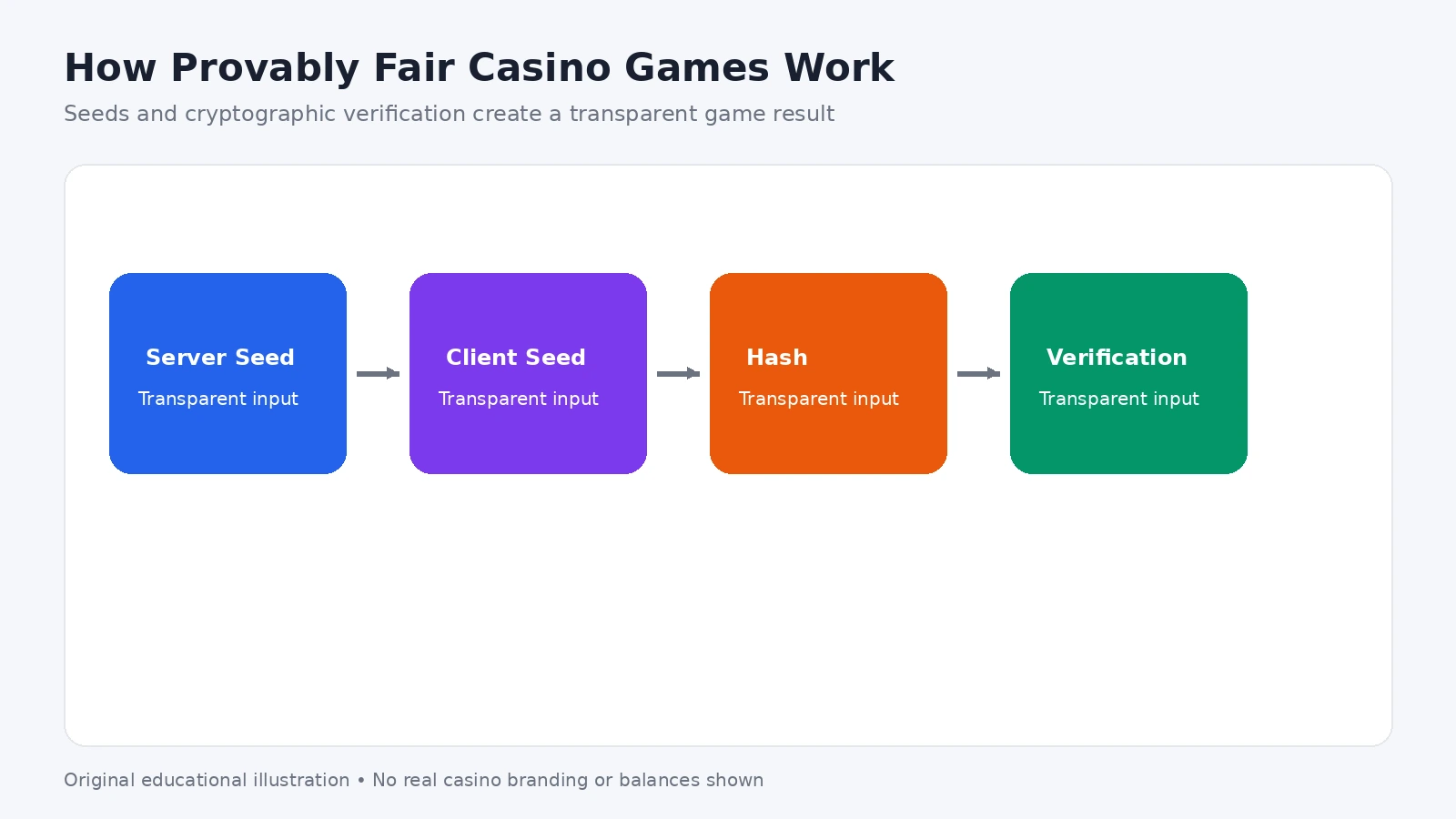
Does provably fair mean a crypto casino is licensed?
No.
A provably fair system may allow a player to verify that a result was not changed after the bet.
It does not prove:
- Operator licensing.
- Legal US availability.
- Player-fund segregation.
- Withdrawal reliability.
- Bonus fairness.
- KYC transparency.
- Website security.
- Solvency.
- Customer-support quality.
It may also apply only to selected in-house games such as crash, dice, mines or Plinko. Third-party slots and live-dealer games may use other testing or certification methods.
Readers comparing game formats can use the site’s crypto casino games overview.
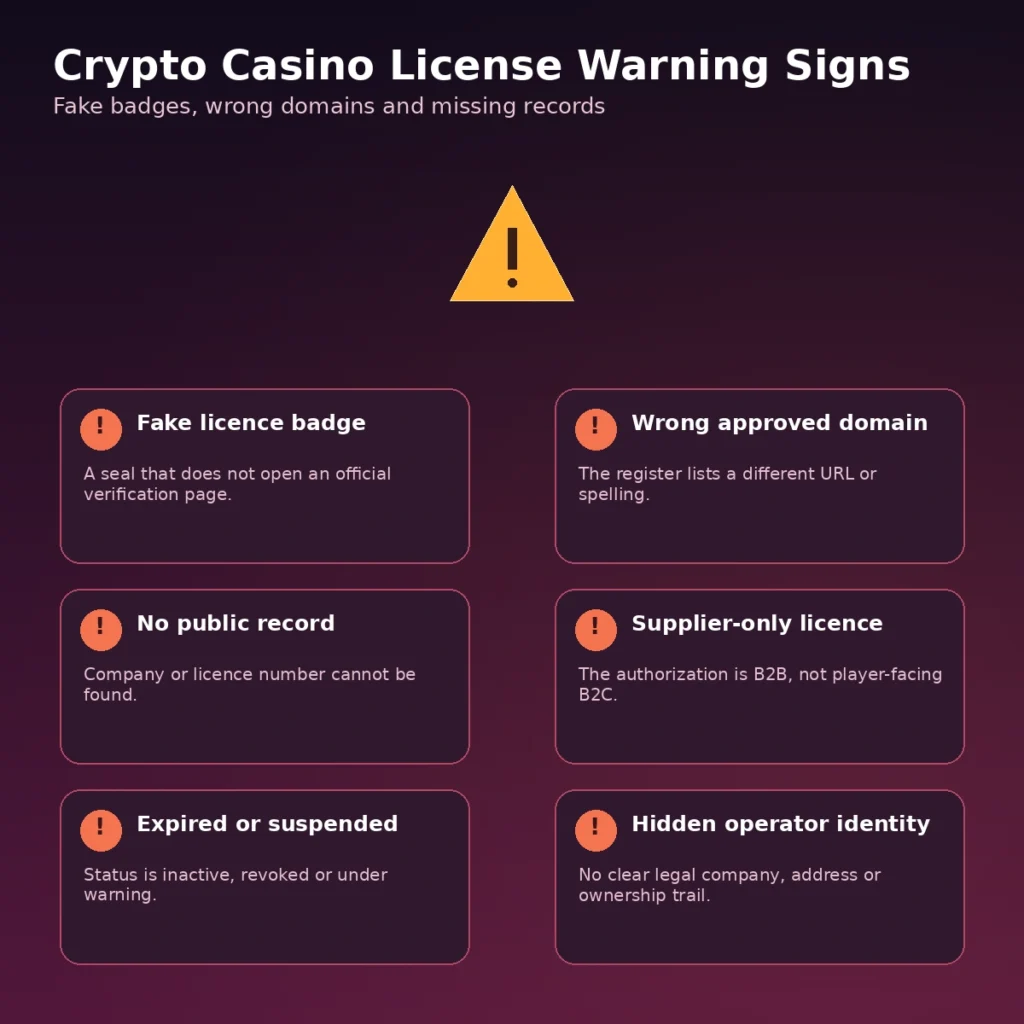
Major warning signs of a fake or weak license claim
1. The badge is not clickable
A static logo provides no current evidence.
2. The link does not open an official regulator domain
A certificate hosted on the casino website can be fabricated.
3. The company does not match
The footer, Terms and register name different legal entities.
4. The casino domain is missing
The operator may be licensed, but the website may not be approved.
5. The status is not active
Suspended, surrendered, cancelled or expired records are not current authorization.
6. Only a B2B license appears
Supplier authorization is presented as player-facing licensing.
7. An old Curaçao sub-license is used
Legacy wording or the former orange seal appears without a current CGA license.
8. Costa Rica registration is called regulation
Corporate or tax evidence is presented as a remote casino license.
9. The Terms appear copied
They contain another brand, outdated URL or unrelated company.
10. The operator hides withdrawal rules
Limits and KYC conditions appear only after a deposit.
11. The casino asks for another deposit to release a withdrawal
A request to pay “tax,” “security,” “unlock” or “verification” fees by depositing more crypto is a severe warning sign.
12. Support asks for wallet credentials
Never provide a seed phrase, private key or remote access.
13. The site encourages a VPN to bypass restrictions
Violating location terms can expose the account to closure or balance disputes.
14. The domain is a lookalike
Misspellings, extra hyphens and alternate top-level domains can indicate impersonation.
15. There is no identifiable operator
A brand name and chat widget are not a legal entity.
Webopedia’s supplied scam reference also prioritizes fake licensing, cloned websites, withdrawal traps, phishing and wallet-drainer attacks, although individual examples and statistics from that page should be independently verified before reuse.
Worked verification example 1: active company, wrong domain
Casino claim: Licensed by the MGA.
Register result:
- Company exists.
- License is active.
- B2C authorization exists.
- Listed websites do not include the casino domain.
Verdict: Incomplete or failed domain verification.
The existence of the company’s license does not prove that the website is authorized.
Worked verification example 2: genuine B2B supplier license
Casino claim: “Fully licensed by the MGA.”
Seal result:
- Company is a game supplier.
- Status is active.
- License type is B2B.
- Casino brand is operated by another company.
Verdict: Supplier license verified; casino operator unverified.
Worked verification example 3: current CGA certificate
Casino claim: Curaçao licensed.
Certificate result:
- Opens on the CGA certificate domain.
- Exact domain is named.
- Operator matches the Terms.
- B2C license number is listed.
- Status is active.
Verdict: Foreign licensing claim verified.
Additional checks are still needed for US eligibility, withdrawal terms and KYC.
Worked verification example 4: Costa Rica registration
Casino claim: “Licensed in Costa Rica.”
Evidence:
- Company registration exists.
- Municipal business evidence exists.
- No public remote-gambling license record exists.
- No approved-domain register is provided.
Verdict: Corporate evidence verified; remote casino license not established.
A practical crypto-casino risk rating
This is not a legal rating or guarantee. It is a way to describe the amount of public evidence.
| Risk label | Typical evidence |
| Lower observable uncertainty | Active B2C license, exact domain match, identifiable operator, current Terms, clear withdrawals, complaint route and player tools |
| Moderate uncertainty | License and company match, but domain, complaint or policy details are incomplete |
| Elevated uncertainty | Offshore claim with weak domain proof, unclear ownership or inconsistent Terms |
| High uncertainty | Missing register entry, wrong domain, B2B-only license, inactive status or withdrawal rules hidden |
| Unverifiable | Insufficient public evidence to reach a conclusion |
A “lower uncertainty” label does not mean risk-free. It means more of the operator’s claims can be checked independently.
Should independent reviews and Reddit be used?
Yes, but only after official verification.
Reviews and forums can reveal:
- Repeated withdrawal complaints.
- Surprise KYC requests.
- Bonus disputes.
- Account closures.
- Operator rebrands.
- Shared ownership across casino brands.
- Support problems.
- Changes in restricted states.
They cannot prove:
- Legal authorization.
- Current license status.
- Game fairness.
- Future payout behavior.
- That every positive or negative report is genuine.
The site’s best crypto casino Reddit guide explains why detailed withdrawal reports are more useful than referral-heavy recommendations.
New crypto casinos require more documentary evidence
A new operator may not have years of player feedback.
That does not prove it is unsafe, but it increases the importance of:
- Current license evidence.
- Exact domain match.
- Identifiable ownership.
- Clear withdrawal rules.
- Published KYC policy.
- Established game suppliers.
- Responsible-gambling controls.
- Responsive official support.
- No contradictory company names.
- No demand for deposits to unlock withdrawals.
Popularity should never substitute for verifiability.
What to save if a dispute begins
Preserve:
- Full casino URL.
- License evidence.
- Date of registration.
- Account identifier.
- Deposit transaction hash.
- Withdrawal request ID.
- Balance screenshots.
- Game history.
- Bonus terms.
- KYC requests.
- Documents submitted.
- Support transcripts.
- Emails.
- Wallet addresses.
- Timestamps.
- Regulator certificate.
- Terms version.
Do not edit screenshots or crop out dates and URLs.
What to do after suspected crypto-casino fraud
Stop sending funds
Do not make another “verification,” “tax” or “unlock” deposit.
Secure connected wallets
When a suspicious site received wallet permissions, review and revoke unnecessary token approvals using a reputable wallet or blockchain tool. Move unaffected funds when compromise is suspected.
Contact the originating exchange
Provide the destination address and transaction hash.
Report impersonation or fraud
US users can report fraud to the FTC and FBI’s Internet Crime Complaint Center. The FTC warns that cryptocurrency recovery can be difficult, and the FBI continues to issue alerts about impersonation and crypto-related fraud.
Contact the regulator
Send the company, domain, license number and supporting records.
Avoid recovery scams
A person promising guaranteed recovery in exchange for another upfront crypto payment may be targeting the victim a second time.
Responsible gambling checks are part of license verification
A regulated operator should normally provide visible player-protection information.
Check for:
- Deposit limits.
- Loss limits.
- Session reminders.
- Timeouts.
- Self-exclusion.
- Access to account history.
- Reality checks.
- Responsible-gambling support.
- A clear method to close the account.
The MGA requires safer-gambling tools and ready access to self-exclusion for its licensed operators.
Crypto can move quickly, but speed does not reduce gambling harm. Keep gambling funds separate from savings and essential expenses.
The National Problem Gambling Helpline provides free, confidential call, text and chat support 24/7 across all 50 states and US territories at 1-800-MY-RESET.
Key takeaways
- A license badge is not proof by itself.
- Match the legal operator, license number, status, domain and B2C scope.
- Open the regulator register independently.
- The exact casino domain should appear in the official record or certificate.
- A B2B supplier license does not automatically authorize a player-facing casino.
- An active offshore license does not establish US state legality.
- The MGA, Isle of Man GSC, CGA and Anjouan provide public verification routes.
- Curaçao’s old orange sub-license seal is no longer valid.
- Costa Rican corporate or tax evidence is not equivalent to a standard remote-casino license.
- “No KYC” does not always mean no later verification.
- Provably fair checks game outcomes, not operator reliability.
- Crypto transfers may be irreversible.
- Never send another deposit to unlock a withdrawal.
- Never share a wallet seed phrase or private key.
- Save the certificate, Terms and payment records before a dispute.
- A verified license reduces uncertainty but does not eliminate gambling or payment risk.
Final verdict
The correct way to verify a crypto casino license is to build a chain of matching evidence.
Start with the exact domain. Identify the legal operator in the footer and Terms. Search the regulator’s official register independently. Confirm the license number, current status and B2C scope. Then verify that the same domain appears in the official certificate or website list.
After the license check, review the casino’s KYC, withdrawal, bonus, country-restriction and complaint rules. For US players, complete a separate state-authorization check because an offshore license does not provide nationwide legal approval.
The practical rule is simple:
Do not deposit when the operator, license, domain and account terms cannot all be connected through current, independently verifiable evidence.
FAQs
Open the regulator’s official register independently and search the legal company, license number and casino domain. Confirm that the status is active and the authorization is player-facing. A footer logo alone is insufficient.
A current CGA license can be valid, but it should be verified through the CGA’s present certificate and dynamic-seal system. The authority states that the former orange sub-license certificate is no longer valid.
Use Anjouan’s public register and search by license number, company name or operational domain. The result can show the holder, B2C or B2B type and current status.
No. Open the MGA Dynamic Seal or Licensee Register and confirm the operator, status, B2C authorization and approved URL. Static logos can be copied.
Costa Rican corporate, tax or municipal evidence may be legitimate, but Costa Rica does not provide an equivalent player-facing remote-casino license register under Law 9050. A company registration should not be presented as the same thing as an MGA, CGA or state online-casino authorization.
No. US online-casino authorization is state-specific. Check the relevant state regulator and its approved-operator list separately.
Yes. The Terms may permit verification during withdrawals, payment checks, fraud reviews or AML procedures. “No KYC” often describes registration rather than a permanent guarantee.
No. It may provide accountability and a complaint route, but withdrawals can still be affected by verification, bonus rules, location restrictions, limits and disputes.
Not usually for a player-facing casino. A B2B authorization may cover software or platform supply. Verify the B2C company that accepts deposits and holds player accounts.
No. It may verify selected game results, but it does not verify licensing, legal access, withdrawals, bonus terms or the security of funds.