
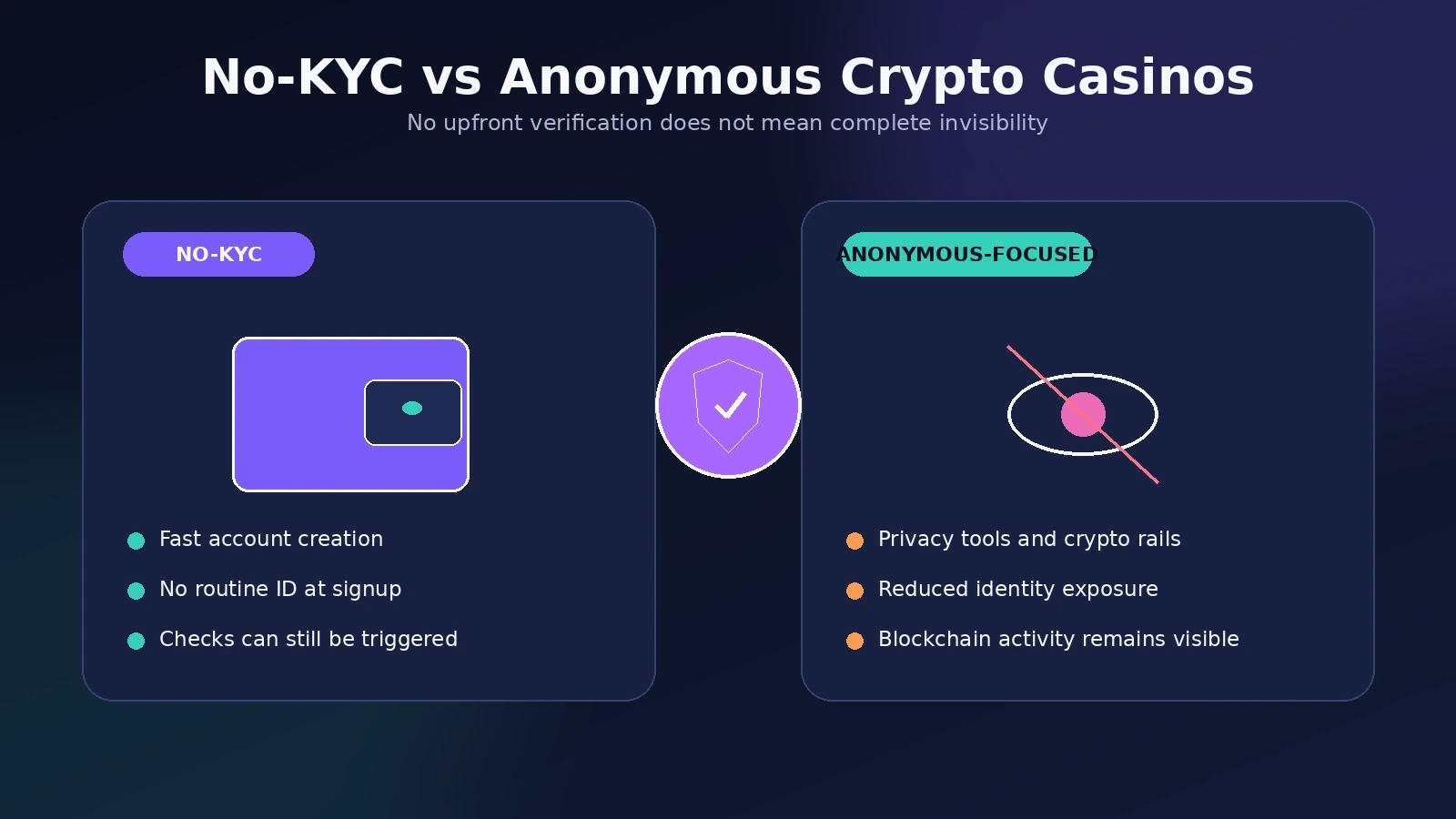
A no-KYC crypto casino can still request identity verification if its terms allow risk-based, conditional or enhanced checks. “No-KYC” usually means documents are not routinely required when an account is opened. It does not necessarily mean the casino has permanently waived its right to verify age, identity, location, payment ownership or source of funds.
An anonymous crypto casino would need to minimize every link between the account and a real person—not just remove the passport upload. That includes registration information, IP and device data, wallet history, payment-provider records and customer-support interactions.
The practical conclusion is straightforward: no-KYC describes a process; anonymity describes an outcome. A casino may offer no-document registration while still collecting enough technical and transaction data to identify risk, link accounts or trigger a later review.
U.S. reader note: Online casino legality and authorized operators vary by state. An offshore site accepting a registration does not prove that it is authorized by the player’s state regulator. This article is informational and does not provide legal or tax advice. The American Gaming Association’s 2026 reporting shows that legal iGaming remains limited to a relatively small number of state markets.
Key Takeaways
● No-KYC is not the same as no monitoring. Casinos can analyze wallet activity, transaction patterns, devices, IP addresses and account behavior without requesting an ID at registration.
● Verification is commonly risk-based. A withdrawal, cumulative transaction threshold, unusual wallet exposure, location conflict or account-security event may escalate the account.
● There is no universal KYC-free withdrawal amount. Thresholds differ by operator, license, risk rating, payment method and account history.
● Bitcoin and most public-chain payments are traceable at the wallet level. Not providing a name does not erase the transaction record.
● Do not split payments to stay below a suspected threshold. Deliberately structuring virtual-asset transactions below monitoring limits is itself recognized as a financial-crime red flag.
● Read the withdrawal and verification terms before depositing. Marketing language is less important than the operator’s binding terms and license conditions.
No-KYC vs Anonymous Crypto Casinos: Quick Comparison
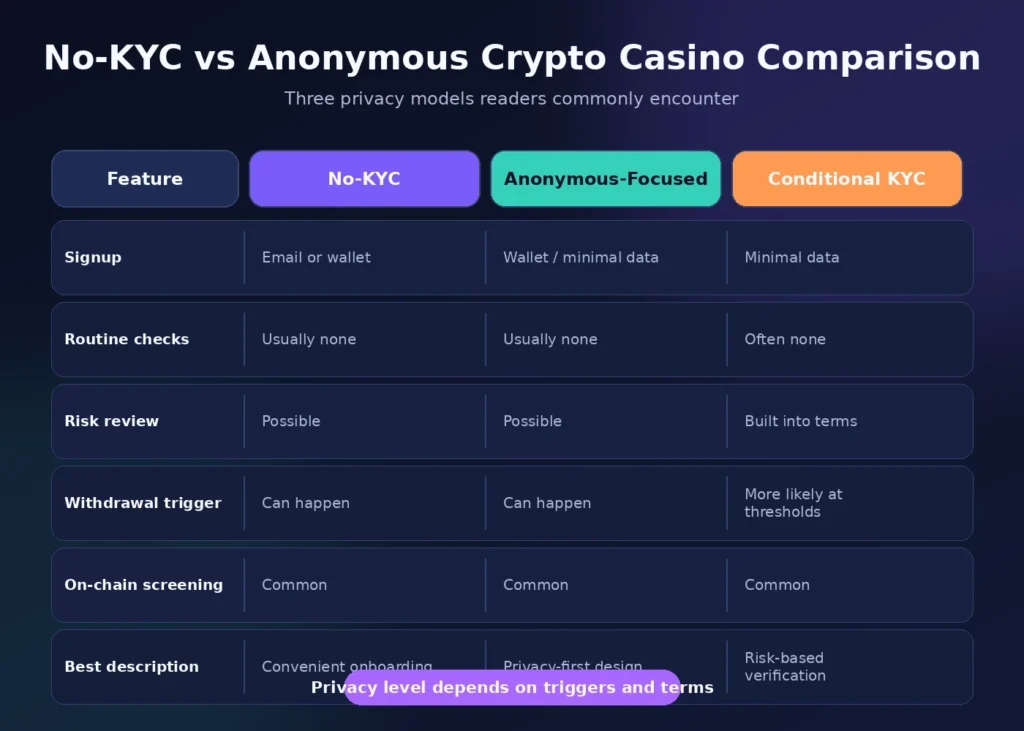
| Feature | No-KYC casino | Anonymous crypto casino | Conditional-KYC casino |
| ID required at signup | Usually no | No | Usually no |
| Email or username | Often required | May be optional | Usually required |
| Wallet-only login | Sometimes | Common | Sometimes |
| IP and device monitoring | Usually possible | Still possible unless technically prevented | Usually used |
| Wallet screening | Possible | Possible | Common |
| Later document request | Depends on terms | Ideally rare, but may still be legally required | Explicitly reserved |
| Verification at withdrawal | May occur | Depends on policy and license | Common after a trigger |
| Practical anonymity | Low to moderate | Potentially higher | Low to moderate |
| Best description | No routine upfront documents | Minimal identity links across the full journey | Documents requested only after risk conditions appear |
What Does “No-KYC” Actually Mean?
KYC stands for Know Your Customer. In online gambling, it normally refers to collecting and verifying information such as a player’s name, date of birth, address and government-issued identification.
A no-KYC casino generally removes or delays that document stage. Registration may require only:
● An email address.
● A username and password.
● A Telegram or social account.
● A connected cryptocurrency wallet.
● A wallet signature proving control of an address.
That reduced-friction registration can be valuable to privacy-conscious users, but the phrase no-KYC has no single universal meaning. Depending on the operator, it can mean:
1. No documents at account creation.
2. No documents for ordinary crypto deposits.
3. No routine documents below internal risk limits.
4. No documents unless an AML, security or fraud alert occurs.
5. No documents for most players, with verification reserved in the terms.
6. Wallet-only registration but continued IP, device and transaction monitoring.
The binding definition is therefore found in the operator’s terms, privacy policy, AML policy and withdrawal rules—not in a banner that simply says “no verification.”
What Makes a Crypto Casino Anonymous?
Anonymity is broader than document collection.
A casino account becomes less anonymous whenever information can connect its activity to a person, household, organization or previously identified wallet.
Potential links include:
● A personal email address.
● A verified Telegram or social-media account.
● A cryptocurrency purchased through a KYC-verified exchange.
● Reused wallet addresses.
● A home or workplace IP address.
● Device fingerprints.
● Browser configuration.
● A phone number.
● Card, bank or e-wallet payments.
● Support messages containing personal information.
● Identification previously supplied to another brand operated by the same group.
For that reason, a wallet-only casino can provide greater privacy without making the user invisible.
Public blockchain information can also be screened before or during a transaction. OFAC recommends risk-based controls for virtual-currency businesses that can include customer, transaction, IP and wallet-address screening. Commercial blockchain tools can assign risk scores based on direct or indirect links to sanctions, scams, mixers, stolen funds and other flagged activity.
A Practical Five-Level Privacy Scale
Level 1: Full document KYC
The operator verifies personal information and government-issued documents before meaningful account use or withdrawal.
This offers the least anonymity but may provide stronger access to a regulated complaint and consumer-protection process.
Level 2: No documents at signup
The player registers with an email or username. Documents are not required immediately, but the terms permit later verification.
This is one of the most common meanings of no-KYC.
Level 3: Conditional or risk-based KYC
The account can deposit and play without documents. Verification appears only after a defined event or elevated risk score.
Possible events include a first withdrawal, cumulative transaction limit, unusual login, wallet-risk alert or bonus-abuse investigation.
Level 4: Wallet-only access
A wallet address and cryptographic signature replace the ordinary account form.
This reduces registration data but does not prevent wallet screening, blockchain tracing, IP logging or device analysis.
Level 5: Decentralized or non-custodial gambling protocol
Gameplay and settlement occur mainly through smart contracts, with limited control by a central casino account.
This can reduce operator-held identity data, but smart-contract activity is often visible on-chain. Interface providers, wallet services and access gateways may also collect technical data.
What Can Trigger Verification at a No-KYC Casino?
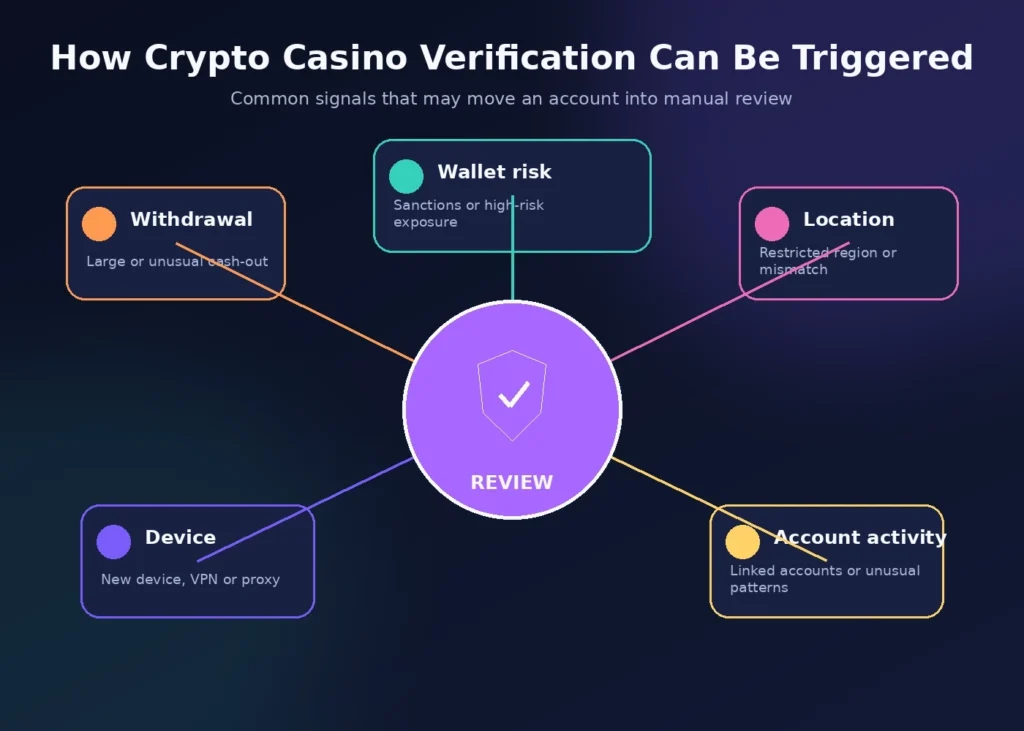
The exact trigger depends on the operator. The following table shows the major categories rather than claiming that every casino applies the same rule.
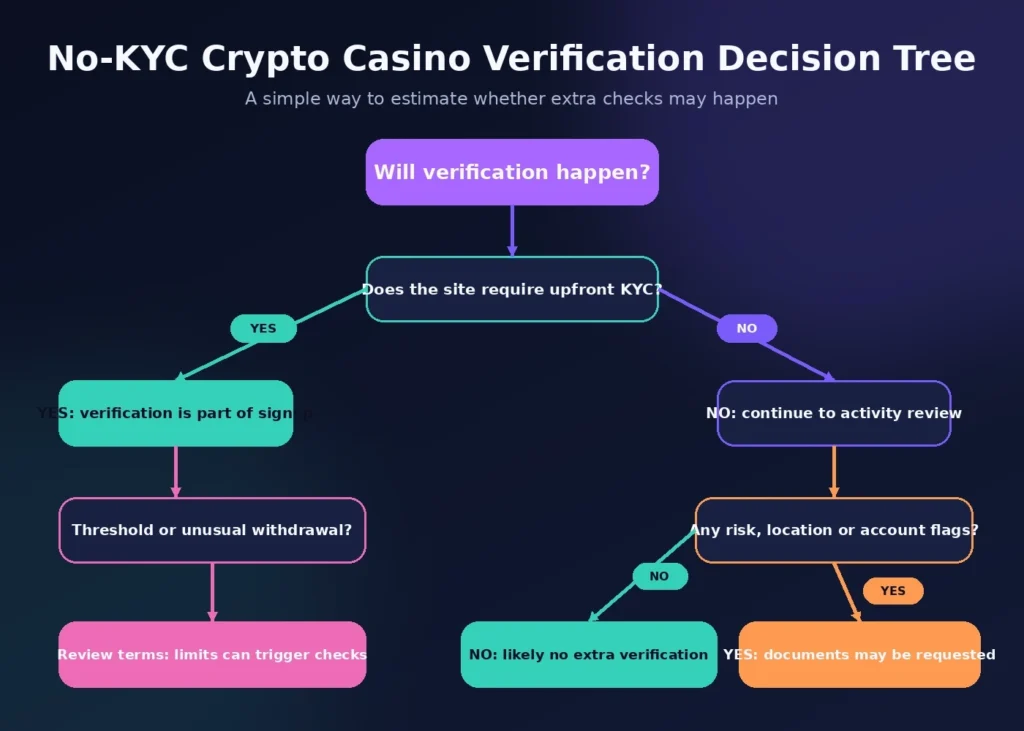
| Possible trigger | Why it creates concern | What may happen |
| First withdrawal | Age, ownership and account checks may be completed before funds leave | ID or age verification |
| Large or cumulative transactions | Operator or license thresholds may have been reached | Identity and source-of-funds review |
| High-risk wallet exposure | Funds may be linked to sanctions, hacks, scams or illicit services | Wallet review, payment hold or enhanced due diligence |
| Rapid deposits and withdrawals | May resemble pass-through activity rather than ordinary gambling | Transaction-history questions |
| Multiple accounts | Can indicate bonus abuse, self-exclusion evasion or fraud | Linked-account investigation |
| New device or unusual location | Can indicate account takeover or unauthorized access | Security challenge or identity check |
| VPN, proxy or location mismatch | May conflict with account data or permitted jurisdictions | Geolocation review |
| Fiat or card payment | Payment providers commonly identify the payer | Payment-ownership verification |
| Account recovery | Support must establish that the requester controls the account | ID, selfie or wallet-signature check |
| Bonus-rule concern | Linked accounts or unusual wagering can suggest promotion abuse | Manual review and possible KYC |
| Age or eligibility concern | Operator must establish that the player is eligible | Proof of age or residency |
| Sanctions or PEP alert | The name, location, wallet or counterparty may require escalation | Enhanced due diligence |
1. A First Withdrawal
A casino may allow registration, deposits and gameplay before checking identity because the most important financial-control point is often the release of funds.
A current Curaçao Gaming Authority responsible-gaming policy states that proof-of-age document checks are subject to the regulator’s KYC and AML rules and should include government-issued ID upon specified thresholds and, in any case, before a first withdrawal. This does not mean every casino worldwide follows the same sequence, but it demonstrates why no-document registration should not be interpreted as guaranteed no-document cashout.
Before depositing, check whether the casino’s terms include wording such as:
● “We may verify your identity at any time.”
● “Verification may be required before withdrawal.”
● “Enhanced due diligence may be conducted.”
● “The operator reserves the right to request supporting documents.”
● “Withdrawals are subject to security and AML checks.”
Those clauses are stronger evidence of the actual policy than a homepage label.
2. Large or Cumulative Transactions
Operators may evaluate both an individual withdrawal and the total value moving through an account.
A transaction can become reviewable because of:
● One unusually large withdrawal.
● Several deposits or withdrawals accumulated over time.
● A rapid increase in account value.
● Activity inconsistent with the account’s previous pattern.
● A high-value win followed by an immediate cashout.
● Deposits and withdrawals with little genuine gameplay.
● Funds moving through several wallets or networks.
There is no credible universal rule that every no-KYC casino permits withdrawals below a particular dollar amount. Internal thresholds can differ, and licensed operators may have mandatory jurisdictional thresholds.
For example, the Curaçao Gaming Authority’s January 2026 AML policy template instructs applicants and licensees to explain the action taken when the XCG 4,000 threshold is reached, including what happens when requested information is not received within 30 days. It also requires ongoing monitoring of customer identity and transactions. That is a current Curaçao framework example—not a universal threshold for every crypto casino or license.
3. Source-of-Funds or Transaction-Pattern Concerns
A casino can ask where cryptocurrency came from even when it has not previously asked who the player is.
Potential red flags include:
● Funds received from many unrelated wallets.
● Immediate withdrawals after deposits.
● Minimal or no gambling between deposit and withdrawal.
● Rapid movement across several networks.
● Repeated transactions just below known limits.
● Activity inconsistent with the player’s normal pattern.
● Use of services or wallet clusters associated with elevated risk.
● Deposit value that appears inconsistent with information already held by the operator.
FinCEN guidance for casinos subject to the U.S. Bank Secrecy Act emphasizes risk-based controls and the detection of suspicious transactions. FATF’s virtual-asset guidance identifies unusual size, frequency, rapid movement and structuring below thresholds as possible red flags.
Why splitting a withdrawal is not a safe solution
Some casino guides suggest dividing a large withdrawal into smaller amounts to avoid verification. That is poor advice.
Repeatedly choosing amounts designed to remain below a monitoring or reporting threshold may look like structuring. It can increase suspicion rather than reduce it. FinCEN’s structuring advisory identifies that activity as a red flag in casino transactions; FATF identifies similar patterns involving virtual assets.
Use the casino’s published withdrawal process. Do not reorganize transactions for the purpose of defeating AML or reporting controls.
4. Wallet Screening and On-Chain Risk
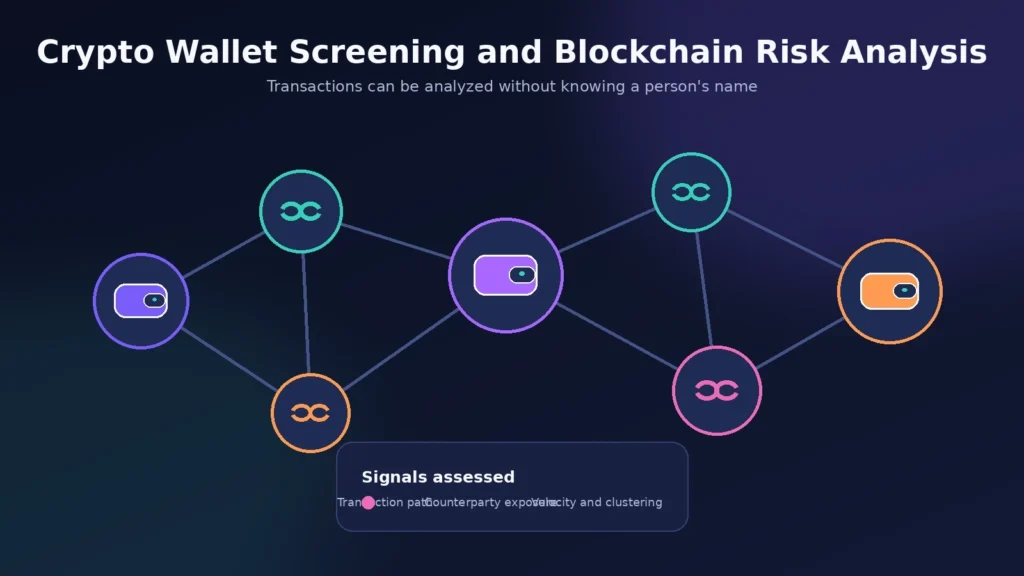
Crypto casinos do not need a passport to examine a wallet.
Wallet-screening systems can assess:
● Direct links to a sanctioned address.
● Indirect exposure through intermediary wallets.
● Funds connected to hacks or stolen assets.
● Darknet-market exposure.
● Scam-related wallets.
● Ransomware or extortion addresses.
● Mixing-service exposure.
● High-risk exchanges or services.
● Unusual transaction chains.
A risk alert does not automatically prove wrongdoing. A wallet may receive exposure indirectly, and different providers apply different rules. However, a sufficiently serious alert may lead the operator to pause a withdrawal, ask for transaction evidence or request identity information.
OFAC’s virtual-currency guidance encourages appropriate screening of wallet and IP information, while wallet screening and continuous transaction monitoring serve different but complementary functions.
5. Device, IP Address and Location Changes
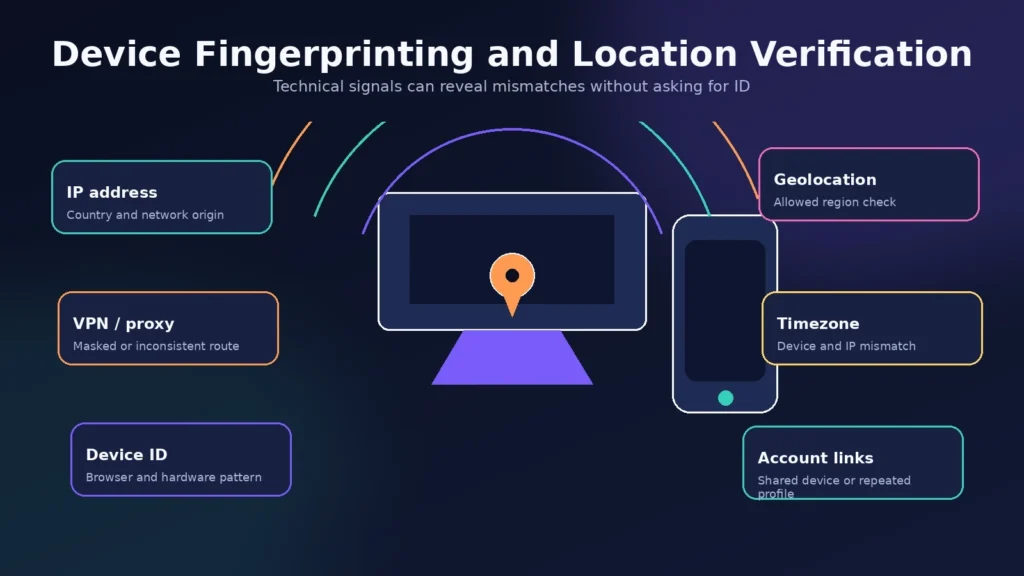
“No documents” does not mean “no technical data.”
Online gambling fraud systems can analyze:
● Browser type and version.
● Operating system.
● Screen and device configuration.
● Time zone.
● Language settings.
● IP address.
● VPN or proxy indicators.
● Emulator use.
● Repeated devices across different accounts.
● Login velocity.
● Changes between deposit and withdrawal devices.
● Patterns associated with automated play.
Device intelligence is used in iGaming to identify multiple accounts, bonus abuse, bot activity, spoofed locations and account takeovers. A new device is not necessarily suspicious on its own, but a new device combined with a new country, password reset and immediate withdrawal can create a much higher risk score.
Can a VPN trigger verification?
Yes, it can contribute to a review.
VPN use is not proof of fraud, and some operators permit it. However, it can create problems when:
● The exit location conflicts with the registered country.
● The player appears to move between countries within a short period.
● The VPN exits through a restricted jurisdiction.
● Different accounts use the same shared IP address.
● The terms prohibit location masking.
● The connection changes during a deposit or withdrawal.
● The casino cannot establish the player’s actual eligibility.
Using a VPN to bypass a location restriction may also violate the casino’s terms and place the balance at risk. It does not make otherwise prohibited gambling lawful.
6. Multiple Accounts and Bonus Abuse
Casinos can link accounts without knowing the legal name behind them.
Possible linking signals include:
● The same device or device fingerprint.
● Shared IP addresses.
● Related wallets.
● Reused payment methods.
● Similar usernames or email patterns.
● Matching betting behavior.
● Repeated bonus activation.
● Identical withdrawal addresses.
● Coordinated play between accounts.
● Referral patterns between controlled accounts.
Fraud-prevention providers specifically market device and behavioral analysis for identifying multi-accounting and promotion abuse in iGaming.
Verification may then be used to determine whether:
● The accounts belong to one person.
● A household limit has been exceeded.
● A bonus was claimed more than once.
● An excluded player has returned.
● Several accounts are coordinating gameplay.
● An account has been sold, shared or taken over.
Readers comparing promotions should examine the site’s guide to crypto casino sign-up bonuses before accepting an offer. Bonus wagering, maximum-bet rules, eligible games and linked-account restrictions can affect a withdrawal even when KYC is not the underlying issue.
7. Fiat Payments and Payment-Ownership Checks
A crypto casino may offer minimal verification for direct wallet deposits but apply different rules when a player uses:
● Visa or Mastercard.
● A bank transfer.
● An e-wallet.
● Apple Pay or Google Pay.
● A third-party crypto purchase service.
● A fiat-to-crypto on-ramp.
● A payment method belonging to another person.
These services generally have their own identification, fraud and chargeback controls. The casino may need to verify that the account holder is also the owner of the payment method.
Possible requests include:
● A card image with sensitive digits obscured.
● A payment statement.
● Proof that the deposit account belongs to the player.
● A screenshot from the payment provider.
● Transaction IDs.
● A wallet-ownership signature.
For readers considering stablecoin deposits, the guide to USDT casinos and withdrawal rules explains why a fast network does not remove operator approval, bonus checks, location review or possible KYC.
8. Account Recovery and Security Events
Identity verification may be initiated for account security rather than AML compliance.
Typical security triggers include:
● A forgotten password with no access to the registered email.
● Lost two-factor authentication.
● A request to change the registered email address.
● A request to replace the withdrawal wallet.
● A suspected account takeover.
● Repeated failed login attempts.
● A withdrawal immediately after a password reset.
● A support request from a new device or country.
● Disagreement over who controls the account.
A wallet-only casino may ask the player to sign a message from the original wallet. An email-based casino may use ID, account history or selfie verification.
In this context, a document request does not necessarily mean the casino has abandoned its normal no-KYC policy. It may be attempting to prevent an unauthorized withdrawal.
9. Age, Residency and Restricted-Jurisdiction Checks
Casinos may need to confirm that a player:
● Meets the minimum gambling age.
● Lives in an accepted jurisdiction.
● Is not using the service from a prohibited location.
● Is not subject to a self-exclusion restriction.
● Has provided accurate registration information.
● Is not on a sanctions list.
● Is not a politically exposed person requiring enhanced review.
Current Curaçao materials require customer due diligence, risk assessment, sanctions screening and ongoing transaction monitoring. The regulator’s responsible-gaming policy also requires age-verification processes and government-issued identification at specified points.
What Is “Soft KYC”?
“Soft KYC” is an industry expression rather than one universally standardized legal category.
It generally means the operator evaluates a user without initially requesting formal identity documents.
It can include:
● IP geolocation.
● Device fingerprinting.
● Email-risk analysis.
● Phone-number checks.
● Wallet screening.
● Sanctions screening.
● Transaction monitoring.
● Behavioral analysis.
● Database matching.
● Account-link analysis.
Soft KYC can preserve a low-friction registration process, but it should not be confused with complete anonymity. The operator may still be building a risk profile that determines whether full document verification is required later.
What Documents Can a Crypto Casino Request?
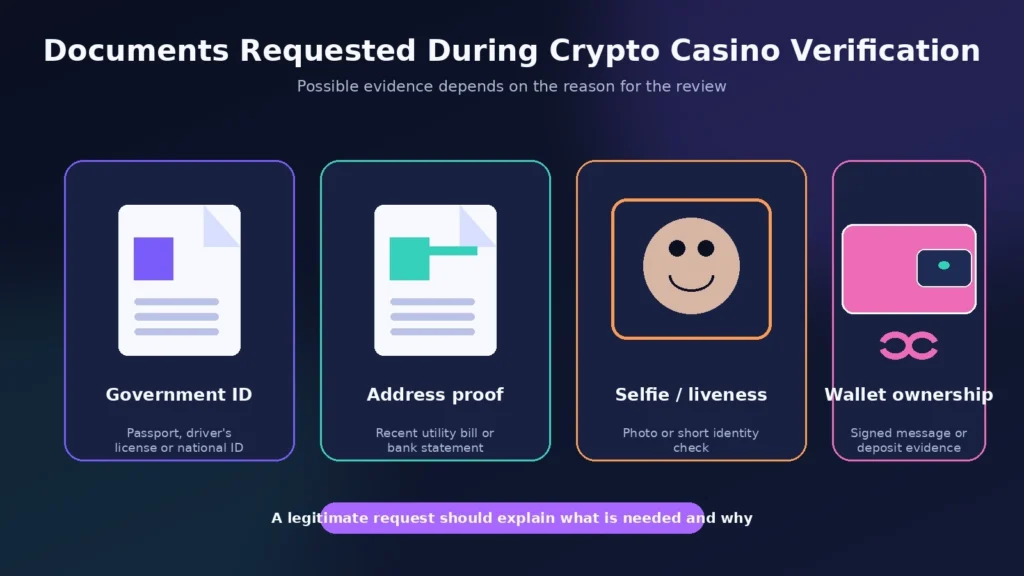
The request depends on what the casino needs to establish.
Proof of identity
Common examples include:
● Passport.
● Driver’s license.
● State or national identity card.
Proof of address
Possible documents include:
● Bank statement.
● Utility bill.
● Tax correspondence.
● Government letter.
● Rental agreement.
The current Curaçao AML regulations describe identity verification using reliable independent sources and an unexpired government-issued document. Where the ID does not confirm an address, other documents such as a bank statement, utility bill, public-authority letter or rental agreement may be used.
Selfie or liveness verification
An operator may request:
● A selfie holding the ID.
● A live facial scan.
● A short video.
● A liveness check involving instructed movements.
Payment or wallet ownership
The operator may ask for:
● A payment statement.
● A deposit transaction hash.
● A wallet screenshot.
● A signed message from the sending wallet.
● Evidence that the player controls the withdrawal address.
Source of funds or source of wealth
For higher-risk or higher-value activity, possible evidence includes:
● Exchange transaction history.
● Wallet transaction records.
● Employment income.
● Business income.
● Investment statements.
● Evidence of a crypto sale.
● Documentation of an inheritance or asset sale.
The operator should explain what it requires and why. Do not send more information than necessary, and use only the casino’s verified document-upload channel.
Verification Request or Ordinary Withdrawal Delay?
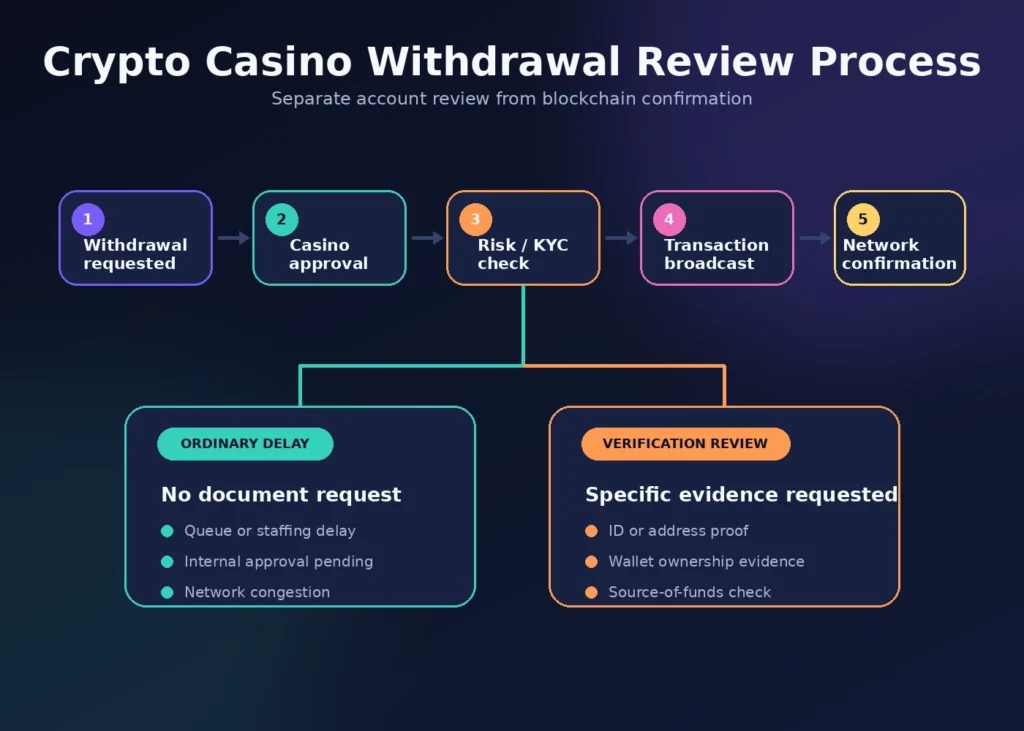
A pending crypto withdrawal does not automatically mean KYC has been triggered.
| Situation | Is it necessarily KYC? | What to check |
| Withdrawal remains “pending” | No | Operator processing time |
| Bonus still active | No | Wagering and max-bet terms |
| Transaction has no blockchain hash | No | Casino has not broadcast it |
| Blockchain hash exists but wallet has not credited | No | Network confirmations and wallet support |
| Operator asks for ID or proof of address | Yes | Verification instructions |
| Operator asks about wallet source | Possibly enhanced review | Transaction history requested |
| Operator asks to confirm email or 2FA | Usually security verification | Account-access issue |
| Withdrawal exceeds daily limit | No | Published payout schedule |
| Account is linked to another account | Possibly | Multi-account investigation |
| Casino asks for another deposit to release winnings | Major warning sign | Stop and verify legitimacy |
A withdrawal reaches the blockchain only after the casino approves and broadcasts it. The payment can therefore be delayed by internal review even when the cryptocurrency network is functioning normally.
For broader context, the site’s best crypto casino guide discusses KYC, payout speed and crypto support, while its crypto casino Reddit research explains why “instant payout” comments are unreliable without the withdrawal size, coin, bonus status and verification history.
What to Check Before Depositing
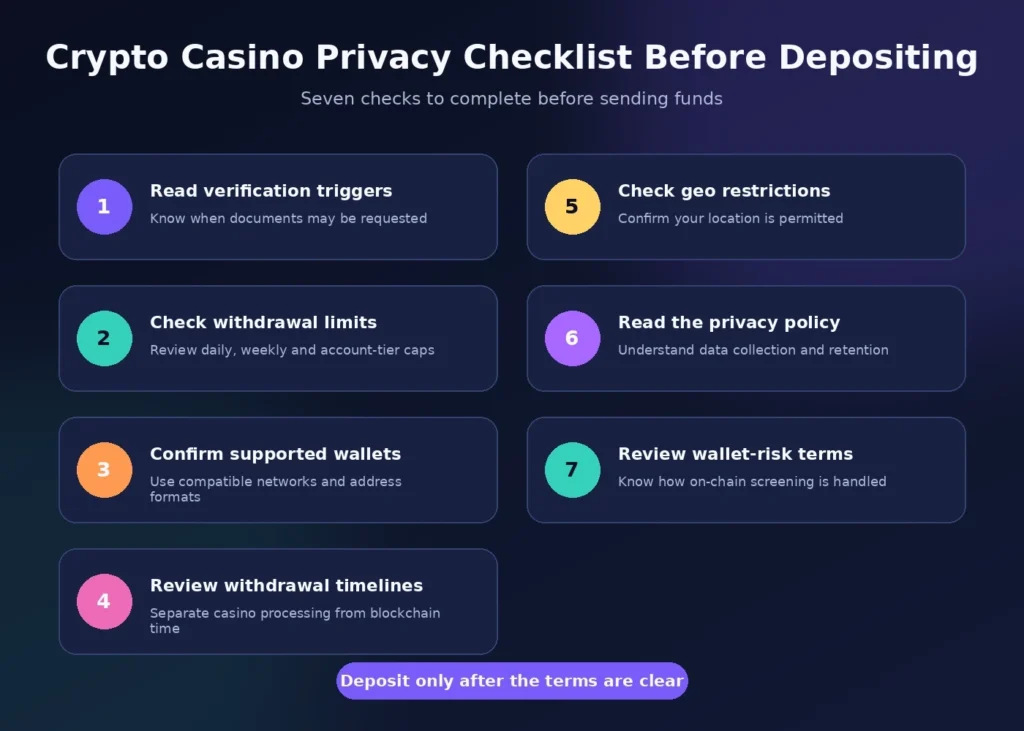
Use this checklist before transferring cryptocurrency.
1. Read the KYC clause
Search the terms for:
● KYC.
● Verification.
● Due diligence.
● Source of funds.
● AML.
● Identity.
● Withdrawal review.
● Restricted jurisdiction.
● Payment ownership.
2. Check when verification can occur
Determine whether it can happen:
● At registration.
● Before the first withdrawal.
● Above a cumulative threshold.
● After a security alert.
● When using certain payment methods.
● At the operator’s discretion.
3. Find the license in the regulator’s register
Do not rely only on a logo or license number displayed in the footer.
Verify:
● The legal operator.
● The approved domain.
● The license status.
● The regulator’s complaint process.
● Whether the seal links to an official register.
4. Examine the privacy policy
Check what the casino collects about:
● IP addresses.
● Devices.
● Wallets.
● Transactions.
● Cookies.
● Location.
● Marketing identifiers.
● Third-party verification providers.
● Data retention.
5. Review withdrawal limits
Find:
● Minimum withdrawal.
● Maximum per transaction.
● Daily and monthly limits.
● Pending periods.
● Manual approval conditions.
● Wallet or network restrictions.
● Verification thresholds, when published.
6. Read the bonus terms separately
A payout can be blocked because of a bonus rule even when no KYC issue exists.
Check:
● Wagering requirement.
● Maximum bet.
● Eligible games.
● Expiration.
● Maximum bonus cashout.
● Multiple-account restrictions.
● Restricted strategies.
● Whether the deposit must be wagered.
7. Test support before depositing
Ask support directly:
“Can identity documents be requested before or after a crypto withdrawal, and where is that rule stated in your terms?”
Save the answer, but remember that the formal terms normally prevail over an informal support reply.
What to Do When a No-KYC Casino Requests Verification
Stop making new deposits or bets
Do not add funds in an attempt to “unlock” the withdrawal. A legitimate identity review should be handled through documents or account evidence, not a new deposit.
The FTC warns that fake crypto platforms may display account balances but prevent withdrawal unless the victim pays additional fees. A demand for more cryptocurrency to release winnings should therefore be treated as a serious scam indicator.
Confirm that the request is genuine
● Log in by typing the casino’s official domain.
● Check the message inside the account.
● Do not use an unexpected email or messaging-app link.
● Confirm the support address.
● Verify the casino’s official domain through its regulator where possible.
Ask for the contractual basis
Request:
● The exact term being applied.
● The reason category.
● The list of required documents.
● The secure submission method.
● The expected review sequence.
● Whether the withdrawal remains reserved during review.
The casino may not disclose sensitive fraud or AML details, but it should be able to identify the applicable policy.
Supply only what is necessary
● Use clear, current documents.
● Do not alter documents.
● Do not obscure information unless the casino permits it.
● Never share wallet seed phrases or private keys.
● Do not email highly sensitive documents when a secure portal is available.
● Keep copies of everything submitted.
Keep a documented timeline
Record:
● Withdrawal request time.
● Amount and cryptocurrency.
● Account status.
● Support conversations.
● Documents requested and supplied.
● Transaction hashes.
● Any changes to the stated reason.
Escalate through the correct channel
When the review appears inconsistent with the terms:
1. Complete the operator’s formal complaint process.
2. Check whether the license is genuine and active.
3. Use the regulator or authorized alternative-dispute-resolution process where available.
4. Report suspected impersonation or crypto fraud through the appropriate U.S. consumer or law-enforcement channel.
U.S. Legal and Tax Context
Online casino authorization is state-specific
The federal Unlawful Internet Gambling Enforcement Act focuses on businesses knowingly accepting payments connected to unlawful internet gambling and requires payment systems to identify or prevent restricted transactions. It does not create a general national license for offshore crypto casinos.
For a U.S. reader, the safest legal check is:
1. Visit the state gaming regulator.
2. Confirm whether online casino gaming—not only sports betting—is authorized.
3. Use the regulator’s list of licensed operators.
4. Check age and location requirements.
5. Do not assume that accepting cryptocurrency or allowing registration establishes legal authorization.
The site’s guide to crypto casinos for U.S. players can provide broader market context, but readers should still verify current state rules independently.
Crypto winnings do not become tax-free
The IRS states that gambling winnings are taxable income. It also treats digital assets as property for federal tax purposes, meaning a later sale, exchange or other disposition may create a separate gain or loss calculation.
“No-KYC” does not remove the player’s responsibility to maintain records and comply with applicable tax rules.
How to Evaluate a Privacy Claim
A practical way to assess a casino is to ask five questions.
What must I provide?
● Wallet only.
● Username.
● Email.
● Phone number.
● Name and date of birth.
● Full documents.
What does the operator collect silently?
● IP address.
● Device information.
● Cookies.
● Geolocation.
● Transaction history.
● Linked-account indicators.
What can trigger escalation?
● First withdrawal.
● Cumulative value.
● Wallet risk.
● Location conflict.
● Account changes.
● Bonus or multiple-account review.
What happens when verification is requested?
● Can the balance remain frozen indefinitely?
● Is there a deadline for submitting documents?
● Will deposits be refunded if verification fails?
● Is there a complaint or ADR process?
● Does the regulator accept player complaints?
Can the license be independently verified?
An active license does not eliminate risk, but an unverifiable license is a major warning sign.
Responsible Gambling and Privacy-Focused Casinos
Reduced identity friction can also reduce the effectiveness of centralized self-exclusion systems. Privacy should not remove personal limits.
Before playing:
● Set a fixed loss limit.
● Set a session-time limit.
● Avoid gambling with borrowed funds.
● Keep essential money outside the gambling wallet.
● Do not chase losses.
● Stop when gambling becomes secretive, stressful or difficult to control.
The National Council on Problem Gambling provides responsible-gambling resources and the National Problem Gambling Helpline, available by call or text at 1-800-MY-RESET, while Gamblers Anonymous maintains in-person, virtual and telephone meeting directories.
Conclusion
The most accurate way to interpret no-KYC is “no routine identity-document request under ordinary conditions,” unless the operator’s binding terms clearly promise something stronger.
It should not be interpreted as:
● No monitoring.
● No wallet screening.
● No location checks.
● No account-security controls.
● No AML obligations.
● No possibility of future verification.
● Complete anonymity.
Before depositing, identify the operator, verify the license, read the KYC and withdrawal clauses and determine what data is collected beyond formal documents.
The safest assumption is that any custodial casino may pause an account when it encounters a legal, security, transaction or fraud concern. A trustworthy operator should explain that possibility before accepting funds—not introduce it for the first time after a withdrawal request.
FAQs
Yes. A no-KYC casino may reserve the right to request ID after a win or before processing the withdrawal. The trigger could be the first cashout, cumulative transaction value, a security concern, wallet-risk exposure or a requirement attached to its license.
Check the terms for conditional-verification language before depositing.
No. A casino can screen and analyze a wallet without knowing the owner’s name. Public-chain transactions may reveal wallet addresses, values, timing and connections to other addresses. Blockchain-monitoring tools can assess direct and indirect exposure to sanctioned or high-risk services.
Not necessarily. A no-verification casino may only remove the document-upload stage. An anonymous casino would also need to minimize identifying registration, device, IP, payment and wallet information.
A wallet-only login improves privacy but does not guarantee complete anonymity.
There is no universal amount. The threshold can depend on the license, operator, cumulative account activity, cryptocurrency, wallet-risk score and player-risk classification.
Do not rely on an affiliate article claiming that all withdrawals below a particular dollar amount are KYC-free.
No. A VPN may conceal the ordinary IP address, but it does not remove wallet history, device signals, account data or payment records. A VPN or rapidly changing location can also contribute to a geolocation or security review.
Using one to bypass a restricted jurisdiction may violate the casino’s terms.
You should not divide transactions for the purpose of avoiding monitoring or reporting controls. FATF and FinCEN identify structuring below thresholds as suspicious behavior. It can increase the risk of account escalation rather than reduce it.
Follow the operator’s published withdrawal process.
A withdrawal can be pending because of:
● Internal approval.
● Bonus wagering review.
● A payment limit.
● A security check.
● Wallet-risk screening.
● Manual processing.
● Hot-wallet liquidity.
● Blockchain confirmation requirements.
KYC has clearly been triggered only when the operator requests identity or related due-diligence information.
No legitimate identity check should require another gambling deposit to unlock the existing balance. A demand for extra cryptocurrency, taxes or release fees before winnings can be withdrawn is a major scam warning. The FTC warns that fake crypto platforms often show balances but demand further fees before permitting withdrawals.