

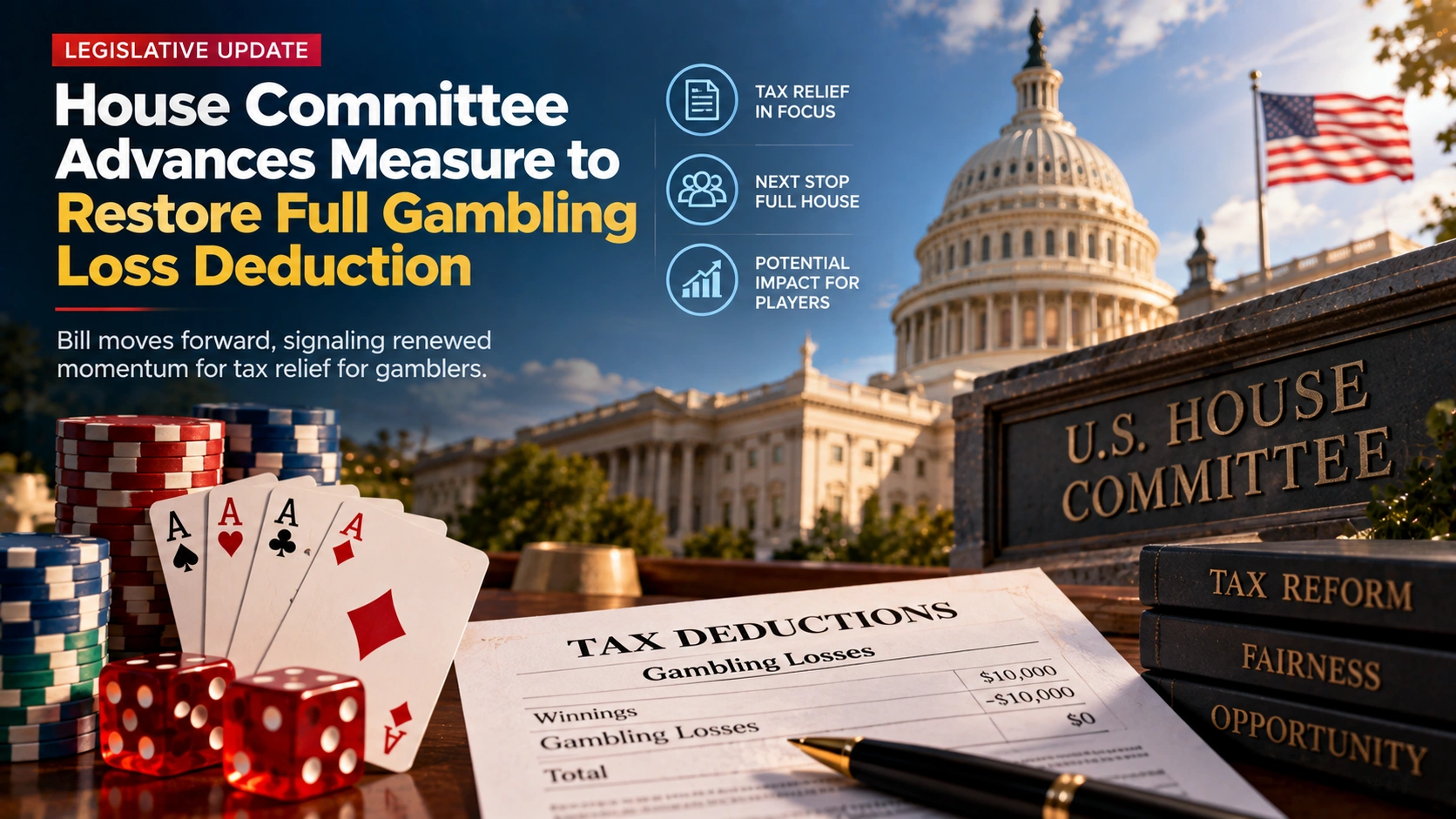
The U.S. House Ways and Means Committee advanced legislation on September 16, 2026 that would restore the full federal deduction for gambling losses after a new 90% limitation took effect for the 2026 tax year.
The provision was approved as part of H.R. 10357, the Digital Asset Tax Certainty Act, which passed the committee 38-5. If ultimately enacted, the gambling provision would reverse the 90% limitation created by the 2025 tax law and again allow wagering losses to be deducted to the extent of wagering gains.
The vote gives supporters of the change a new legislative path, but the proposal still has to move through the rest of Congress before it could become law.
Key Facts
| Detail | Confirmed information |
| Committee | House Ways and Means Committee |
| Action date | September 16, 2026 |
| Legislation | H.R. 10357, Digital Asset Tax Certainty Act |
| Committee vote | 38-5 |
| Gambling provision | Restores full wagering-loss deduction to extent of gains |
| Current federal rule | 90% of wagering losses, limited to wagering gains |
| Proposed effective period | Tax years beginning after Dec. 31, 2025 |
| Current status | Passed committee; not yet law |
What the House Committee Approved
The gambling-tax change was not passed as a standalone vote on the FAIR BET Act.
Instead, the Ways and Means Committee approved H.R. 10357, a broad digital-asset tax bill containing a separate provision addressing wagering losses. The House committee’s own description says the bill includes a change to current tax law that would restore taxpayers’ ability to deduct financial losses from gambling and prevent taxation of what the committee describes as phantom income.
The legislative text identifies the provision as Title VII — Full House Act. Section 701 would amend Internal Revenue Code Section 165(d) so that wagering losses would again be allowed only to the extent of wagering gains, without the 10% reduction currently imposed.
That distinction is important because several gambling-tax proposals have circulated in Congress since the 2025 change.
How the Current 90% Gambling-Loss Rule Works
The change stems from the One Big Beautiful Bill Act, enacted in July 2025.
The IRS says the law amended Section 165(d) so that, beginning in 2026, wagering losses are deductible only at 90% of the loss amount, and only to the extent of wagering gains.
The IRS’s 2026 Publication 505 gives the current rule as the lesser of:
- 90% of gambling losses; or
- gambling winnings.
This differs from the previous treatment, under which qualifying wagering losses could be deducted to the extent of gambling gains.
A simplified example
Consider a taxpayer with:
- $100,000 in gambling winnings; and
- $100,000 in documented gambling losses.
Under the current 90% limitation, 90% of the $100,000 loss is $90,000.
Assuming the taxpayer is otherwise eligible to claim the deduction, the simplified calculation would leave $10,000 of gambling winnings that is not offset by the wagering-loss deduction.
That does not mean the taxpayer’s final federal tax bill is automatically calculated by applying a tax rate to $10,000. Other aspects of the taxpayer’s return, including filing status, itemization and other income and deductions, remain relevant.
The example illustrates only the effect of the wagering-loss limitation.
What the Proposed Change Would Do
The gambling provision in H.R. 10357 would remove the 90% limitation.
The proposed Section 701 language states that wagering losses would again be allowed to the extent of wagering gains. The provision is written to apply to taxable years beginning after December 31, 2025.
Using the same simplified example, a taxpayer with $100,000 in winnings and $100,000 in qualifying losses would potentially be able to deduct the full $100,000 of losses against those wagering gains under the proposed rule.
Again, the example does not represent an individual’s complete tax calculation.
The FAIR BET Act Is a Separate Bill
The committee action is connected to a longer campaign led by Nevada Rep. Dina Titus, but the legislation approved Wednesday should not be confused with her original FAIR BET Act.
Titus introduced the Fair Accounting for Income Realized from Betting Earnings Taxation Act, or FAIR BET Act, H.R. 4304, on July 7, 2025. The bill would restore the 100% deduction for wagering losses.
Titus has continued pushing for the change, including through a discharge petition filed in February 2026 after the FAIR BET Act remained before the Ways and Means Committee.
Her office said on September 16 that H.R. 10357 incorporates one of the measures that followed the FAIR BET proposal and that the committee action represents progress toward restoring the deduction.
The distinction matters for readers tracking the legislation: H.R. 4304 did not itself become the bill approved by the committee on September 16.
Why the Change Matters to U.S. Gamblers
The federal change primarily matters to taxpayers who report gambling winnings and have wagering losses that could otherwise qualify for the deduction.
The IRS says gambling losses can generally be deducted only by taxpayers who itemize and only up to the amount of gambling income. The taxpayer must also maintain records supporting winnings and losses.
The 90% limitation adds another restriction to that calculation.
As a result, someone whose annual wagering activity appears economically close to break-even can potentially have some gambling winnings left without a corresponding deductible loss under the current federal rule.
The proposed legislation would remove that additional 10% limitation if enacted.
The Change Also Affects Sports Bettors and Casino Players
The federal rule applies to wagering transactions, rather than being limited to one particular type of gambling.
That makes the issue relevant across different forms of gambling, including casino activity and sports betting, subject to the applicable federal tax rules.
The supplied KSNV report quotes Nevada lawmakers arguing that the current treatment could affect professional gamblers and recreational bettors.
Those are arguments made by the lawmakers and should be distinguished from the confirmed mechanics of the tax law.
Gambling Industry Groups Support the Proposed Change
Rep. Titus’ office said the FAIR BET effort has received support from organizations and companies including the American Gaming Association, MGM, DraftKings, FanDuel, Caesars, Wynn Resorts, the Nevada Resort Association and the National Thoroughbred Racing Association.
The supplied KSNV report similarly identified support from several major casino companies and the Nevada Resort Association.
That support reflects an industry position on the tax issue, rather than evidence that the proposed change has already been enacted.
The Tax Rule Is Already in Effect for 2026
One important point for taxpayers is that the House action does not mean the 90% rule has been suspended.
The IRS currently states that the 90% limitation applies beginning in 2026. Its May 2026 proposed regulations were specifically updated to reflect the statutory change made by the One Big Beautiful Bill Act.
Until Congress passes a replacement and it becomes law, taxpayers should not assume that the proposed restoration applies to their current tax filings.
For taxpayers preparing returns, the applicable law and IRS guidance in effect when the return is filed should be used.
What Happens Next?
The Ways and Means Committee’s action moves H.R. 10357 forward, but it is not the final legislative step.
The committee’s September 16 announcement says the Digital Asset Tax Certainty Act advances to the full House of Representatives.
If the gambling provision survives the remaining legislative process and becomes law, the proposed language would restore the previous wagering-loss treatment for taxable years beginning after December 31, 2025.
The measure would still need to clear the House and Senate and receive presidential approval before becoming federal law.
What U.S. Gamblers Should Know Now
The immediate situation is therefore straightforward:
The 90% gambling-loss limitation remains current law for 2026.
The House Ways and Means Committee has now approved legislation that would reverse that limitation, but the change is not yet law.
Taxpayers should continue keeping detailed records of gambling winnings and losses. The IRS requires taxpayers claiming gambling-loss deductions to maintain records supporting those amounts.
Anyone with substantial gambling activity, professional-gambler status or complicated tax circumstances may also need advice based on the law applicable to their specific return.
What to Watch Next
The next major milestone is congressional consideration of H.R. 10357 beyond the Ways and Means Committee.
The key question is whether the gambling-loss provision remains in the legislation as it advances and whether Congress ultimately passes the measure.
Until that happens, the current federal rule remains the 90% deduction limitation for 2026.
FAQs
For 2026, the IRS says the gambling-loss deduction is limited to the lesser of 90% of wagering losses or gambling winnings, subject to the applicable deduction requirements.
On September 16, 2026, the committee approved H.R. 10357, the Digital Asset Tax Certainty Act, by 38-5. The bill includes a provision that would restore the full wagering-loss deduction.
No. The FAIR BET Act, H.R. 4304, is a separate bill introduced by Rep. Dina Titus in 2025. The September 16 committee action involved H.R. 10357, which contains a related wagering-loss provision.
The text of the H.R. 10357 provision says the amendment would apply to taxable years beginning after December 31, 2025. That would include tax year 2026 if the provision is enacted in its current form.
No. The committee vote is a legislative step, not enactment. The IRS currently continues to describe the 90% limitation as applicable for 2026.