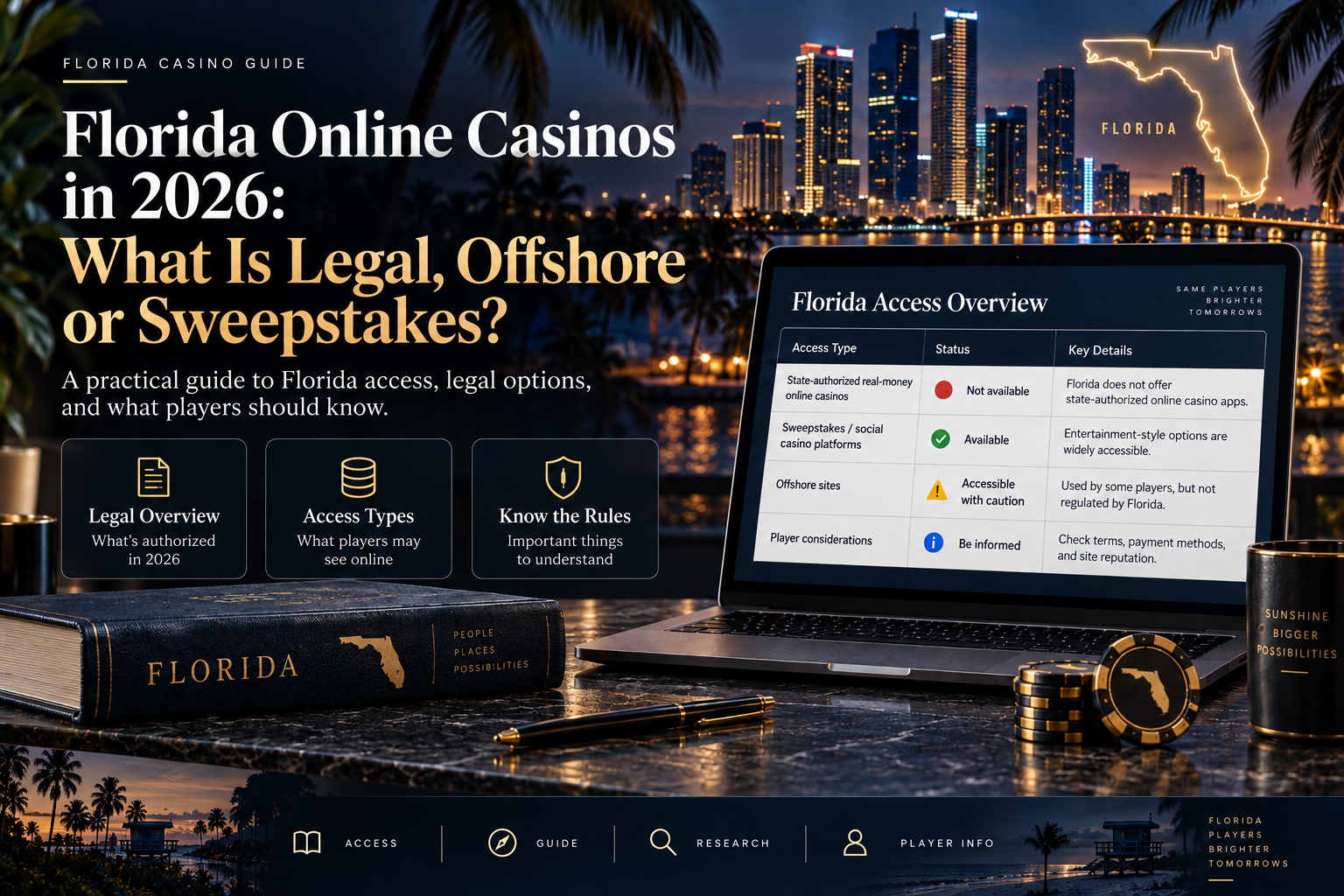

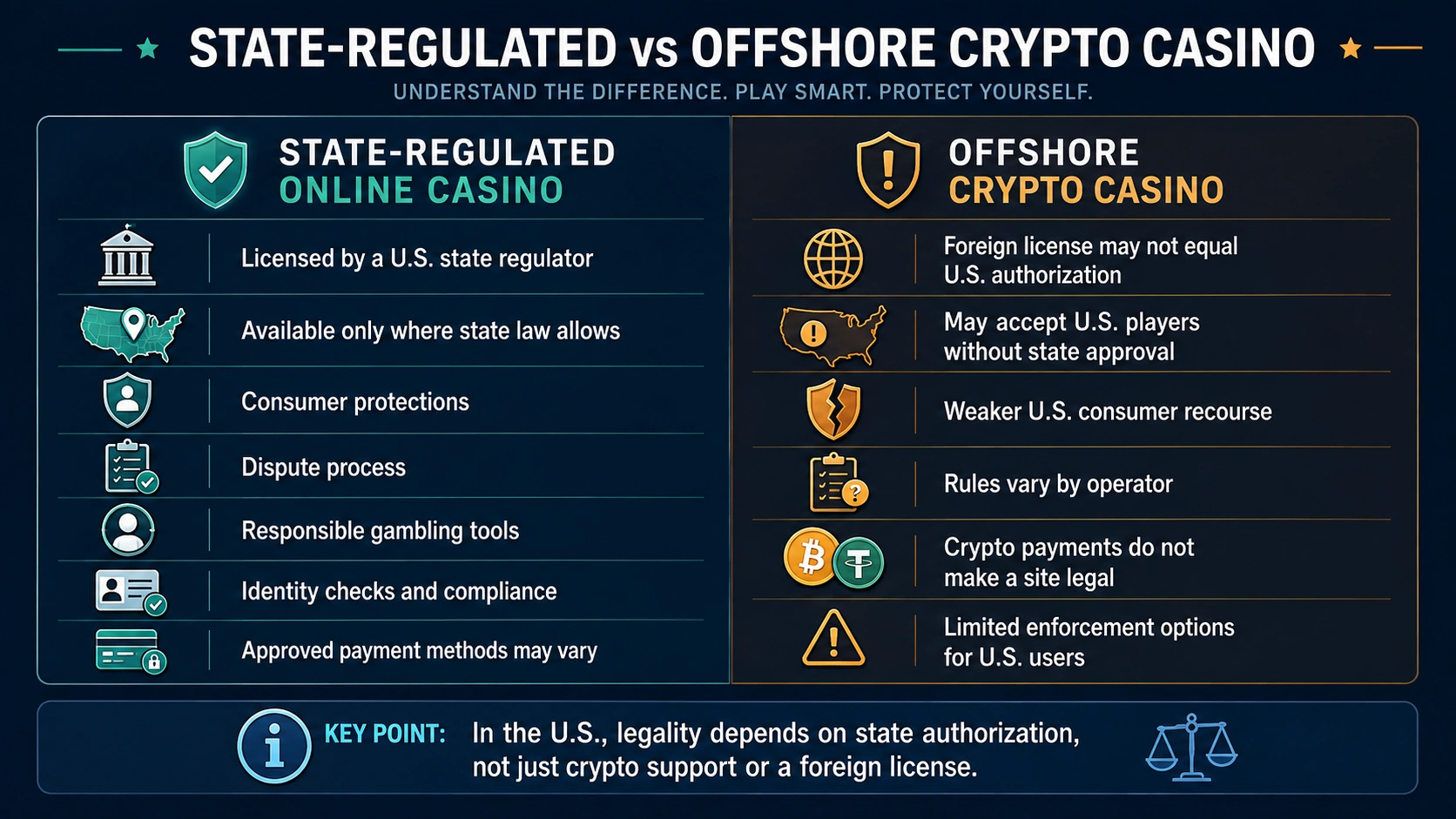
A state-regulated online casino and an offshore crypto casino can offer many of the same games, but they operate under fundamentally different regulatory relationships with a U.S. player.
A state-regulated casino is authorized by the gaming regulator in the state where the wager is legally accepted. An offshore crypto casino operates outside the United States and may hold a foreign gambling license, but that foreign license does not automatically authorize the site to offer online casino gaming in any particular U.S. state.
Crypto does not change that distinction. A casino accepting Bitcoin, Ethereum or USDT is simply using a different payment rail. Calling a site a USDT casino tells you something about its cashier; it does not tell you whether a U.S. regulator has approved it.
That is the most important point to understand before comparing bonuses, games, KYC policies or withdrawal speeds.
State-Regulated vs Offshore Crypto Casinos at a Glance
| Feature | State-Regulated U.S. Online Casino | Offshore Crypto Casino |
| Primary authorization | U.S. state regulator | Foreign jurisdiction, if licensed |
| U.S. state legality | Operates under authorization in the relevant state | Foreign license alone does not establish it |
| Physical-location controls | Required under applicable state framework | Operator-dependent |
| Identity/age verification | Formal regulatory controls | Varies by operator and foreign licensing regime |
| USDT/crypto support | Depends on state and operator | Often a major payment feature |
| Game approval | State-regulatory framework | Foreign regulator/provider/operator framework |
| Player complaint route | State regulator generally provides formal route | Operator, foreign regulator or ADR depending on jurisdiction |
| Responsible-gambling controls | State-mandated framework | Depends on license and operator |
| Self-exclusion integration | State/local system where applicable | Usually operator or foreign-jurisdiction based |
| Withdrawal rules | Subject to state-regulated operator terms | Subject to operator and foreign-license terms |
| Legal recourse | U.S. state regulatory system | Potentially foreign jurisdiction or ADR |
| Cryptocurrency risk | Usually limited if crypto is not used | Wrong-chain transfers, custody and digital-asset risks can apply |
The comparison is therefore not simply traditional banking versus cryptocurrency. It is primarily a comparison of regulatory jurisdiction, accountability and recourse.
What Is a State-Regulated Online Casino?
A state-regulated online casino is an operator authorized to offer internet casino gaming under the laws and regulatory framework of a particular U.S. state.
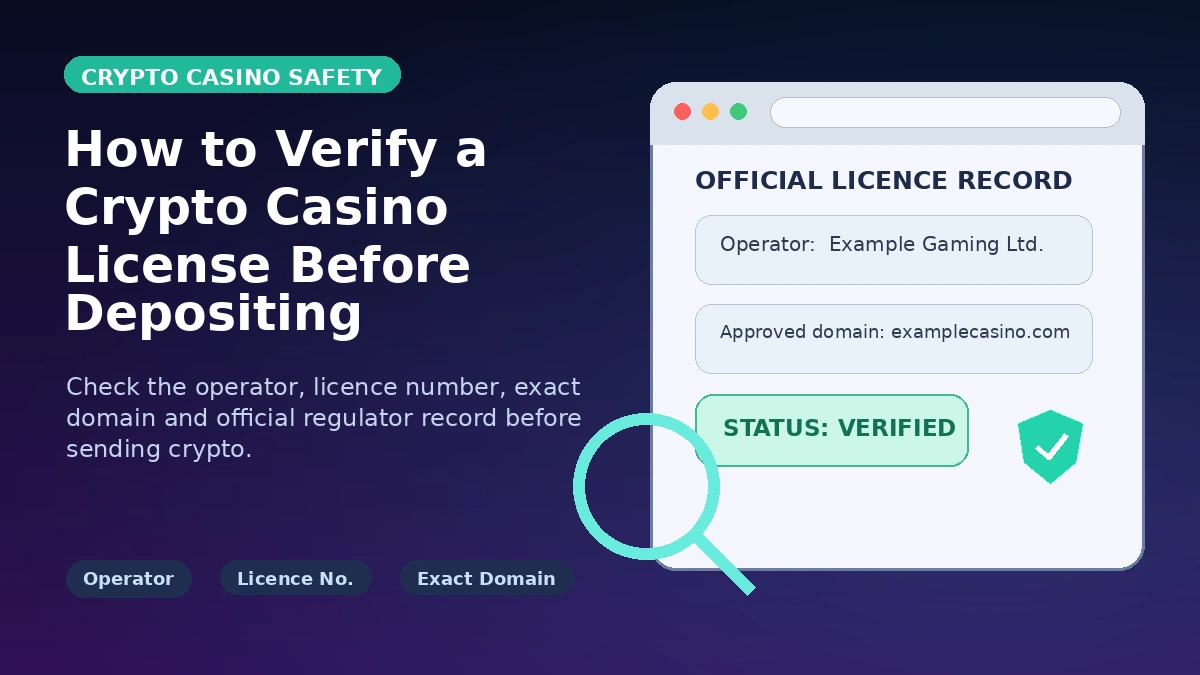
A reliable way to establish that status is not to trust a logo in the casino footer, but to check the regulator's official operator list.
For example, thePennsylvania Gaming Control Board's licensed-operator directory specifically tells users to verify that an online gaming site is PGCB-regulated before wagering.
Michigan follows a similar model. Its Gaming Control Board publishes the legal internet-gaming websites authorized in the state and explains that gambling is generally prohibited unless specifically authorized by state law.
Federal law also reflects the importance of state authorization. Under the Unlawful Internet Gambling Enforcement Act framework, “unlawful Internet gambling” depends on whether the underlying wager is unlawful under applicable federal or state law. The statutory intrastate provisions contemplate state rules that include age and location verification designed to block minors and people outside the authorized state.
That is why state-authorized U.S. online casino apps verify more than a payment method: they must establish that a wager is being accepted under the appropriate state framework.
Which States Have Live State-Regulated Online Casinos in 2026?
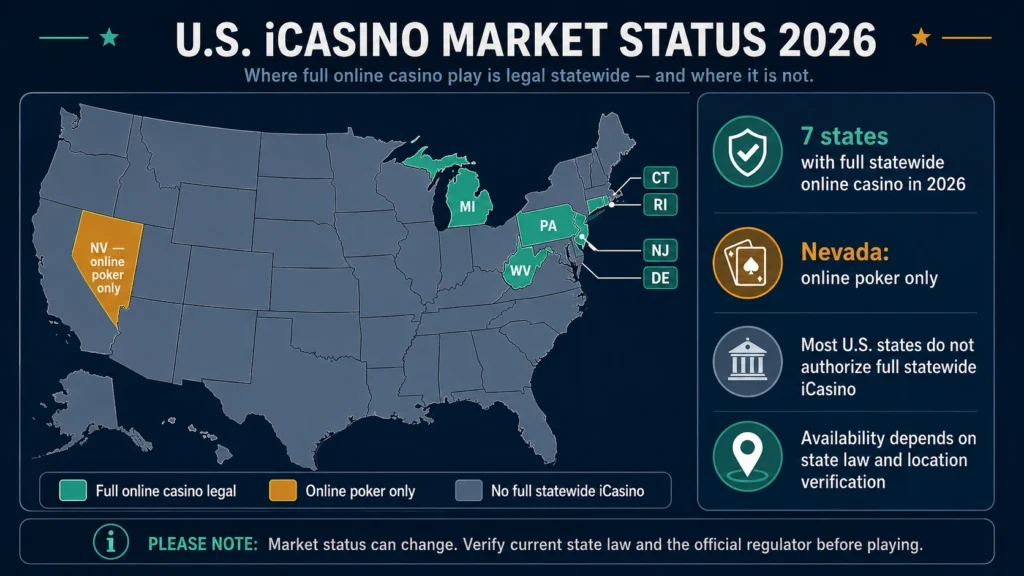
As of August 18, 2026, seven states have live full-scale state-regulated iCasino markets:
- Connecticut
- Delaware
- Michigan
- New Jersey
- Pennsylvania
- Rhode Island
- West Virginia
The American Gaming Association reported that these seven markets generated approximately $10.73 billion in iGaming revenue during 2025, up 27.6% from the previous year. The AGA is an industry trade association rather than a government regulator, but its State of the States reporting provides a useful nationwide market snapshot.
What About Maine?
Maine is the important 2026 exception.
Public Law 2025, Chapter 538 became law without the governor's signature on January 11, 2026, and created a framework allowing eligible Wabanaki Nations to operate internet gaming under licensing by the Maine Gambling Control Unit.
However, legalization of a framework is not the same thing as a live market.
The Maine Gambling Control Unit currently states that internet-gaming applications are available for applicants to prepare but are not yet being accepted, with the submission date still to be announced.
For that reason, Maine should be described as authorized by law but not yet live, rather than being added to the seven operating iCasino states.
This distinction matters because some current comparison pages already count Maine alongside active state-regulated casino markets even though operators have not yet completed the licensing process.
What Is an Offshore Crypto Casino?
An offshore crypto casino is an online gambling operator based outside the United States that accepts cryptocurrency as one or more of its payment methods.
Some offshore casinos are licensed by foreign gambling authorities. Others may have weaker forms of corporate registration, and some may have no meaningful gambling authorization at all.
Those categories should not be mixed together.
For example, Curaçao now regulates online gaming under its National Ordinance on Games of Chance, and the Curaçao Gaming Authority describes itself as responsible for online-gaming licensing and AML/CFT supervision.
Anjouan is more complicated. The Anjouan Gaming website publishes a searchable register that lists company names, licence numbers, operational domains, B2C/B2B types and status.
However, the legal status of that licensing framework is disputed. A 2024 GIABA mutual evaluation endorsed by the FATF states that gambling and games of chance are prohibited in the Union of the Comoros under Article 201 and related provisions. An Anjouan register entry therefore should not be presented as equivalent to an uncontested national gambling authorization.
In any case, neither a Curaçao license nor an Anjouan register entry is a Michigan, Pennsylvania, New Jersey or other U.S. state gaming license.
The site's crypto casino licensing guide explains this distinction in more detail and recommends checking state authorization before evaluating any foreign license.
A Foreign License Does Not Equal U.S. State Authorization
This is where much offshore-casino content becomes misleading.
A casino can truthfully say:
Licensed by a foreign gaming authority.
while it is also true that:
The casino is not authorized by the gaming regulator in the U.S. state where a player is located.
Those statements are not contradictory.
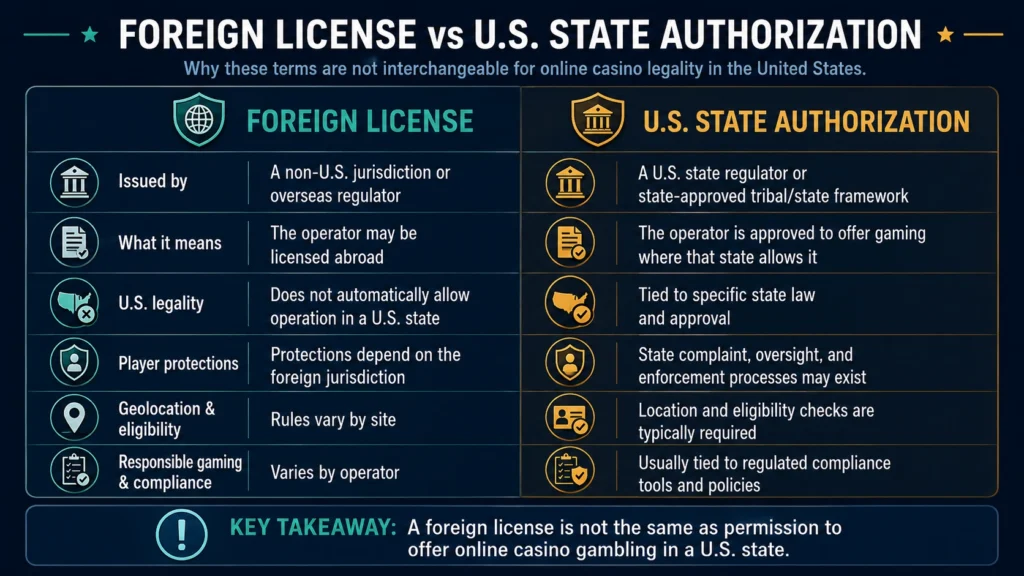
A foreign license governs the relationship between the operator and its licensing jurisdiction. A U.S. state authorization governs whether that operator can legally provide the covered gambling activity under that state's framework.
Michigan's current enforcement activity shows the distinction in practice. On April 7, 2026, the Michigan Gaming Control Board announced that it had issued cease-and-desist orders to 45 offshore gambling operators it said were unlawfully offering online casino gaming or sports wagering to Michigan residents.
The regulatory question for a U.S. reader should therefore be:
Is this exact operator and domain authorized in the state where I am physically located?
Not:
Can I load the website?
Not:
Does it accept U.S. dollars?
And not:
Does it accept USDT?
Accessibility is not authorization.
1. Geolocation Works Differently
State-regulated internet gaming operates within state boundaries.
The federal intrastate framework specifically contemplates age and location controls intended to stop access from minors and people outside the authorized state.
That is why state-authorized U.S. casino apps may use combinations of:
- Device location.
- Network information.
- Approved geolocation software.
- Account information.
- Identity checks.
An offshore casino may also restrict jurisdictions or perform location checks, but those controls arise from its own terms, payment providers or foreign regulatory obligations rather than the licensing rules of a U.S. state.
Using a VPN or other tool to misrepresent a physical location does not create state authorization and may also violate the operator's terms.
2. KYC and Privacy Are Not the Same as Regulation
State-regulated casino frameworks generally require operators to establish who is using the account, verify age and maintain appropriate compliance controls.
Offshore casino practices are more variable.
One operator might verify identity during registration. Another might allow registration with an email address and reserve document requests for withdrawals or risk reviews. A third might market itself as “no KYC” while its terms still permit enhanced checks.
Neither model should be reduced to:
KYC = safe
or
No KYC = private and safe.
Identity verification is one control. Operator solvency, account security, withdrawal rules, game integrity and dispute resolution are separate issues.
3. State-Regulated Casinos Offer a Local Regulatory Complaint Route
This is one of the most practical differences.
If a player has a qualifying dispute with a Pennsylvania-regulated operator, the Pennsylvania Gaming Control Board provides a formal complaint/dispute process. It states that patrons can submit an electronic complaint or dispute form within the applicable period and receive confirmation from the Board.
The regulator is therefore part of a defined local oversight structure.
Foreign-licensed casino disputes can work differently.
The Curaçao Gaming Authority currently states that it does not mediate or adjudicate individual player disputes and cannot order an operator to compensate a player, although complaints can still provide regulatory information that may lead to supervisory action.
The Anjouan Gaming website publishes a complaint process under which the player first uses the operator's process and unresolved qualifying disputes may proceed to an approved independent ADR provider; the site says its Authority does not adjudicate the merits of individual complaints. Because the legal standing of the broader Anjouan licensing framework is disputed, readers should not assume this process has the same public-law status as a U.S. state regulator's complaint route.
So “licensed” does not mean every licensing authority gives players the same remedy.
The strength and accessibility of the complaint route should be checked separately from the existence of the license.
4. Game Oversight Is Structured Differently
State-regulated casino games operate within the testing, approval and reporting requirements imposed by the relevant state regulator.
Offshore casinos may use established game providers, independent testing laboratories or provably fair systems, but the oversight framework depends on the operator and licensing jurisdiction.
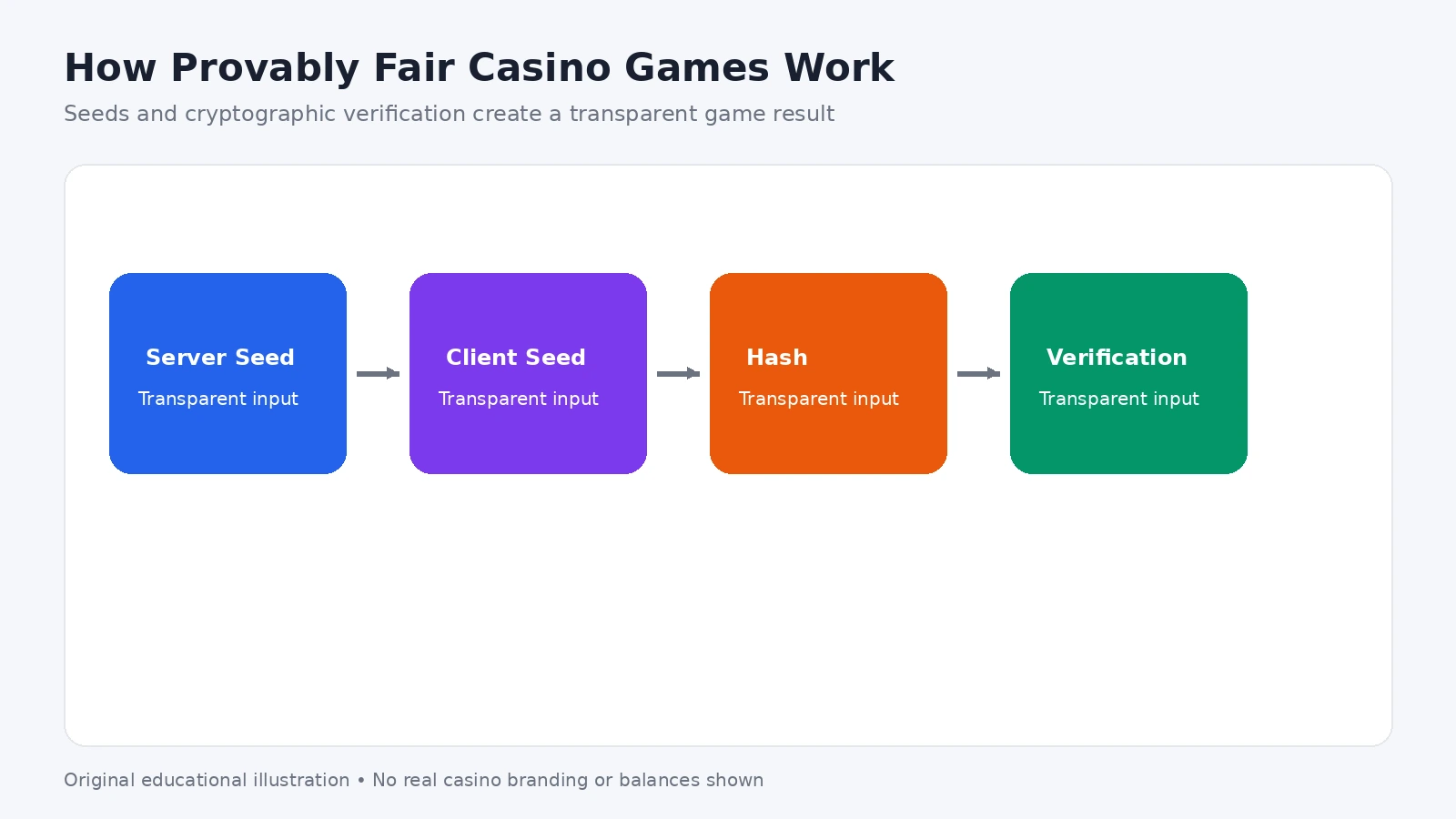
Provably fair technology can be useful for checking the cryptographic integrity of certain game outcomes. It does not prove:
- That the casino is authorized in a U.S. state.
- That withdrawals will be honored.
- That account terms are favorable.
- That the operator has adequate reserves.
- That a complaint will be resolved in your favor.
Game fairness and operator accountability are related but distinct checks.
5. Responsible-Gambling Protection Can Differ Materially
State-regulated markets can integrate casino operators into state-level responsible-gambling systems, including formal self-exclusion and account-control requirements.
Offshore sites may provide:
- Deposit limits.
- Loss limits.
- Time-outs.
- Session reminders.
- Account closure.
- Self-exclusion.
But availability and enforcement depend on the operator and foreign regulatory framework.
That becomes especially important with crypto because deposits can operate 24/7 and can remove some of the banking friction that might otherwise slow repeated transfers.
Regardless of platform type, OnlineCryptoCasino.us recommends treating gambling as entertainment and using responsible gambling controls before gambling becomes financially or emotionally difficult.
6. Payment Choice Is Where Offshore Crypto Casinos Differ Most
Crypto payments are one of the clearest product-level distinctions.
Offshore platforms commonly market support for assets such as:
- Bitcoin.
- Ethereum.
- Litecoin.
- USDT.
- USDC.
- Solana.
- Other digital assets.
State-regulated U.S. casino payment options depend on the state and operator's approved banking infrastructure.
The crucial point is that payment convenience does not alter regulatory status.
A casino does not become legal in a state because a blockchain permits the payment.
And a state-regulated operator does not become less regulated merely because a particular payment technology changes.
Where Does a USDT Casino Fit Into This Comparison?
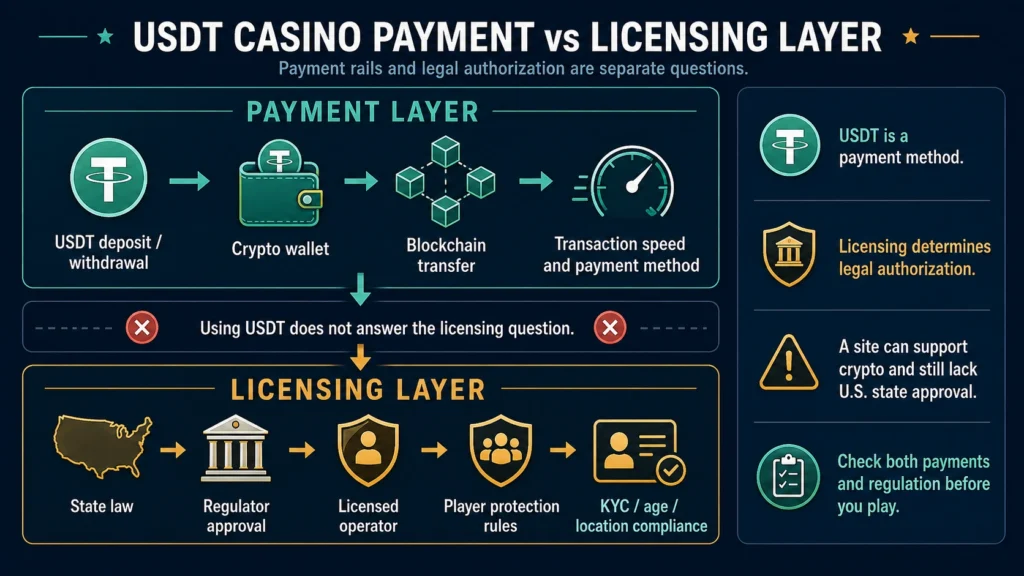
The phrase USDT casino describes an online casino where Tether's stablecoin can be used for deposits, withdrawals or both.
It does not describe a distinct category of gambling license.
Think of two independent questions:
Regulatory Question
Who is authorized to operate this casino, and by which authority?
Payment Question
Which asset and blockchain can be used to move funds?
Those questions must be answered independently.
Suppose an offshore site supports:
USDT — TRC20
That tells you the casino accepts USDT over the TRON network.
It tells you nothing by itself about:
- Whether the domain is licensed.
- Whether the license is active.
- Whether U.S. players are permitted.
- Whether the operator is authorized in your state.
- What dispute process applies.
- Whether withdrawal KYC can occur.
Similarly, a statement such as “USDT accepted” is incomplete payment information unless the supported blockchain is also identified.
OnlineCryptoCasino.us's TRC20 vs ERC20 USDT payment guide explains why the exact USDT network must be verified: the same token can exist on incompatible blockchains.
7. Crypto Withdrawals Can Settle Quickly—After the Casino Sends Them
Offshore crypto casinos frequently market withdrawals as instant or near-instant.
Blockchain settlement can indeed be much faster than some traditional banking methods, depending on the network.
But there are two separate clocks:
Casino processing time
and
blockchain settlement time.
Before the transaction reaches a blockchain, the operator may perform:
- Account review.
- KYC.
- Bonus verification.
- Withdrawal-limit checks.
- Fraud screening.
- Payment ownership checks.
- Manual approval.
Only after the casino broadcasts the transaction does network settlement begin.
Therefore, “fast blockchain” should not be translated into “the operator approves every withdrawal instantly.”
The site's guide to pending crypto casino withdrawals explains how a TXID can help determine whether a delay is still inside the casino or has moved on-chain.
8. Offshore Does Not Automatically Mean Globally Unregulated
Another common mistake is treating “offshore” and “unlicensed” as synonyms.
They are not.
An offshore operator can hold a legitimate foreign license and still lack U.S. state authorization.
Conversely, a website may claim to be offshore or “international” without holding a meaningful gaming license at all.
A useful due-diligence hierarchy is:
- State authorization, where relevant to the player's location.
- Exact foreign operator license, if claimed.
- Exact approved domain.
- Current license status.
- B2C rather than supplier-only authorization.
- Complaint process.
- KYC and withdrawal rules.
- Payment/network rules.
For Anjouan, the published register can be used to check whether a site is listed within that framework, but a registry entry should not be treated as proof of uncontested legal authorization in the Union of the Comoros. The FATF-endorsed GIABA assessment says gambling is prohibited in the Union.
Curaçao similarly operates its current online-gaming licensing framework under the National Ordinance on Games of Chance.
Neither register substitutes for a U.S. state regulator's operator list.
9. Bonuses and Game Libraries Can Be Broader Offshore—but Terms Matter More Than Size
Commercial offshore-casino comparisons commonly emphasize larger game libraries and larger percentage bonuses.
Those differences can exist because the operators participate in different regulatory, supplier and promotional ecosystems.
But bonus size alone provides little information about actual value.
A 400% match with:
- High wagering requirements.
- Restricted games.
- Maximum bet rules.
- Maximum cashout.
- Short expiry.
- Verification conditions.
can be less useful than a much smaller promotion with straightforward terms.
The same applies to game count. Ten thousand games do not compensate for weak withdrawal terms or unclear regulatory recourse.
10. U.S. Tax Obligations Do Not Disappear Because the Casino Is Offshore
The casino's location and payment method should not be treated as determining whether gambling income must be reported in the United States.
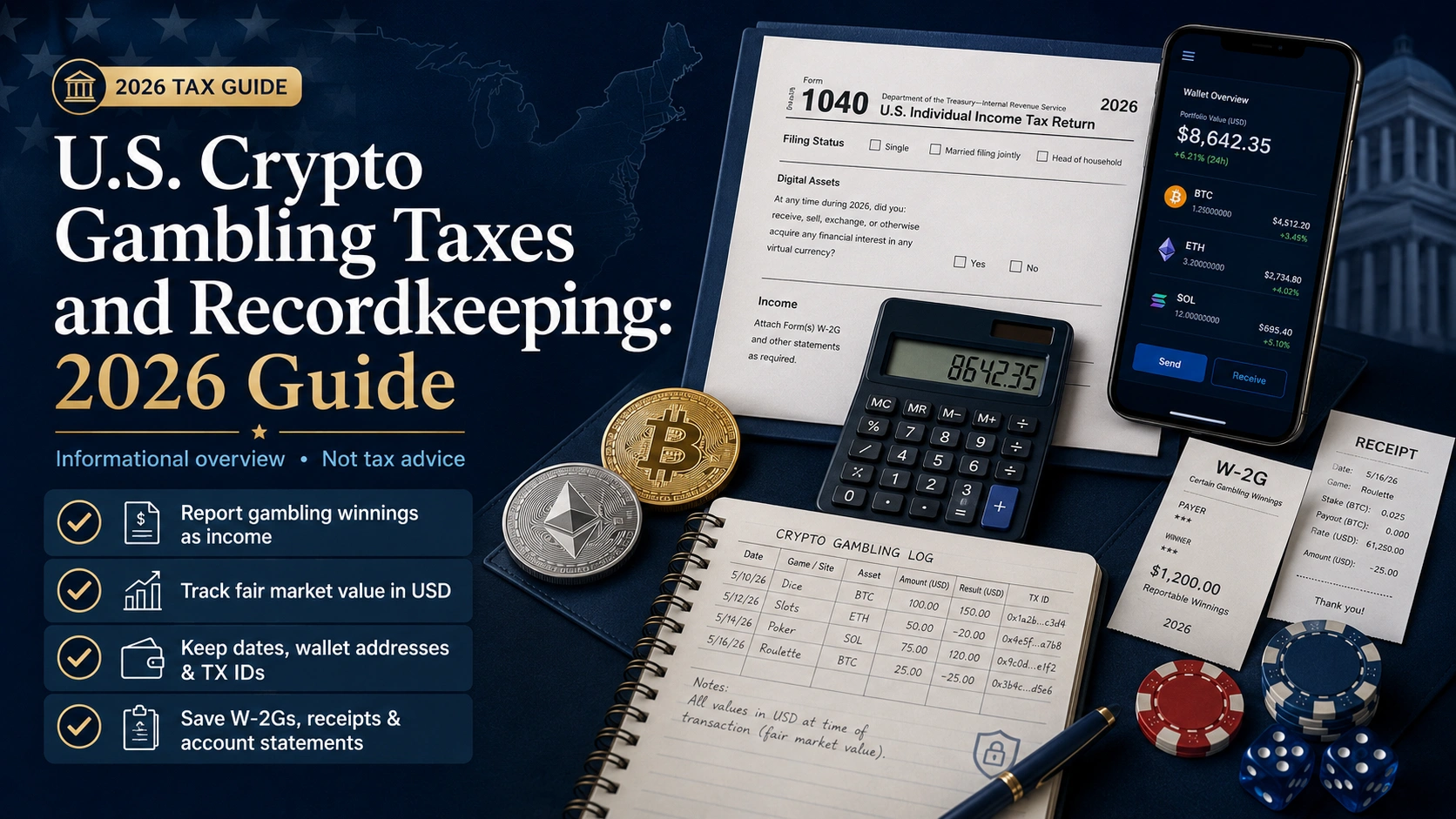
Current IRS guidance states that gambling winnings are taxable and must be reported as income. Receiving value through cryptocurrency can introduce additional digital-asset recordkeeping considerations depending on the later transactions involving that asset.
A person with significant offshore gambling or digital-asset activity should obtain tax advice appropriate to their individual circumstances rather than assuming that the absence of a conventional U.S. casino tax form removes an obligation.
Why Offshore Sites Remain Highly Visible in U.S. Search Results
The availability of an offshore casino in Google is not evidence that a state regulator approves it.
Academic research provides an interesting reason this distinction matters.
Sinyong Choi's study of offshore gambling sites accessible from the United States found that online visibility—measured using factors including referring domains and organic keywords—was associated with use and website traffic among the sampled offshore sites. The study also found that gambling review sites maintaining blacklists could function as an informal “guardian” by helping users avoid unreliable operators. The dataset was collected in 2021, so it should be treated as behavioral research rather than a current operator census.
That creates an important responsibility for review publishers.
A website describing an offshore casino should not turn:
“accessible from the U.S.”
into:
“authorized in the U.S.”
Nor should:
“foreign licensed”
be shortened to:
“U.S. legal.”
Search visibility is discoverability, not regulatory approval.
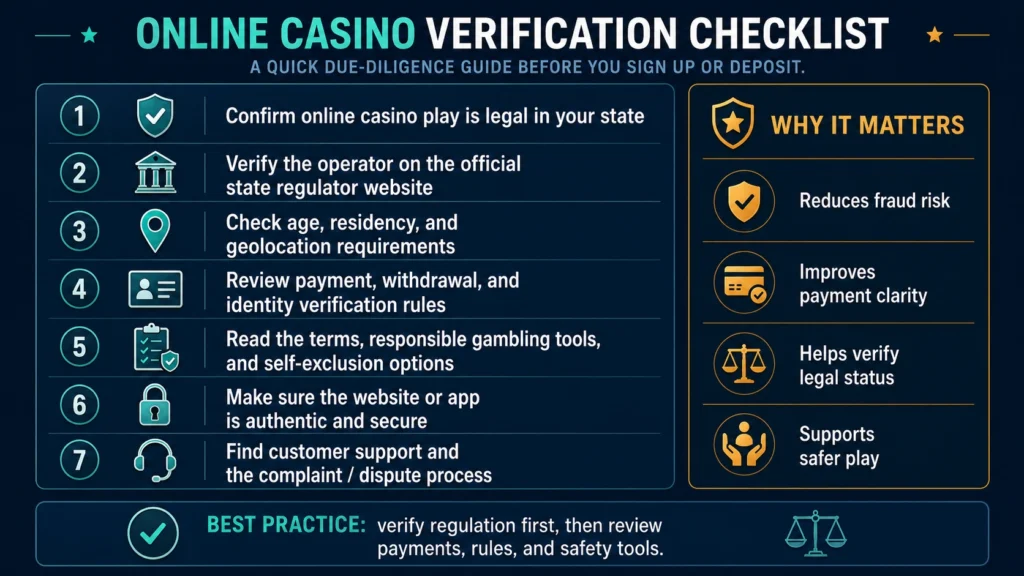
How to Verify an Online Casino Before Depositing
Step 1: Identify Your Physical State
Online casino law is state-specific. Start with the state where you will actually be located when wagering.
Step 2: Check Whether Full Online Casino Gaming Is Live There
Do not confuse:
- Sports betting.
- Online poker.
- Sweepstakes casinos.
- Social casinos.
- Full real-money iCasino gaming.
They can operate under different laws.
Step 3: Open the State Regulator's Website
Search its official authorized-operator list.
Do not rely on:
- Affiliate rankings.
- Google ads.
- Reddit recommendations.
- A casino's own “USA accepted” claim.
For example, Pennsylvania tells players directly to confirm that a site appears among its regulated online gaming operators.
Step 4: Match the Exact Domain
A legitimate company can operate multiple brands and websites.
Verify the exact domain you intend to use, not just a similar company name.
Step 5: Treat a Foreign License as a Separate Check
If the site claims a Curaçao or another foreign license, verify it through the relevant authority’s official database. If it claims Anjouan, check the published register but also verify the legal basis independently and note the conflict with the FATF-endorsed GIABA assessment of Comorian gambling law.
Do not substitute foreign licensing for state authorization.
Step 6: Read Withdrawal and Verification Terms Before Depositing
Check:
- Minimum withdrawal.
- Maximum withdrawal.
- Internal processing period.
- KYC rules.
- Source-of-funds clauses.
- Bonus restrictions.
- Withdrawal fees.
- Supported payment networks.
- Account closure rules.
Step 7: Verify the Exact Crypto Network
If using USDT, confirm whether the casino requires:
- TRC20.
- ERC20.
- Solana.
- BNB Chain.
- Another network.
A token name alone is not enough.
Step 8: Check the Complaint Route
Ask before depositing:
If my withdrawal is disputed, who can review it besides the casino itself?
For a state-regulated site, the answer may include the state regulator.
For a foreign-licensed site, it may involve the operator, ADR provider or another process—and some foreign regulators expressly state that they do not adjudicate individual compensation disputes.
Step 9: Save Evidence
Keep copies of:
- Terms.
- Bonus conditions.
- Deposit address.
- Payment network.
- TXID.
- Withdrawal request.
- Support correspondence.
- License status.
Terms and website content can change.
Which Offers Stronger Consumer Protection?
If the comparison is strictly about local regulatory recourse, a properly state-regulated U.S. online casino has the clearer advantage for a player located in the state where it is authorized.
The regulator can identify the legal operator, control the approved websites, enforce state requirements and provide a local complaint framework.
That does not mean state-regulated casinos are risk-free. Gambling still has a built-in house advantage, disputes can occur, accounts can be reviewed and responsible-gambling risks remain.
It also does not mean every foreign-licensed crypto casino is fraudulent.
A properly licensed offshore operator can have meaningful compliance standards, transparent terms, independent dispute mechanisms and strong account security.
The difference is where those protections come from and how enforceable they are for the U.S. player.
State-Regulated or Offshore: A Practical Decision Framework
| Priority | What to Check First |
| Clear U.S. authorization | State regulator |
| Local complaint recourse | State-regulated operator |
| USDT payments | Exact casino + blockchain support |
| Lower-friction crypto cashier | Offshore options may offer more choice, subject to eligibility |
| Privacy | Read KYC and privacy policies separately |
| Fast cashout | Compare operator processing, not only network speed |
| Foreign license | Verify official registry and domain |
| Responsible gambling | Check actual controls and self-exclusion system |
| Game fairness | Verify regulator/provider/testing framework |
| Bonus value | Read wagering and cashout terms |
| Legal eligibility | Applicable state rules and regulator |
Bottom Line
The most important difference between a state-regulated online casino and an offshore crypto casino is not the game library, bonus percentage or payment speed.
It is who has authorized the operator and what happens when something goes wrong.
A state-regulated casino operates inside a U.S. state framework with defined operator approval, location controls and regulatory recourse.
An offshore crypto casino may be regulated in another jurisdiction and may offer useful features such as USDT payments, broader cryptocurrency support or blockchain withdrawals. But a foreign license does not establish U.S. state authorization, and the available complaint and enforcement mechanisms can be materially different.
For U.S. readers, verify in this order:
your state → official operator list → exact domain → terms → foreign license → payment network.
And remember the simplest rule in this entire comparison:
USDT is a payment method. It is not a gambling license.
FAQs
As of August 18, 2026, the seven live full-scale state-regulated iCasino markets are Connecticut, Delaware, Michigan, New Jersey, Pennsylvania, Rhode Island and West Virginia. The American Gaming Association reported the same seven active markets for 2025.
Maine enacted an internet-gaming framework in January 2026, but the state's Gambling Control Unit currently says license applications are not yet being accepted. It should therefore be treated as an authorized-but-not-yet-live market.
There is no responsible one-line answer covering every state.
Federal UIGEA provisions define unlawful Internet gambling partly by reference to applicable federal and state law, and states impose their own gambling rules. A foreign casino license therefore does not automatically establish that a site is authorized to accept wagers from a player in a particular U.S. state.
Michigan, for example, continues to issue cease-and-desist orders to offshore operators it says are serving residents without state authorization.
Maine has legalized an internet-gaming framework, but it does not yet have a live state-regulated iCasino market.
Public Law 2025, Chapter 538 became law in January 2026. However, Maine's regulator states that internet-gaming applications currently may be prepared but are not yet being accepted.
No.
USDT is a payment asset. A casino's regulatory status depends on the operator, jurisdiction and applicable authorization—not the cryptocurrency it accepts.
A USDT casino may be foreign-licensed, unlicensed, or potentially operate under another model. Always verify the operator and exact domain independently.
For a U.S. player, the most important difference is usually local regulatory recourse.
Pennsylvania, for example, provides an official operator-verification system and a formal patron complaint/dispute process. Foreign licensing systems may use different structures. Curaçao currently says it does not adjudicate individual player compensation disputes, while Anjouan uses an operator-first complaint process followed by approved ADR for qualifying unresolved disputes.
A VPN does not change your physical location or create regulatory authorization.
State-regulated internet gaming uses location controls precisely because wagering authorization is jurisdiction-specific. Misrepresenting location may also violate operator terms.
Not necessarily.
A blockchain may settle a transaction quickly, but the casino first has to approve and broadcast the withdrawal. KYC, bonus review, withdrawal limits or security checks can delay that first stage.
The crypto casino withdrawal process should therefore be evaluated as operator processing plus payment settlement, not blockchain speed alone.
A casino being offshore or paying in cryptocurrency does not automatically remove U.S. tax obligations. Current IRS guidance states that gambling winnings are taxable and must be reported as income. Digital assets can also create additional reporting considerations depending on what happens to the cryptocurrency afterward.