
Prediction market platforms are sending growing numbers of suspected insider-trading cases to authorities, creating a new enforcement test for the Commodity Futures Trading Commission as event-contract trading expands across sports, politics, corporate events and other markets.
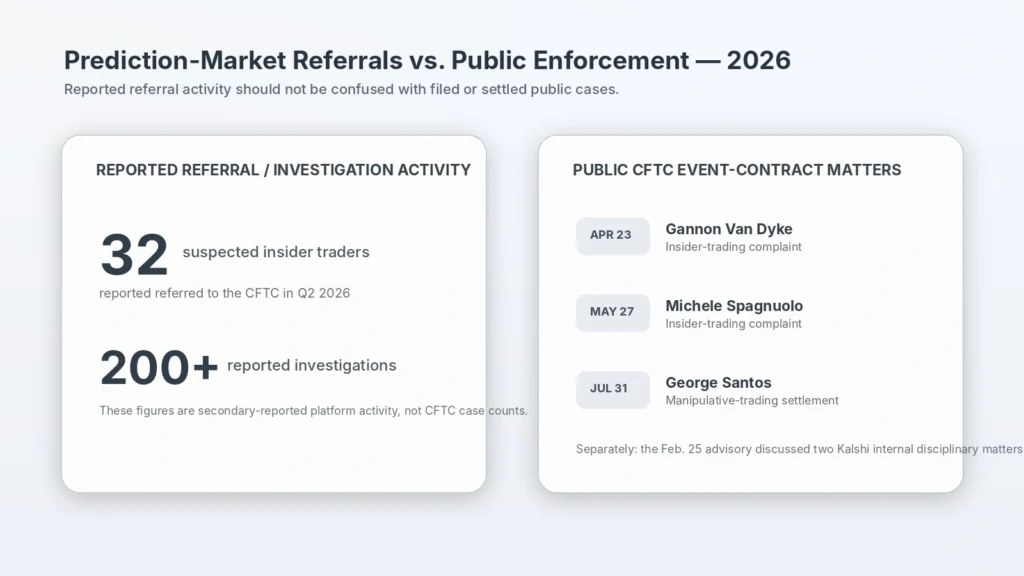
The New York Times reported on August 12 that Kalshi referred 32 possible insider traders to the CFTC during the three months ending in June. The newspaper also reported, based on confidential sources, that as many as 20 investigations were underway from Kalshi referrals alone. Those investigation figures have not been publicly confirmed by the regulator.
The referral numbers are considerably larger than the CFTC’s public prediction-market enforcement docket, but that comparison needs qualification. A platform referral is not proof of misconduct, and federal investigations generally remain confidential unless authorities file charges or otherwise disclose an action.
Key Facts
| Category | Confirmed or Reported Status |
| Kalshi Q1 investigations | 150+ |
| Potential insider trades blocked by Kalshi in Q1 | 100+ |
| Kalshi Q1 law-enforcement referrals | 20+ |
| NYT-reported Kalshi referrals, three months through June | 32 |
| Polymarket account referrals | 90+ to law enforcement |
| First CFTC event-contract insider case | April 23, 2026 |
| Second public CFTC insider case | May 27, 2026 |
| George Santos action | Manipulation, not insider trading |
| CFTC staffing decline cited by Sen. Warren | 25% since Jan. 2025 |
| Kalshi/Nasdaq surveillance announcement | Aug. 10, 2026 |
Kalshi’s Own Data Shows Wider Surveillance Activity
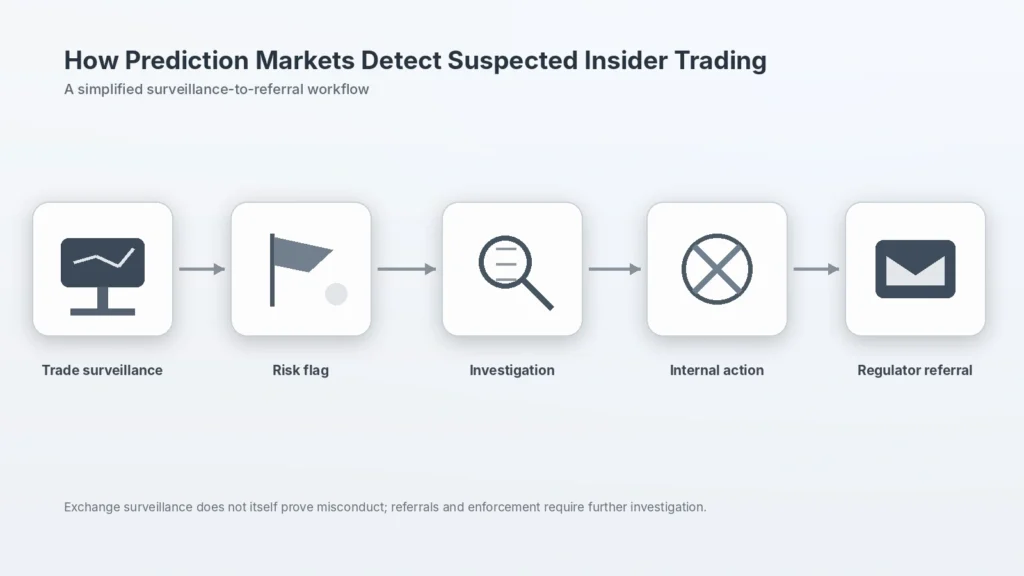
Public statistics from Kalshi’s June market-integrity update show that suspected activity extends beyond the cases that ultimately become public enforcement matters.
Kalshi said it conducted more than 150 investigations during Q1 2026, blocked more than 100 potential insider trades using screening technology, referred more than 20 matters to law enforcement and took five disciplinary actions.
The exchange also introduced a risk-scoring system that looks at factors including corporate information, concentration of knowledge about an outcome, national-security issues and other situations where relatively few people may know material facts before the broader market.
For higher-risk contracts, Kalshi said it can request employment information before allowing a user to trade, enabling the platform to identify people who may have advance nonpublic knowledge connected to their jobs.
That structure demonstrates why referral numbers and actual enforcement cases should not be compared one-for-one. A platform may investigate or block potentially problematic activity before a prohibited trade occurs, while other cases may be referred without ultimately meeting the legal threshold for prosecution.
Polymarket Says It Has Referred More Than 90 Accounts
Polymarket’s market-integrity disclosures show an even larger referral figure.
The platform says it has referred more than 90 accounts to law enforcement, provided information involving more than 315 wallets and cooperated in two arrests.
Those statistics need an important qualification: they are not the same as saying the CFTC has received 90 Polymarket insider-trading cases.
Polymarket describes cooperation with relevant authorities in the United States and overseas, and its global platform maintains a separate set of integrity materials from Polymarket US.
The company’s rules prohibit trading on stolen confidential information, illegally obtained tips and contracts whose outcomes a trader can directly influence.
Polymarket also gives examples of nonpublic information that may still be permissible to trade on when the trader lawfully owns or develops that information and owes no duty of confidentiality. That distinction closely resembles an important feature of the CFTC’s own enforcement position.
CFTC Has Brought Two Major Insider-Trading Cases in 2026
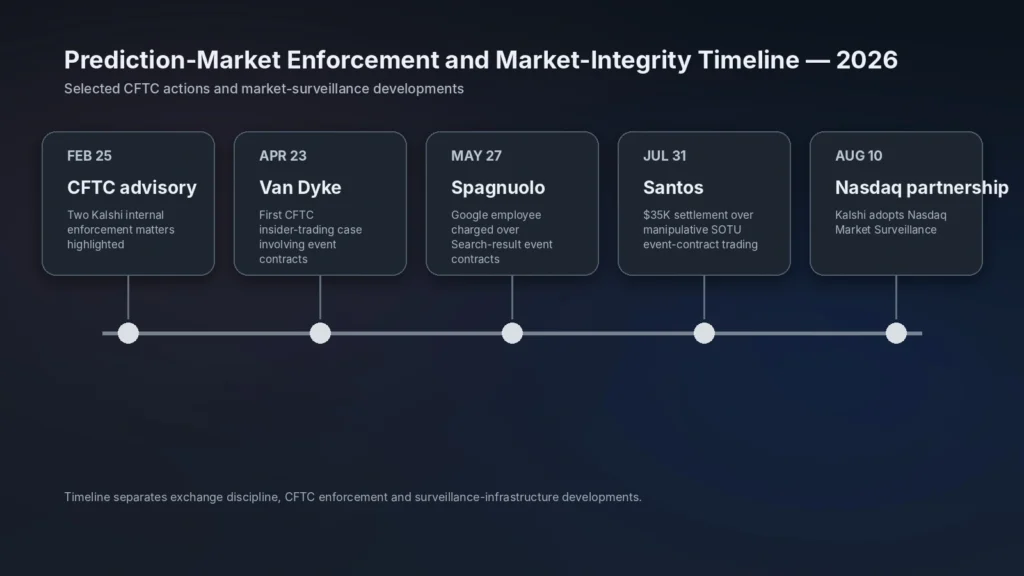
Although public CFTC cases remain far fewer than platform referrals, the agency has already tested its insider-trading authority against two substantially different types of nonpublic information.
U.S. Soldier Case Became First Event-Contract Insider Action
On April 23, the CFTC filed what it described as the first CFTC insider-trading case involving event contracts.
The regulator alleges active-duty Army service member Gannon Ken Van Dyke used classified nonpublic information concerning a U.S. operation to capture Nicolás Maduro to buy more than 436,000 “Yes” shares in a Polymarket event contract.
According to the CFTC complaint, the trading generated more than $404,000 in profits.
The case also represented the CFTC’s first prediction-market use of the so-called “Eddie Murphy Rule,” a Commodity Exchange Act provision addressing misuse of nonpublic government information.
A parallel federal criminal case was announced on the same date.
The allegations remain subject to court proceedings and should not be treated as a final finding of liability.
Google Employee Allegedly Made $1.2 Million
One month later, the CFTC brought a second case involving corporate rather than government information.
In the Google Year in Search insider-trading complaint filed May 27, the regulator alleged software engineer Michele Spagnuolo used sensitive nonpublic information concerning Google’s 2025 Year in Search rankings.
The CFTC alleges Spagnuolo traded at least 23 related Polymarket contracts with near-perfect accuracy and generated approximately $1.2 million in profits.
According to the complaint, the legal basis rests on the employee’s duty of trust and confidence to Google and the alleged use of confidential employer information for personal financial gain.
A parallel criminal complaint was also filed.
Again, these are allegations rather than a final adjudication.
George Santos Case Was Manipulation, Not Insider Trading
The third major CFTC prediction-market action of 2026 is legally different.
In its George Santos State of the Union manipulation order, the agency found that the former congressman made misleading statements about whether he would attend the 2026 State of the Union while trading a contract whose outcome depended on his own conduct.
The CFTC ordered Santos to disgorge $17,569.98, pay a $17,500 civil monetary penalty and accept a three-year trading ban.
The distinction matters for reporting on the wider issue.
Santos was not charged under an insider-trading theory. His case concerned manipulative trading in an outcome he could control.
Grouping all three public actions as insider-trading prosecutions would therefore overstate the CFTC’s current case count.
Not Every Informational Advantage Is Illegal Insider Trading
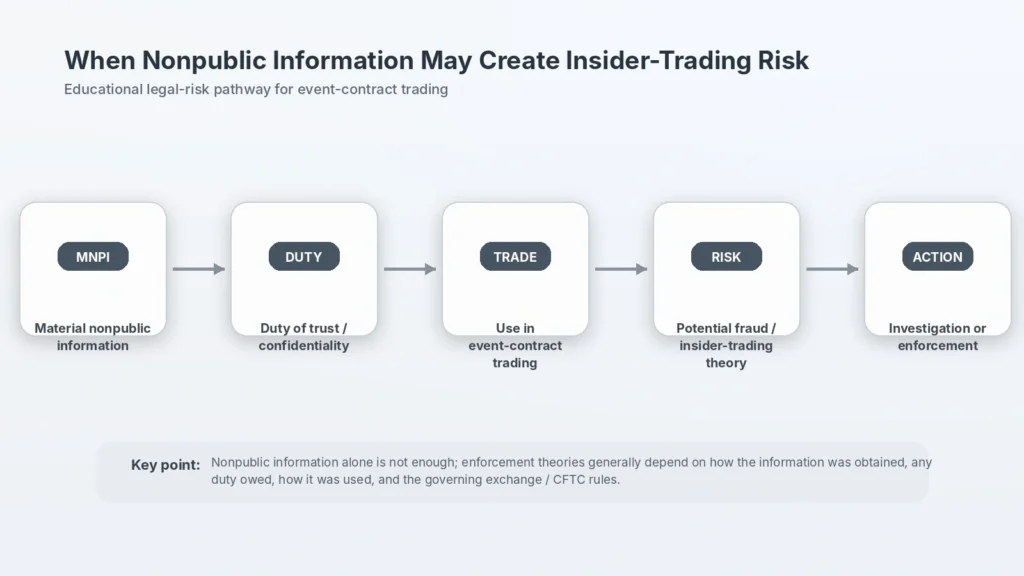
Prediction markets create an unusual enforcement problem because contracts can be tied to an enormous range of events, from corporate announcements and sports injuries to political decisions and public speeches.
But possessing better information than other traders is not automatically illegal.
CFTC Enforcement Director David Miller explained the distinction in the agency’s prediction-market insider-trading enforcement guidance on March 31.
Under the CFTC’s misappropriation theory, liability generally involves material nonpublic information that a person uses or tips in breach of a duty of trust or confidence owed to the information’s source, together with the other required legal elements.
That is why a company employee using confidential product-launch information could face a different legal analysis from a trader who develops a private forecasting model from public information.
Miller also said traders can use nonpublic information they rightfully own when doing so does not breach a duty to another party.
This distinction means some apparently suspicious prediction-market trades may ultimately fall outside insider-trading law even if the trader knew more than the rest of the market.
Fraud, manipulation or other Commodity Exchange Act provisions could still apply depending on the conduct.
CFTC Staffing Has Become a Congressional Issue
The rise in referrals is occurring as the regulator’s staffing levels face political scrutiny.
Sen. Elizabeth Warren asked the Government Accountability Office on July 22 to examine CFTC staffing reductions and their effect on the agency’s ability to carry out its enforcement responsibilities.
In Warren’s request for a GAO review, she said CFTC staffing had declined 25% since January 2025 and noted that buyout and early-retirement offers reportedly continued into June 2026.
Warren also cited Reuters figures showing a large decline in the number of enforcement actions and monetary relief after fiscal 2024.
Those statistics establish that staffing and enforcement levels have changed, but they do not prove that workforce reductions caused particular prediction-market referrals to go uncharged.
The CFTC has publicly maintained that it can police illegal activity in prediction markets and has identified insider trading as an enforcement priority.
The unanswered question is whether the scale and complexity of future referrals will strain that capacity as the sector grows.
CFTC Is Also Expanding Event-Contract Data Requirements
Enforcement actions are only one part of the federal response.
The CFTC published a proposed event-contract reporting framework on July 1 that would change how certain fully collateralized event-contract data is reported.
Of particular relevance to insider trading, the regulator proposed requiring designated contract markets to obtain certain trader-identifying information.
The Commission said such information is important for detecting insider trading, preventing wash trading and conducting cross-market surveillance when economically similar contracts trade on several exchanges.
The proposal also acknowledges that event-contract markets may be vulnerable to manipulation, fraud and insider trading.
The public-comment period closed July 31. The proposal is not yet a final rule.
Kalshi Turns to Nasdaq Surveillance Technology
Prediction-market exchanges are also increasing their own compliance infrastructure.
On August 10, Kalshi announced a multi-year Nasdaq Market Surveillance partnership.
Kalshi said the system will be implemented in phases and provide real-time capabilities for identifying potential insider trading, market manipulation and other forms of abuse.
It will also help format and transmit trading data to the CFTC.
The agreement follows Kalshi’s earlier introduction of employment screening and market-risk scoring and illustrates how exchanges are being positioned as a first line of surveillance rather than relying exclusively on federal investigators.
The CFTC has explicitly said designated contract markets have independent responsibilities to maintain audit trails, conduct surveillance and enforce their own rules.
Congress Is Considering Additional Restrictions for Officials
Lawmakers are separately considering whether federal ethics rules need to respond directly to prediction-market trading.
The House Public Integrity in Financial Prediction Markets Act of 2026 was introduced on January 9 by Rep. Ritchie Torres and other lawmakers.
The House proposal would restrict certain federal officials and employees from knowingly trading relevant prediction-market contracts when they possess—or could reasonably obtain through official duties—material nonpublic information.
A Senate version introduced March 25 would apply restrictions to the president, vice president, members of Congress, congressional staff, political appointees and employees of executive or independent regulatory agencies.
Neither proposal has been enacted.
The legislative interest reinforces one of the central regulatory challenges: event contracts can create monetizable markets around government decisions and political events that historically were not directly tradeable in the same way.
Wider Prediction-Market Legal Fight Remains Unresolved
Insider-trading enforcement is developing alongside a separate dispute over who should regulate sports-related prediction markets.
CFTC-regulated exchanges argue that qualifying event contracts fall within federal derivatives regulation, while several state gaming authorities have challenged sports contracts under state gambling laws.
OnlineCryptoCasino.us has covered that issue separately through the ongoing New York prediction-market litigation involving Novig and other event-contract operators.
The insider-trading cases are distinct from that federal-versus-state jurisdiction dispute.
Even where an event contract falls within CFTC jurisdiction, market participants may still face federal anti-fraud, manipulation and insider-trading requirements.
What the Referral Numbers Actually Tell Us
The growing referral totals show that prediction-market surveillance is identifying potentially problematic activity.
They do not establish that dozens of people have broken federal law.
There are several stages between an unusual trade and an enforcement action:
1. A platform surveillance system identifies unusual behavior.
2. The exchange investigates the account.
3. Trading may be blocked or the user disciplined internally.
4. The matter may be referred to authorities.
5. Regulators determine whether the facts warrant investigation.
6. Investigators assess whether the conduct satisfies the legal requirements for a violation.
7. Only some matters ultimately become public enforcement actions.
This makes a direct numerical comparison between 90 platform referrals and two CFTC insider-trading complaints potentially misleading.
What is clear is that the surveillance workload is expanding.
Why It Matters for Prediction-Market Users
For users, the developing cases demonstrate that prediction markets should not be treated as spaces where confidential workplace or government information can automatically be monetized without legal consequences.
At the same time, the CFTC’s position is more nuanced than a blanket ban on informational advantages.
The source and ownership of the information, whether a confidentiality or trust obligation exists, whether a trader can influence the outcome and whether manipulation occurred can all affect the legal analysis.
Event contracts can also result in complete loss of the amount committed to a position when the predicted outcome does not occur. Readers using gambling-adjacent products for entertainment can review OnlineCryptoCasino.us’ responsible gambling resources for broader information about financial-risk awareness and problematic gambling behavior.
Prediction markets are regulated differently from conventional online casinos and sportsbooks, so that internal resource should not be read as a statement that every event contract is legally classified as gambling.
What Happens Next?
Several developments now warrant attention.
The first is whether the platform referrals reported in 2026 translate into additional CFTC or Justice Department cases.
The second is the GAO response to Warren’s requested review of CFTC staffing and enforcement capacity.
The third is whether the CFTC finalizes its proposed event-contract reporting requirements, particularly the trader-identification provisions designed to strengthen surveillance.
Platform-level enforcement will also be important. Kalshi’s Nasdaq implementation, employment screening and risk-scoring system provide measurable areas to watch, while Polymarket has said it will continue referring suspicious accounts to authorities.
For now, the evidence supports a more measured conclusion than saying federal enforcement has simply failed to keep pace.
Prediction markets are producing a growing pipeline of suspected insider-trading activity, while regulators and exchanges are still building the enforcement, surveillance and legal framework needed to determine which cases amount to actual violations.
FAQs
Yes, certain forms are illegal under the Commodity Exchange Act and CFTC regulations. The CFTC says liability can arise when material nonpublic information is misappropriated and used in breach of a duty of trust or confidence.
Kalshi publicly reported more than 20 law-enforcement referrals during Q1 2026. Separately, the New York Times reported that the exchange referred 32 possible insider-trading cases to the CFTC during the three months ending in June. Those periods and categories should not simply be added together.
Polymarket says it has referred more than 90 accounts to law enforcement. The figure covers cooperation with authorities generally and should not be interpreted as 90 CFTC insider-trading investigations.
The CFTC has publicly announced two 2026 cases specifically alleging insider trading in event contracts: Gannon Ken Van Dyke on April 23 and Michele Spagnuolo on May 27. The July George Santos action involved manipulation rather than insider trading.
No. The CFTC says the legal analysis generally turns on issues including whether material nonpublic information was misappropriated and whether the trader breached a duty owed to the information’s source. Privately developed information or information lawfully owned by a trader can present a different situation.