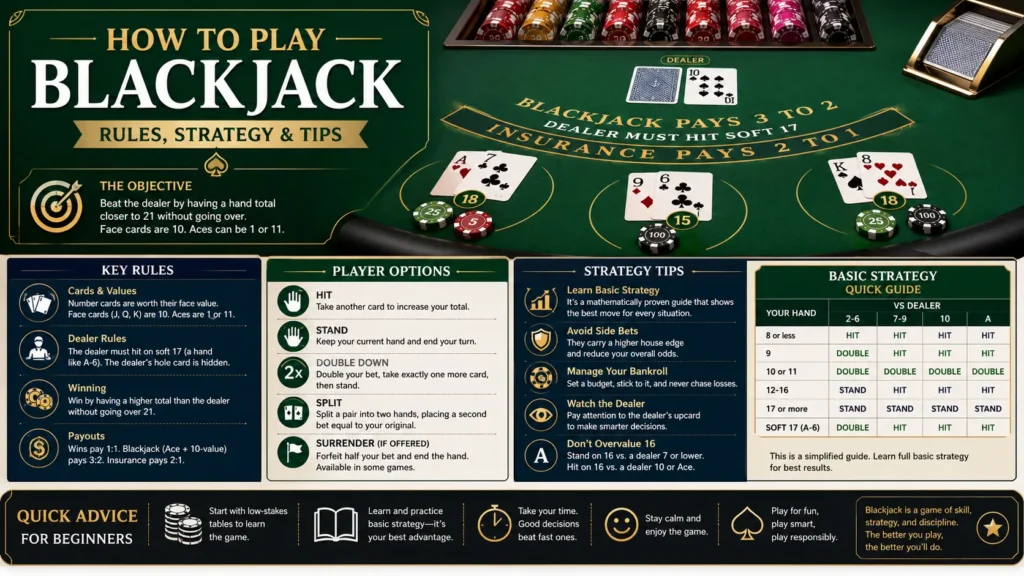
How to Play Blackjack: Rules, Strategy & Tips
How to Play Blackjack: Blackjack is one of the world’s most popular casino card games, where your goal is to beat the dealer by getting a hand value as close to 21 as possible without going over. With simple rules and a low house edge when played correctly, it’s a favorite among both beginners and experienced players. Blackjack is a casino card game in which you try to finish with a hand closer to 21 than the dealer without going over 21. You are playing against the dealer, not against the other people at the table, and you do not need to reach exactly 21 to win. A standard blackjack round begins with two cards. After comparing your total with the dealer’s visible card, you can hit, stand, double down, split, or surrender when the table rules allow it. Blackjack is easy to understand, but the mathematically correct decision can change according to your cards, the dealer’s upcard, and the rules being used. This guide explains the complete process for beginners without suggesting that any strategy can guarantee a profit. Blackjack Rules at a Glance Here are the main blackjack rules beginners should understand: Individual casinos can apply different rules for soft 17, splitting, doubling, surrender, and blackjack payouts. Always check the information displayed at the table before placing a bet. What Is the Objective of Blackjack? The objective is to beat the dealer in one of three ways: You do not need a total of exactly 21. For example: Beginners sometimes take unnecessary cards because they believe they must get as close to 21 as possible. In many situations, the better decision is to stand and allow the dealer to take the risk of drawing. Blackjack Card Values Blackjack uses a standard 52-card deck without jokers. Card Blackjack value 2 through 9 Printed value 10 10 Jack 10 Queen 10 King 10 Ace 1 or 11 The value of an Ace changes automatically to create the strongest legal hand. For example: What Is a Soft Hand in Blackjack? A soft hand contains an Ace that is currently being counted as 11. For example, Ace-6 is called soft 17. Taking another card cannot immediately make the hand bust because the Ace can change from 11 to 1. If you draw a 10, the hand becomes: A hard hand either contains no Ace or contains an Ace that must count as 1. Examples include: Soft and hard totals require different strategy decisions, so they should not be treated as the same type of hand. How to Play Blackjack Step by Step 1. Place your bet Place your wager in the designated betting area before the round begins. In online blackjack, you normally select a chip value and click the betting area. At a physical table, you place casino chips inside the marked betting circle. 2. Receive the first two cards The player normally receives two cards face-up. In American-style blackjack, the dealer generally receives: European-style blackjack may deal the dealer’s second card later. This can affect what happens to additional bets placed through splitting or doubling if the dealer eventually reveals blackjack. 3. Check your hand total Add the values of your first two cards and compare your total with the dealer’s visible card. The dealer’s upcard helps determine whether you should hit, stand, double, or split. 4. Choose your action Depending on your hand and the table rules, you may be able to: 5. The dealer completes the hand Once every player has finished, the dealer reveals the hidden card and follows the table’s fixed drawing rules. The dealer usually: 6. The bets are settled The casino compares each remaining player hand with the dealer’s completed hand. Winning bets are paid according to the table rules, while losing bets are collected. Blackjack Actions Explained Hit To hit means taking another card. You can usually continue hitting until you either stand or exceed 21. Hitting is often correct when your current total is too weak to compete with the dealer’s likely completed hand. Stand To stand means keeping your current total and ending your turn. Standing does not guarantee that your hand will win. It means that taking another card presents more risk than allowing the dealer to complete the hand. Double down Doubling down normally allows you to double your original wager in exchange for receiving exactly one more card. Doubling can be valuable when: For example, a player holding 11 against a dealer 6 will normally double under common American blackjack rules. Some casinos restrict the totals that can be doubled. Always check the table rules. Split When your first two cards have the same value, the casino may allow you to divide them into two separate hands. You must place a second wager equal to the original bet. Each card then becomes the first card of a new hand. Split rules can vary. Check whether the table permits: Surrender Late surrender allows you to give up your hand after the dealer checks for blackjack. You normally lose half the original wager and recover the other half. Not every table offers surrender. When available, it can reduce losses on selected weak hands, such as hard 16 against a strong dealer upcard. Insurance Insurance is a separate side bet offered when the dealer shows an Ace. The insurance wager is normally limited to half your original stake and pays 2:1 when the dealer has blackjack. Insurance does not protect the original hand in the way its name suggests. It is an independent wager on whether the dealer’s hidden card is worth 10. Basic strategy advises most players to decline insurance because the wager carries its own house advantage. How Does the Blackjack Dealer Play? The dealer cannot freely choose whether to hit or stand. The dealer must follow the table’s fixed rules. The most important variation is soft 17. Dealer stands on soft 17 A dealer holding Ace-6 must stand. This rule may be displayed as: Dealer hits soft 17 A dealer holding Ace-6 must take another card. This rule may be displayed as: A dealer-hit-soft-17 rule is less