Nevada Approves Fertitta Directors as Caesars Deal Awaits Reviews
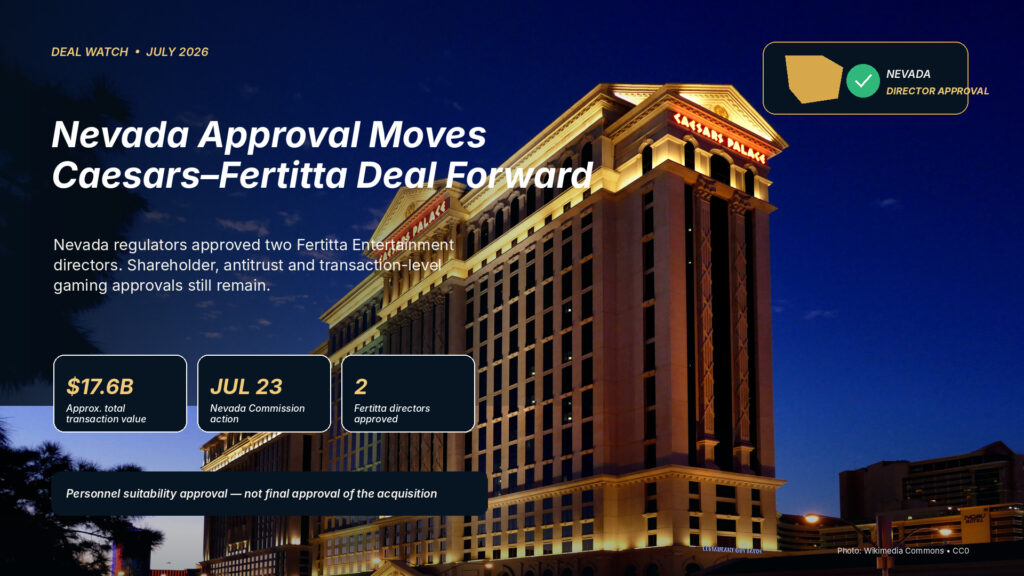
The Nevada Gaming Commission approved Richard Holden Liem and Steven Lee Scheinthal as suitable directors of Fertitta Entertainment on July 23, marking another regulatory step in the company’s proposed $17.6 billion acquisition of Caesars Entertainment. The decision applies to the two executives, however, and does not constitute final approval of the acquisition. (Nevada Gaming Commission) Key facts Detail Current confirmed information Nevada decision date July 23, 2026 Executives approved Richard Holden Liem and Steven Lee Scheinthal Approved positions Directors of Fertitta Entertainment Proposed consideration $31 in cash for each eligible Caesars share Approximate equity value $5.7 billion Total transaction value Approximately $17.6 billion, including assumed debt Go-shop deadline July 11, 2026 Current status Proposed transaction; not completed Remaining conditions Shareholder, antitrust, gaming and other regulatory approvals What Nevada approved The Nevada Gaming Commission’s July disposition records approval of applications concerning Liem and Scheinthal’s suitability to serve as Fertitta Entertainment directors. Liem is Fertitta Entertainment’s chief financial officer, while Scheinthal serves as its general counsel. Both have previously appeared before Nevada gaming regulators in connection with Fertitta-controlled gaming businesses. The July decision is relevant because individuals holding influential positions in licensed gaming companies must satisfy Nevada’s suitability requirements. It does not, by itself, authorize Fertitta Entertainment to acquire Caesars or transfer control of Caesars’ Nevada gaming operations. Further applications and transaction-specific regulatory decisions will be required before ownership can change. Caesars and Fertitta agreed to the transaction in May Caesars entered the merger agreement on May 27 and announced the proposed acquisition the following day. Under Caesars’ Form 8-K, eligible shareholders would receive $31 in cash for each Caesars share when the merger is completed. Caesars would then become a wholly owned subsidiary of the Fertitta acquisition entity and its shares would no longer trade on Nasdaq. The companies place the overall value at approximately $17.6 billion. That figure combines an equity purchase valued at approximately $5.7 billion with the assumption of approximately $11.9 billion of Caesars’ outstanding debt. Distinguishing those figures is important because headlines describing a “$5.7 billion acquisition” are generally referring only to the equity consideration, while the larger figure includes assumed debt. The end of the go-shop period did not finalize the deal The merger agreement allowed Caesars and its advisers to solicit competing acquisition proposals through July 11. No alternative transaction had been publicly confirmed by the time this article was researched. Reports of possible interest from investor Carl Icahn should therefore not be described as a submitted or accepted competing offer without an official filing or announcement. The end of the go-shop period also did not make the Fertitta transaction final. It mainly ended Caesars’ contractual period for actively soliciting alternatives, subject to provisions allowing the board to consider certain later unsolicited proposals. Caesars had previously said it would not provide updates about the process unless it considered disclosure appropriate or required. What approvals are still required? Caesars shareholder approval Caesars’ board approved the merger agreement and recommended that shareholders adopt it. A shareholder vote remains a closing condition. No confirmed date for the special shareholder meeting was identified in the official material reviewed on July 30. Federal antitrust review Large U.S. acquisitions can require notification under the Hart-Scott-Rodino Act. Fertitta executives told Nevada regulators that the required antitrust filing had been submitted, according to hearing coverage. The FTC cannot independently confirm that statement publicly because individual HSR filings are protected from disclosure. Under the FTC’s merger-review guidance, most reportable transactions have an initial 30-day waiting period. Regulators can request additional information, which can extend the review substantially. The expiration of an initial waiting period does not prevent a later antitrust challenge. (Federal Trade Commission) No federal clearance, additional-information request or required asset sale has been publicly confirmed for this transaction. Gaming approvals in multiple jurisdictions Caesars operates gaming businesses in numerous U.S. jurisdictions. The buyer must obtain applicable approvals in the states and markets where a change of control requires regulatory consent. The Nevada approval of Liem and Scheinthal addresses only one part of that broader process. Caesars remains publicly traded Caesars continued operating as a publicly traded company after the July 23 Nevada decision. The company reported second-quarter net revenue of approximately $2.99 billion and a net loss of $62 million on July 28. Caesars did not hold its usual earnings call, stating that the decision was related to its pending merger agreement with Fertitta Entertainment. (Caesars Investor Relations) The results release contained no material announcement that the acquisition had been completed, cleared by antitrust regulators or scheduled for a shareholder vote. What the development means for players and operators The approval produces no immediate change for Caesars or Golden Nugget customers. Current casino operations, online accounts, rewards programs, responsible-gambling controls and state availability continue under existing ownership and regulatory requirements until the transaction closes and any approved operational changes take effect. Readers can review the site’s responsible-gambling resources for information about account controls and support services. The proposed acquisition does not change the risks associated with gambling or make any casino product available in a state where it is not authorized. For the companies, the Nevada decision removes one director-suitability matter from a much larger approval process. Regulators may still review ownership, financing, competition, compliance procedures and the proposed management structure. It remains unknown whether any regulator will require property sales, licensing conditions or changes to the companies’ current plans. The merger agreement allows time for regulatory reviews The merger agreement initially allows either party to terminate if the transaction has not closed by May 27, 2027. That deadline can automatically extend to August 27 and then November 27, 2027 when specified conditions have been satisfied but antitrust or gaming approvals remain outstanding. Those dates are contractual outside dates, not forecasts that the acquisition will necessarily remain pending that long. (SEC) The contract also provides for an additional per-share payment if closing occurs after a separate June 2027 threshold, subject to its detailed terms. What remains unknown The principal unanswered questions