
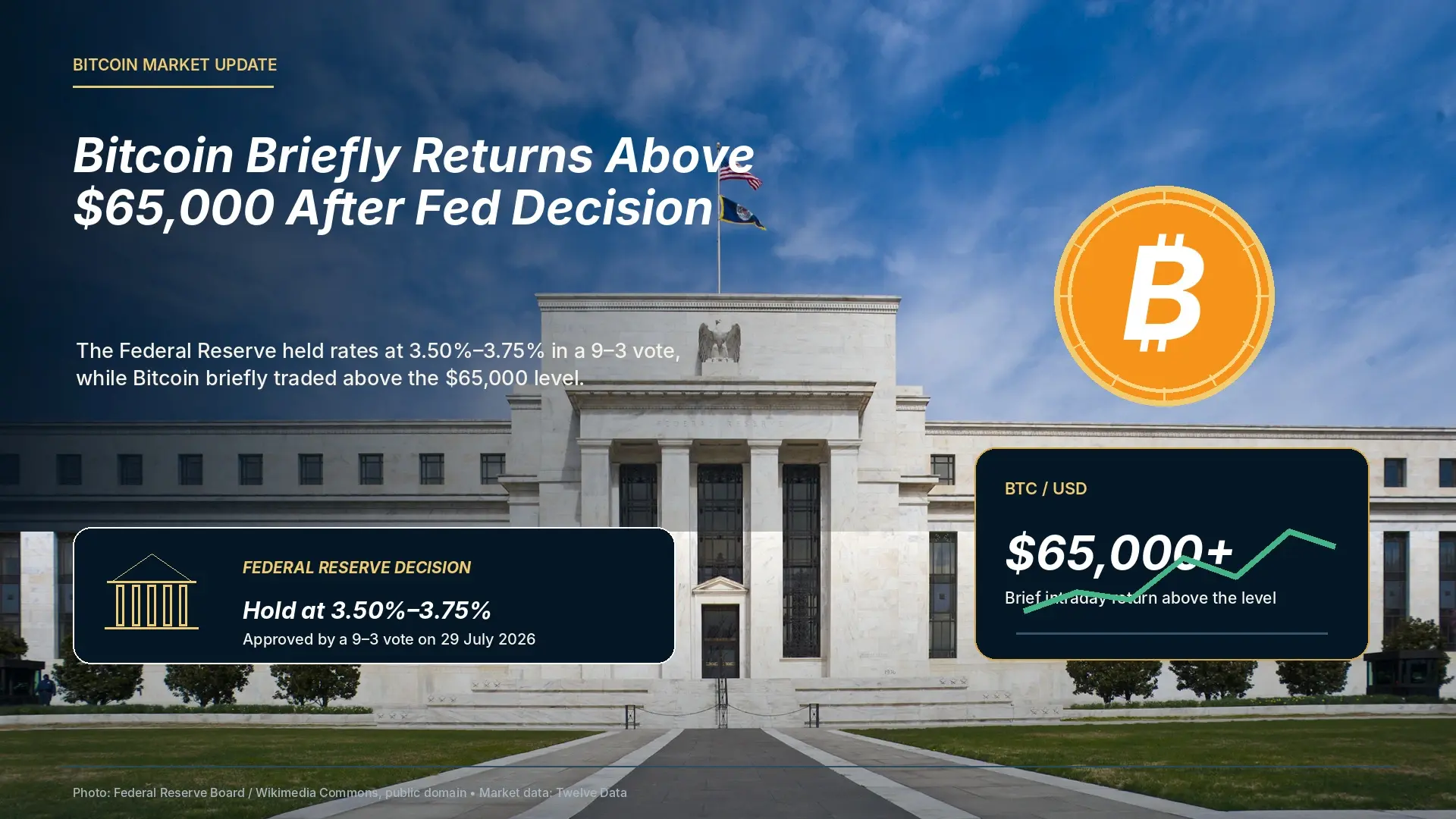
Bitcoin briefly traded above $65,000 on July 30 after the Federal Reserve kept U.S. interest rates unchanged, extending the cryptocurrency’s gain from its June 30 close to approximately 10.6%. Bitcoin was trading near $64,765 at about 4:42 p.m. EDT, showing that the move above $65,000 had not yet developed into a sustained breakout.
Key facts
| Detail | Confirmed information |
| Federal Reserve decision | Rates maintained at 3.50%–3.75% |
| Decision date | July 29, 2026 |
| FOMC vote | 9–3 |
| Dissenting position | Three members preferred a 0.25-point increase |
| Bitcoin intraday high | Approximately $65,040 |
| Bitcoin at research time | Approximately $64,765 |
| July month-to-date gain | Approximately 10.6% from the June 30 close |
| Bitcoin market capitalization | Approximately $1.3 trillion |
| Current status | Trading remained volatile around the $65,000 level |
Market data at approximately 4:42 p.m. EDT on July 30 showed Bitcoin trading near $64,765, with an intraday high of approximately $65,040 and an intraday low of approximately $63,252.
Bitcoin crossed $65,000 but did not remain above it
Bitcoin traded between approximately $63,252 and $65,040 during the July 30 session covered by the live market feed. It was near $64,765 when this article was researched, representing an intraday increase but leaving the cryptocurrency below its session high.
The approximately $65,040 peak differs slightly from the $65,100 figure reported by some cryptocurrency publications. That variation is normal because Bitcoin trades on numerous exchanges, each with its own order book and transaction history.
The most accurate wording is therefore that Bitcoin traded around or briefly above $65,000, rather than describing $65,100 as a universal market high.
Its market capitalization was approximately $1.3 trillion, although that figure moves continuously with price and circulating supply.
July’s gain was above 10% at the research time
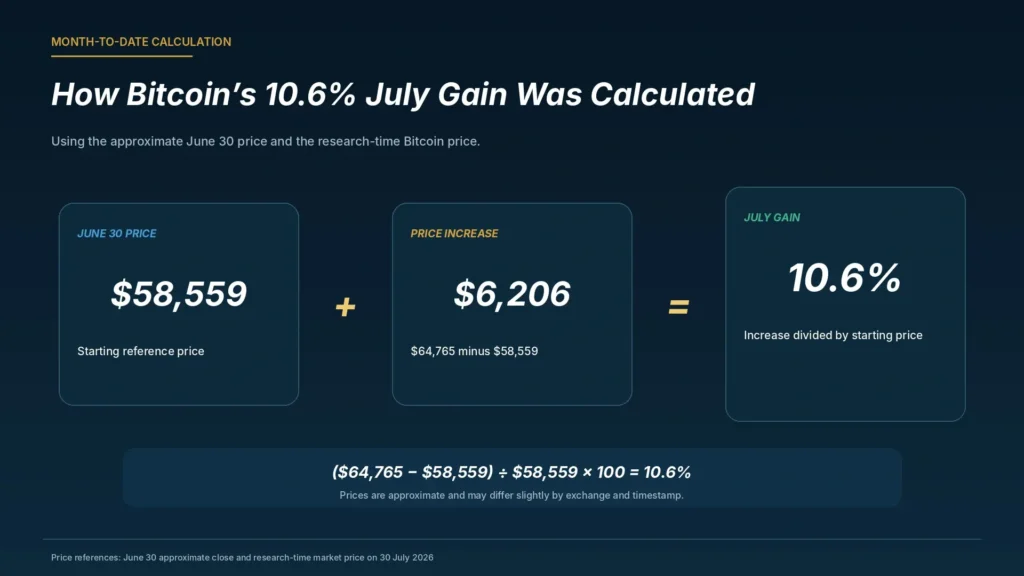
Historical market data places Bitcoin’s June 30 closing price at approximately $58,559. Comparing that benchmark with the research-time price of $64,765 produces a month-to-date increase of approximately 10.6%.
That percentage should not yet be described as Bitcoin’s final July return. Cryptocurrency markets operate continuously, and the final result depends on:
● The selected exchange or price index.
● The benchmark’s daily cutoff.
● The price at the end of July 31.
● Whether the calculation begins with the June 30 close or July 1 opening price.
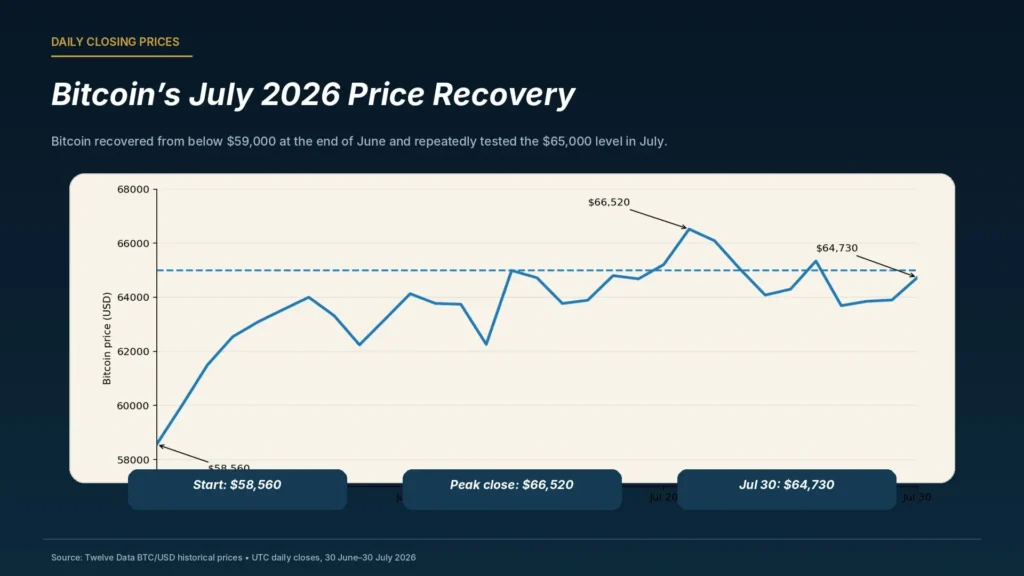
The month-to-date advance nevertheless represents a significant recovery from Bitcoin’s late-June decline below $59,000.
Fed holds rates with three votes favoring a hike
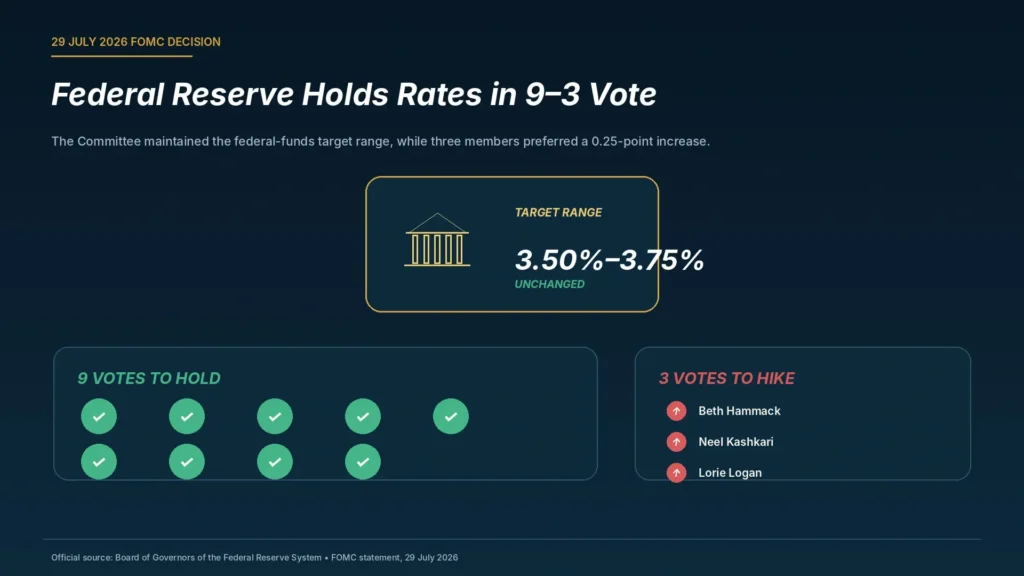
The Federal Open Market Committee voted on July 29 to maintain its target range at 3.50%–3.75%. The decision passed by nine votes to three.
The dissenters-Beth Hammack, Neel Kashkari and Lorie Logan-preferred to raise the target range by 0.25 percentage points. The division is important for cryptocurrency markets because it shows that the debate was between holding rates and tightening policy, not between holding and cutting.
The Fed said economic activity continued to expand at a solid pace, but inflation remained above its 2% objective. It also referred to uncertainty arising partly from the Middle East conflict and supply shocks affecting energy prices.
Higher interest rates can make cash and interest-bearing assets comparatively more attractive while increasing financing costs. Bitcoin and other volatile assets can therefore react sharply to changes in rate expectations, although no single Fed decision determines their price.
The Bitcoin rebound began before the Fed announcement
The July recovery was already underway before the July 29 policy decision.
Bitcoin had traded above $65,000 earlier in the month, while a mid-July sequence of U.S. spot ETF inflows provided additional market demand. Farside data showed net inflows of approximately $226.8 million on July 20, $203.2 million on July 21 and $69.1 million on July 22.
The inflow trend later weakened. Farside Investors recorded renewed net outflows on July 23, July 24, July 27 and July 28, meaning ETF demand was supportive during part of the recovery but was not consistently positive throughout the entire period. (Farside Investors)
Geopolitical developments, equity-market sentiment, oil prices, leveraged trading and profit-taking also influenced Bitcoin during July. It would therefore be inaccurate to attribute the entire monthly gain to the Fed’s decision.
New economic data gives the Fed reasons to remain cautious
The Bureau of Economic Analysis reported on July 30 that U.S. real GDP increased at an annualized rate of 1.5% during the second quarter. Growth slowed from 2.1% in Q1, although consumer spending accelerated.
Inflation readings remained mixed.
The quarterly PCE price index increased at a 5.1% annualized rate, compared with 4.6% during the first quarter. Core PCE, which excludes food and energy, slowed from 4.4% to 3.4%.
The separate June report showed:
● Headline PCE prices decreased 0.1% from May.
● Core PCE prices increased 0.1% from May.
● Headline PCE was 3.7% higher than one year earlier.
● Core PCE was 3.3% higher than one year earlier.
These measurements explain why statements that “PCE was 3.2%” are incomplete or inaccurate unless the period and calculation method are identified.
The monthly data contained some evidence of easing price pressure, but inflation remained above the Fed’s long-term objective.
What the move means for crypto-casino users
Bitcoin’s price recovery does not change casino game mathematics, regulatory status or withdrawal rules.
For someone holding a casino balance in Bitcoin, however, market volatility creates a second financial variable alongside gambling results. A balance of 0.01 BTC is worth more in dollars when Bitcoin rises and less when Bitcoin falls-even when no bets are placed.
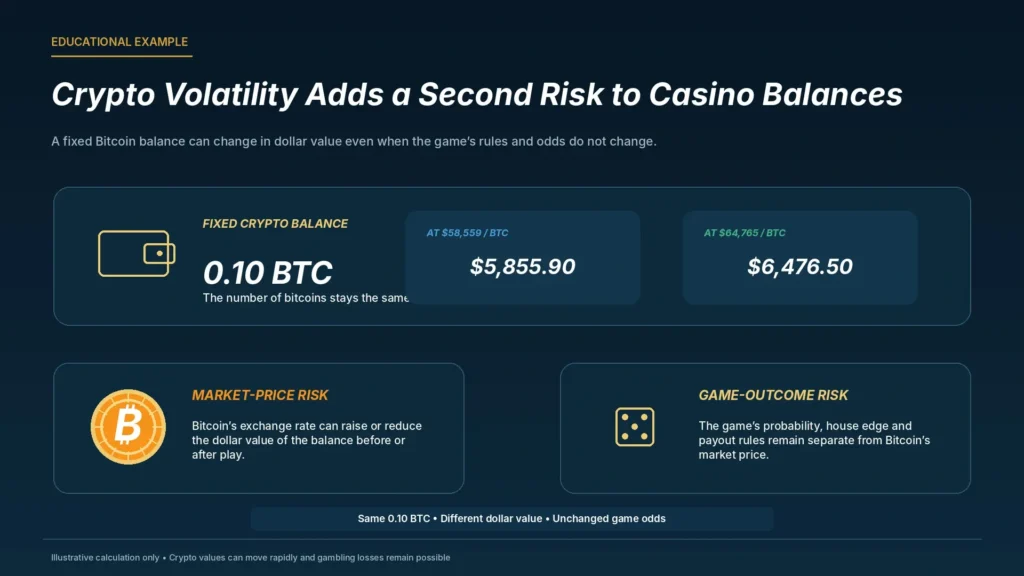
OnlineCryptoCasino.us explains this additional risk in its responsible-gambling guidance, which recommends recording crypto gambling activity in a familiar fiat currency and keeping gambling funds separate from long-term cryptocurrency holdings.
The Federal Reserve’s decision also does not authorize an offshore casino to operate in the United States. U.S. online-gambling legality remains state-specific, and a platform accepting Bitcoin is not necessarily licensed by a U.S. state regulator.
Readers researching crypto payments can review the site’s Bitcoin casino guide for U.S. players, but operator eligibility and terms should be checked independently before transferring funds.
Bitcoin’s July recovery remains vulnerable
The return above $65,000 is a measurable market event, but it does not confirm that Bitcoin has entered a sustained upward trend.
Important risks include:
● The three Fed votes favoring higher interest rates.
● Inflation remaining above the Fed’s target.
● Renewed changes in oil prices or geopolitical conditions.
● Inconsistent spot ETF demand.
● Leveraged liquidations during rapid price movements.
● Selling pressure near recent July highs.
Bitcoin was still trading below its intraday peak at the research time. A later decline would not invalidate the fact that it crossed $65,000, but it would weaken the argument that the level had become durable support.
Likewise, a move above $65,000 does not guarantee a test of $68,000 or any other technical target.
What happens next?
The first immediate milestone is Bitcoin’s final July benchmark close, which will determine whether its completed monthly gain remains above 10%.
The Federal Reserve’s next scheduled policy meeting is set for September 15–16, 2026. Minutes from the July meeting are expected approximately three weeks after the decision.
The BEA is scheduled to publish its second estimate of Q2 GDP and its July personal-income and spending data on August 26, 2026.
Crypto-market participants will also monitor whether U.S. spot Bitcoin ETF flows return to sustained inflows and whether Bitcoin can remain above $65,000 rather than only crossing the level during intraday trading.

The confirmed position at publication is that Bitcoin briefly returned above $65,000 after the Fed held rates, while its month-to-date July gain stood at approximately 10.6%. Neither result guarantees that the advance will continue.
FAQs
Yes. Bitcoin recorded an intraday high of approximately $65,040 on July 30 after the Fed’s July 29 decision. It was trading near $64,765 when this article was researched.
No. The Fed maintained the target range at 3.50%–3.75%. Three FOMC members voted for a 0.25-point increase rather than a cut.
Bitcoin was up approximately 10.6% month-to-date at the research time. The calculation compares a June 30 close of approximately $58,559 with a price of approximately $64,765. The final monthly percentage could change before the end of July.
No single cause has been established. The rebound began before the Fed meeting and coincided with ETF inflows, geopolitical developments, changing oil prices and broader risk-market activity.
No. Bitcoin’s market price does not change a game’s RTP, house edge or probability of winning. It only changes the dollar value of BTC-denominated funds.
No. The decision concerns monetary policy. Online-casino licensing and legal availability continue to depend on federal and state law.